

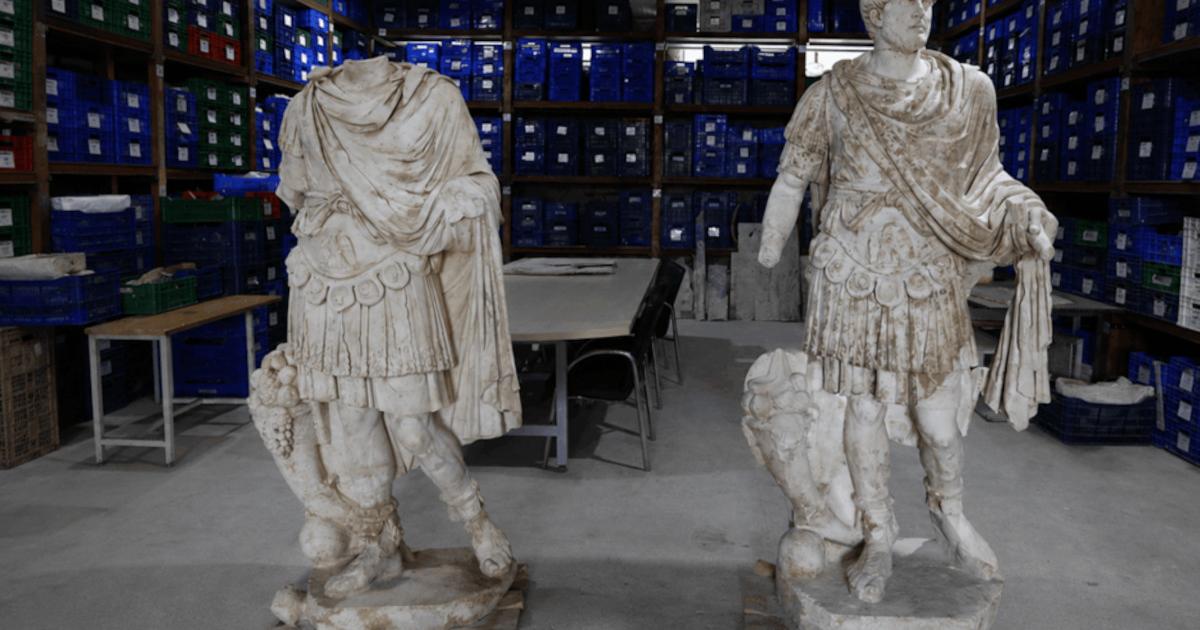

Archaeologists working in an ancient city in the southwest of Turkey known as Kibyra have recently completed the reconstruction of a unique and very rare statue which had previously been broken into many pieces by an earthquake around 1600 years ago. The statue depicts the Roman Emperor Hadrian and measures approximately 2.14 meters (about 7 feet) tall from base to top of head.
The statue would have been displayed prominently at the main gateway of the city, likely above the city's monumental entrance. Remnants of the statue of Emperor Hadrian's wife, Empress Sabina, have also been discovered, thanks to this work, which provides an insight into how the citizenry of this thriving region of Anatolia showed their respect and reverence toward their imperial rulers around 130 AD.
- Five Exquisite Statues from Roman Period Found in Ancient Anatolian City
- Marble Statue of Athena Discovered at Ancient Laodicea

Headless Hadrian torso recovered around Kibyra's Monumental City Gate. (Kibyra Excavation / Burdur Mehmet Akif Ersoy University)
A Roman Emperor Shattered by Earthquake
The parts of the statue were found during the excavations taking place at the Monumental City Entrance Gate of Kibyra, which is characterized by a series of circular towers as well as three arched passageways regulating entry via the necropolis road. According to the Council of Higher Education (YÖK), the upper level of this monumental entrance was adorned with four statues made of marble, and the Director of the Excavation, Professor Şükrü Özüdoğru from Burdur Mehmet Akif Ersoy University, stated to Hürriyet Daily News that it is believed that they fell and broke due to a large earthquake that occurred in 417 AD.
The team recovered approximately twenty sculptural fragments - arms, legs, and large portions of foot - during the course of their work over several seasons. The most important discovery was a well-preserved portrait head of Hadrian which was found to fit onto an armored torso that had been discovered previously.
After a long and careful conservation process performed by Professor Ünal Demirer, the restored sculpture shows the Emperor standing tall once again. This statue is sculpted from high-quality Afyon-Döger and İscehisar marble, and Hadrian is depicted wearing his military uniform with the breastplate embellished with lion and eagle reliefs.
- The Ancient City of Kibyra and its Stellar Rise to Power
- City of Gladiators Earthquake Shattered Fountain Flows After 2,000 Years
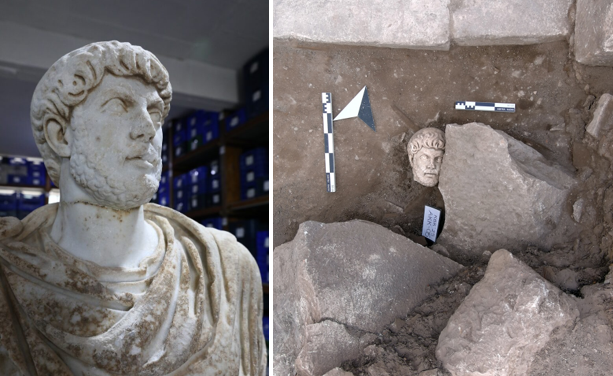
The portrait head of Emperor Hadrian, whose recognizable facial features, beard and arranged curls allowed archaeologists to identify the statue with confidence. (Kibyra Excavation / Burdur Mehmet Akif Ersoy University)
Empress Sabina and the Imperial Household
One of the four statues has been identified as Empress Sabina, Hadrian's wife and a grand-niece of Emperor Trajan. Substantial portions remain of her marble sculpture, but it has not been reconstructed to the same level as Hadrian's statue.
Arkeonews reports that discovery of both emperor and empress representations in one monumental setting is highly significant. By AD 128, Sabina had been bestowed with the title of Augusta. She traveled with Hadrian through much of the Eastern Empire and had numerous cities throughout Asia Minor that dedicated temples and other statuary to her honor.
Other remaining figures include: 1) another armored emperor statue measuring roughly 1.86 meters/6 foot 1 inch; 2) Two parts of a female statue; and 3) a male portrait head measuring about 30 centimeters/12 inches.
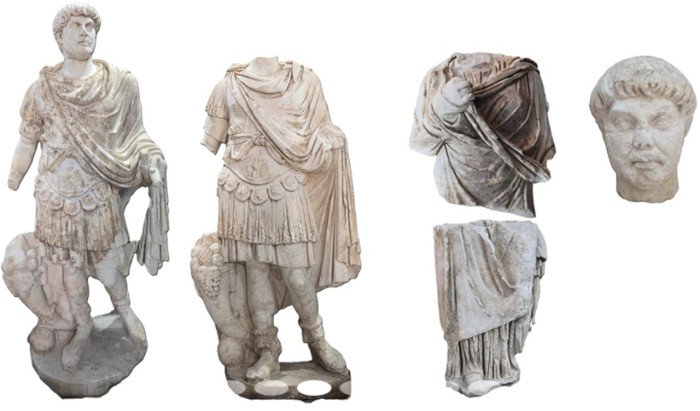
Other statue fragments that have been discovered at Kibyra. The group includes the reconstructed figure of Hadrian and parts belonging to other imperial-era statues. (Kibyra Excavation / Burdur Mehmet Akif Ersoy University)
Archaeologists theorize that other missing statue pieces may still be lodged in the earth surrounding the gate. There have been approximately 2,500 stone blocks relocated and classified to date since the commencement of excavation operations in 2025.
Prepared for an Imperial Visit?
Özüdoğru states that the sculptures were produced sometime around 130 AD, which corresponds to Hadrian’s reign (117 to 138 AD) as recorded by the Roman historians. It is suggested by Özüdoğru that Kibyra commissioned the sculptures with the hopes of receiving Hadrian during his travels through Anatolia, since at that time, many cities thought it important to demonstrate their loyalty to the Emperor. However, there is no evidence so far that indicates that the Emperor ever set foot in Kibyra, suggesting that the sculptures may have been Kibyra’s preparation for an expected visit that never occurred, or simply an expression of the city’s support of the Roman Empire.
The discovery is notable because substantially complete statues of Hadrian are rarely found in Anatolia. Once conservation is completed, they will likely be displayed at the Burdur Museum. Kibyra was once an important center of gladiatorial combat, with a remarkable collection of Medusa mosaics. A recreated emperor stands as physical testament to the region's vibrant cultural landscape during the time it served as a critical juncture between regions like Lycia, Caria, Phrygia, and Pisidia.
Top image: The reconstructed 2.14-meter statue of Emperor Hadrian stands beside another armored imperial figure recovered at Kibyra's Monumental City Gate. Source: Kibyra Excavation / Burdur Mehmet Akif Ersoy University
By Gary Manners
References
Altuntaş, L. 2026. Rare Statues of Roman Emperor Hadrian and Empress Sabina Discovered at Ancient Kibyra. Arkeonews. Available at: https://arkeonews.net/rare-statues-of-roman-emperor-hadrian-and-empress-sabina-discovered-at-ancient-kibyra/
Büyükyıldırım, O. 2026. Archaeologists Reassemble Rare Statue of Emperor Hadrian from 20 Fragments at Kibyra. Anatolian Archaeology. Available at: https://www.anatolianarchaeology.net/archaeologists-reassemble-rare-statue-of-emperor-hadrian-from-20-fragments-at-kibyra/
Council of Higher Education (YÖK ). 2026. Burdur'da 1950 yıllık tarih gün yüzüne çıktı: Roma İmparatoru Hadrianus'un heykeli bulundu. Available at: https://www.yok.gov.tr/tr/news/burdurda-1950-yillik-tarih-gun-yuzune-cikti-roma-imparatoru-hadrianusun-heykeli-bulundu-u3Xm9
Hürriyet Daily News. 2026. Hadrian statue restored at Kibyra. Available at: https://www.hurriyetdailynews.com/hadrian-statue-restored-at-kibyra-226136





















