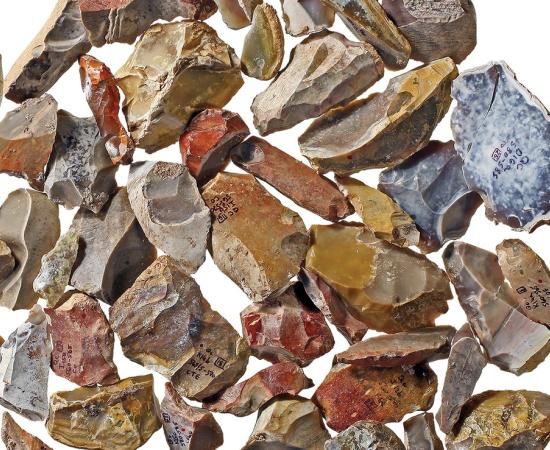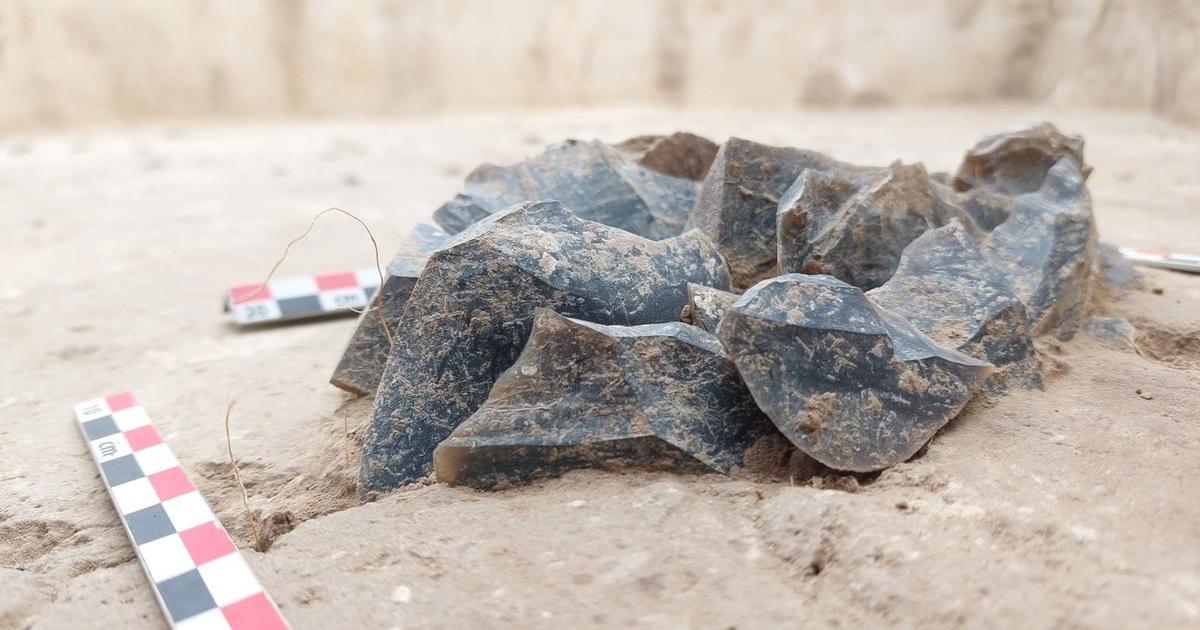

Archaeologists digging at Gródek in eastern Poland have pulled a farming-era stash out of the ground, one the local museum dates to about 6,000 years ago. The deposit is a bundle of partly worked flint pieces rather than finished tools, gathered in one spot and probably kept in a bag of leather or cloth that has long since decayed. Why would anyone leave good raw material buried and never come back for it?
According to the Stanisław Staszic Museum in Hrubieszów, whose account was published by the regional news site Lublin112 on October 25, 2026, the cache lay about 1 meter (3.3 ft) below the surface. The same season showed that a long feature seen from the air for decades is a wide, deep defensive ditch. Who dug that ditch, and when, is still an open question.
Where Is Gródek and Why Do Archaeologists Care?
Gródek is a village in Hrubieszów municipality, close to Poland's border with Ukraine and near the point where the Huczwa River flows into the Bug, as Poland-24 reports. The work centers on what researchers call site 29, which the museum's project page places right beside the early medieval fortified settlement known as Wołyń.
The museum says the site was known until 2017 only from scattered surface finds linked to the Roman period and the Middle Ages. Since then, its western part has yielded material tied to the Goths, including dozens of Roman denarii, dress fittings, pottery and animal bones, HeritageDaily reports. The eastern part holds a partly excavated early medieval cemetery that, in the words HeritageDaily attributes to researchers, has produced "the oldest known Slavic inhumation burials in Poland." Farming has disturbed some of those graves.
Readers who followed the Goth cemetery uncovered near Stara Rzeka in northern Poland will recognize the period, though Gródek sits at the opposite end of the country.
What Exactly Did the Flint Cache Contain?
The museum's description, as reported in Polish by Lublin112, is careful on one point. The pieces are semi-finished rather than ready for use, and were placed together, probably in some kind of leather or linen bag. HeritageDaily, working from the regional conservator's release, describes the deposit as "partly worked pieces or blanks" and says the material was "apparently deliberately collected and stored together."
HeritageDaily also notes that pottery and animal bones from the Neolithic are fairly common finds, while "the concentration of flint uncovered at Gródek is considerably more unusual." The museum dates the deposit to about 6,000 years ago. None of the reports give a count of pieces, a description of the flint type or the method used to arrive at that date, so the figure is best treated as the team's estimate for now.
Poland-24 sets out what the cache might represent. It "could represent material stored by a craftsperson, a temporary cache or another form of deliberate deposition," the outlet writes, adding that further study of the pieces and their context "may help narrow those possibilities." A bag of blanks in the ground is indicative rather than conclusive about who left it and why.
How Did Neolithic People Handle Flint Blanks?
The best known example of a Neolithic flint economy in Poland lies far to the west of Gródek, at Krzemionki in the Świętokrzyskie Mountains. UNESCO, which listed the mining region as a World Heritage site, says it dates from 3,900 BCE to 1,600 BCE and holds "some 4,000 shafts and pits." Its striped flint was mainly used for axes.
UNESCO adds that a permanent miners' settlement at Gawroniec "received semi products of flint axes from the mines for finishing and polishing prior to distribution." Finished axes traveled as far as 650 kilometers (404 miles) from the mines, according to the same listing. No source links the Gródek cache to Krzemionki or to any particular quarry, and that question will have to wait for a study of the stone itself.
At Krzemionki, at least, semi-finished flint was something that moved between sites before it became a finished tool. The reports from Gródek do not yet say what its pieces were meant to become, or whether they were made nearby.
A Ditch Seen From the Air for 50 Years
The second headline find started as a line in photographs. HeritageDaily says the feature was visible in aerial images from half a century ago as well as in modern drone and satellite pictures. Researchers weighed several explanations, including a road from the period of Gothic settlement and a route used by the warriors of Bolesław I the Brave before "his famous battle on the River Bug in 1018."
An 18th-century map also raised the possibility of an old transport route that has since vanished. The hills nearby hold kilometers of First World War trenches, but the team ruled that out because the feature's shape and size did not match wartime earthworks.
Excavation has now settled the basic question of what the line was. HeritageDaily reports that the line formed part of "a substantial defensive system surrounding an elevated area covering more than a dozen hectares," with "a broad, deep ditch that apparently functioned as a fortification or reinforced boundary." Poland-24 gives the area as more than ten hectares, so the exact size is not yet clear from the reports.
What the team will not yet say is who built it. HeritageDaily reports that researchers "already have hypotheses about its origins" but are "not yet prepared to offer a definitive interpretation." Poland-24 stresses that the ditch "must therefore be distinguished from the much older flint deposit discovered elsewhere within the investigated site."
A Pomeranian Burial and a Gothic Comb
The same three trial trenches turned up more surprises. One was a cremation burial that HeritageDaily and Lublin112 link to the Pomeranian culture of the early Iron Age, about 2,500 years ago. Only a few bones survived, along with fragments of a clay pot that had been placed upside down over the burial. Ancient Origins has covered this culture's distinctive face urns and a rare Iron Age house urn from Pomerania, both from the north of the country.
In a spot where the team expected a Gothic settlement, it found an early medieval refuse pit instead, holding hundreds of pottery sherds, animal bones and glass beads. The same small trench still produced a Roman coin and a piece of a Gothic comb, HeritageDaily reports.
Poland-24 makes a useful point about the later finds, noting that the Roman coin "does not necessarily indicate that Roman soldiers or settlers lived at the site," since Roman money circulated well beyond the frontier. The finds also describe separate phases of use, the outlet notes, "rather than one population living continuously at Gródek for six millennia."
Promising, but Early Days
The excavation is part of a project that HeritageDaily renders in English as "At the Crossroads of Goths and Slavs: Non-invasive Investigation of Multicultural Site No. 29 at Gródek, Hrubieszów Municipality". The museum's project page says it runs from 2026 to 2027, and Lublin112 reports funding of 87,000 zloty from the Ministry of Culture and National Heritage, out of a total budget of 114,300 zloty. One aim, the museum says, is to prepare paperwork to place the site on the heritage register.
Dr. Michał Jakubczak and Robert Ryndziewicz of the Institute of Archaeology and Ethnology of the Polish Academy of Sciences are running the geophysical work, and 11.5 hectares have been surveyed so far with non-invasive methods, HeritageDaily reports. Poland-24 notes that this figure is the surveyed area, not the size of the enclosure. Students from Maria Curie-Skłodowska University in Lublin joined the dig under Professor Barbara Niezabitowska-Wiśniewska.
Promising, but the fieldwork at Gródek is not finished yet. HeritageDaily reports that the season has answered some questions "while simultaneously producing many new ones." Until the flint is studied and the ditch is dated, the story of who stored that bag of blanks, and who later fortified the hill, remains less a settled history than a set of well-placed clues.
How we label claims
Established: the flint deposit of partly worked pieces about 1 meter down, the defensive ditch around an elevated area, the Pomeranian culture cremation burial, the refuse pit, the Roman coin and Gothic comb fragment, and the earlier Gothic and Slavic finds, all as reported by the museum and regional conservator. Unverified: the 6,000-year date (method not published), the leather or cloth bag, any purpose for the cache, any source for the flint, and the date and builders of the ditch. Exact enclosure size: reported as more than a dozen hectares (HeritageDaily) and more than ten hectares (Poland-24).
The cache of partly worked flint pieces in the ground at site 29, Gródek, with scale bars beside it. Photo: Stanisław Staszic Museum in Hrubieszów
By Aris Manus
Sources
- Stanisław Staszic Museum in Hrubieszów, report on the flint deposit and earthworks at Gródek, Lublin112, October 25, 2026 (in Polish)
- Mark Milligan, 6,000-year-old flint deposit and fortifications at Gródek, HeritageDaily, October 27, 2026
- Archaeologists find 6,000-year-old flint cache and defensive ditch in Poland, Poland-24, October 26, 2026
- Na styku Gotów i Słowian, project page for site 29 at Gródek, Stanisław Staszic Museum in Hrubieszów (in Polish)
- Krzemionki Prehistoric Striped Flint Mining Region, UNESCO World Heritage Centre