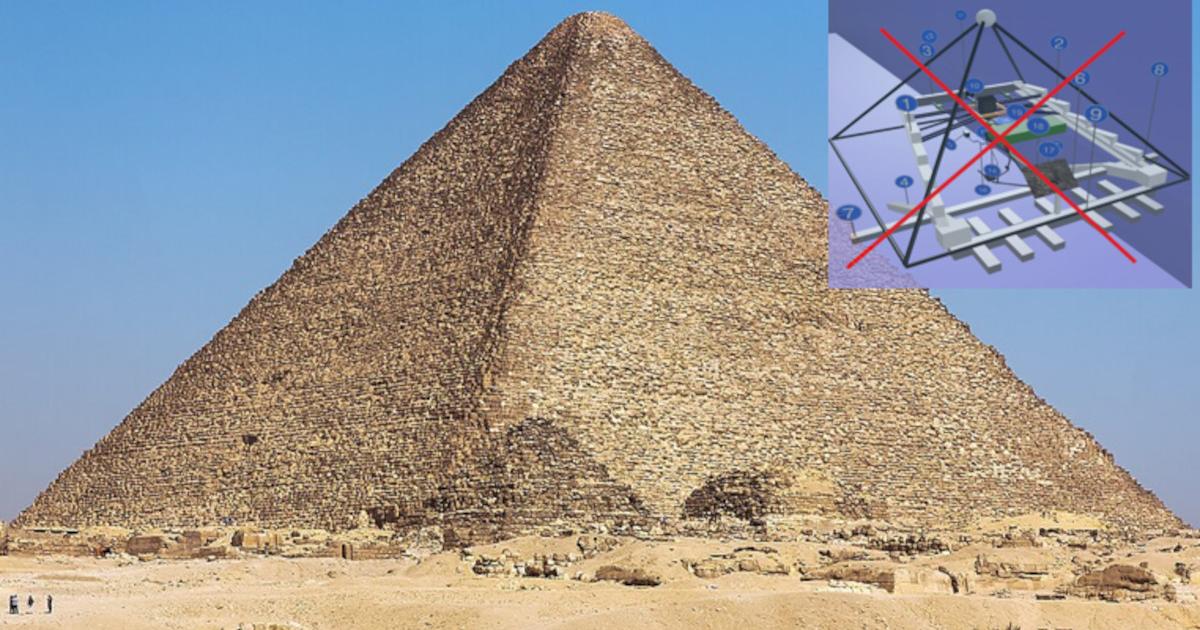

The journal Remote Sensing has published a formal retraction of a peer-reviewed piece of research which claimed that satellite radar had uncovered a mysterious series of rooms and tunnels within the Great Pyramid of Giza. A subsequent inquiry had shown clear methodological and statistical flaws in the study. The retraction of the article on the Great Pyramid of Giza also highlights the difference between spectacular imagery and independently tested archaeological evidence.
A Retraction Four Years Later
Filippo Biondi and Corrado Malanga’s 2022 paper proposed that synthetic aperture radar data from Italy’s COSMO-SkyMed satellites could be processed to reveal the pyramid’s interior. Their method interpreted tiny “micro-movements,” supposedly produced by background seismic noise, as a way to reconstruct structures hidden inside solid stone. The paper presented a 3D network of ramps, rooms and tunnels far more extensive than the monument’s known architecture, whose development can be traced through earlier Egyptian pyramid building.
- Hidden Chamber Found? Cosmic Ray Tech Reveals Large Void in Great Pyramid
- Thermal Scan of Egyptian Pyramids Reveals Mysterious Anomaly in the Great Pyramid
This article was released on October 19, 2022, however, the journal has retracted it 4 years later, on August 10, 2026, due to complaints made by a reader regarding its methodology. Editorial staff of the journal stated that their investigations “confirmed serious methodological flaws and statistical errors” that invalidated the scientific conclusions. The authors received notification and have formally opposed this decision, but no details of the response to retraction are available. As a result, the retraction of The Great Pyramid removes the research from the reliable data collection, but not from its public history.
- Analysis Begins on Cosmic Particles in the Egyptian Bent Pyramid
- Will a New Great Pyramid Corridor Reveal Khufu’s Secret Chamber?
Why the Radar Claim Failed
Retraction Watch contacted the well-known radar archaeologist Lawrence Conyers, who stated that the satellite signal could not be penetrating the pyramid, reflecting off features inside and coming back to the sensor. He asserted that the vibrations supposedly produced are far below what can be detected by a satellite, and added: “I don’t care what magical properties you’re using; it just doesn’t work.” This is different from working with near-surface techniques to investigate archaeological features and earlier infrared investigations of Giza indicating the presence of thermal anomalies without making the claim of coming up with complete maps of what is happening inside.
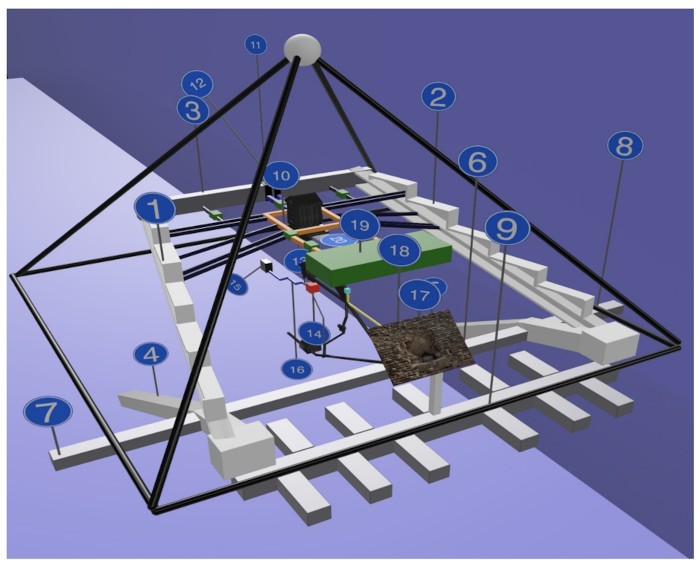
The retracted paper’s Figure 22 presented a 3D reconstruction of alleged passages inside and beneath Khufu’s pyramid. (F. Biondi and C. Malanga / Remote Sensing 2022, CC BY 4.0)
These scholars have later put forth even bolder claims concerning deep tunnels, spiral formations, and tremendous underground blocks situated in vicinity of pyramids in 2025. According to Helen Santoro’s article on the matter, these claims existed unreviewed and unpublished in the peer-review context although they were globally covered in the news and described in the podcast. The fact that the claim has gone viral does not mean that it has been confirmed, especially when there is no editorial vetting of the approach. The information about how rock is being moved in the construction process along the waterways of Nile, to the contrary, is solid evidence-based, being derived from documents, archaeology, and environmental data.
What Verified Scans Have Found
Authentic discoveries made in Khufu's pyramid show what stronger verification entails. A Nature study in 2017 discovered an empty space at least 30 meters in length above the Grand Gallery through the use of three different muon-specific detection systems. In 2023, a separate Nature Communications study outlined the characteristics of the North Side Corridor to be approximately 9 meters long, as well as 2 meters high and 2 meters wide, with the help of the two detector teams, along with independent analyses. These results also fed into later discussion of testable Great Pyramid construction models.
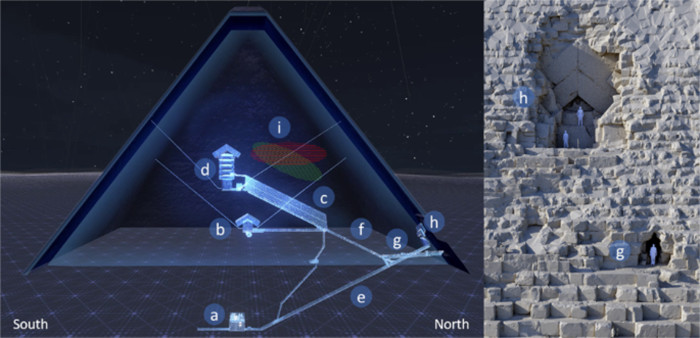
The Great Pyramid’s known internal layout, North Face Chevron area and proposed positions of the ScanPyramids Big Void. (Procureur et al. / Nature Communications 2023, CC BY 4.0)
Muon radiography functions because of the different way cosmic-ray particles penetrate rock compared to voids, thereby enabling scientists to decipher different density levels without boring holes into the material. In particular, the identification of voids using multiple equipment and models does not make the Great Pyramid less mysterious, but rather reduces the gap between what is known, what can be imagined, and what is impossible to prove.
Top image: The Great Pyramid of Giza, also known as the Pyramid of Khufu. Source: Douwe C. van der Zee / Wikimedia Commons, CC BY-SA 4.0
By Gary Manners
References
Biondi, F. and Malanga, C. 2022. Synthetic Aperture Radar Doppler Tomography Reveals Details of Undiscovered High-Resolution Internal Structure of the Great Pyramid of Giza. Remote Sensing 14(20), 5231. Available at: https://www.mdpi.com/2072-4292/14/20/5231
Biondi, F. and Malanga, C. 2026. Retraction: Synthetic Aperture Radar Doppler Tomography Reveals Details of Undiscovered High-Resolution Internal Structure of the Great Pyramid of Giza. Remote Sensing 18(16 ), 2679. Available at: https://www.mdpi.com/2072-4292/18/16/2679
Morishima, K. et al. 2017. Discovery of a Big Void in Khufu’s Pyramid by Observation of Cosmic-Ray Muons. Nature 552, 386–390. Available at: https://www.nature.com/articles/nature24647
Procureur, S. et al. 2023. Precise Characterization of a Corridor-Shaped Structure in Khufu’s Pyramid by Observation of Cosmic-Ray Muons. Nature Communications 14, 1144. Available at: https://www.nature.com/articles/s41467-023-36351-0
Santoro, H. 2026. Journal Retracts Paper Claiming Network of Corridors Inside the Great Pyramid of Giza. Available at: https://retractionwatch.com/2026/08/31/retraction-corridors-inside-great-pyramid-giza/