
The small, carefully prepared burial of the newborn children was in an unexpected place. The funerary space was found during the 2010 excavations in an abandoned Roman sewer at the Odeon in the ancient Greek city of Ephesus in modern-day Turkey. Many historians see the placement of human remains in sanitation contexts as evidence of abandonment or selective disposal. Archaeologists from the Austrian Academy of Sciences have documented the grave with two perinatal remains from the Byzantine period. Their study, published in the journal Childhood in the Past, shows that the children died shortly before, during, or soon after birth. According to study co-author Caroline Partiot, however, the unusual discovery within the sanctuary of Artemis provides new information about the treatment of infants during a time of religious and social change.
- Turkey's Third-Largest Roman Odeon Emerges from Ancient Sagalassos
- The Cosmic Catastrophe That Changed Christianity Forever
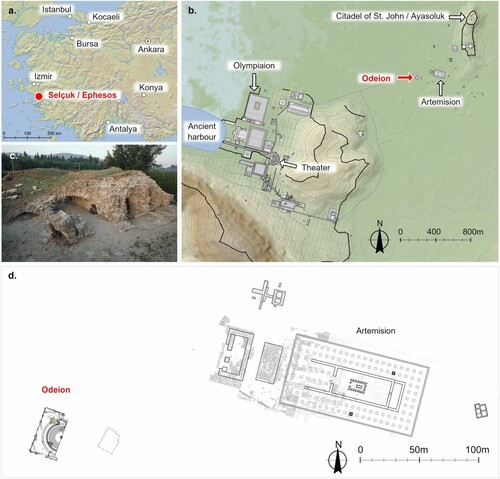
Maps and excavation views showing the location of the Middle Byzantine burial of two newborn infants within the Roman Odeion and the Artemision at ancient Ephesus. The figure places the unusual grave within the former sanctuary of Artemis, illustrating the relationship between the abandoned Roman public building and one of antiquity's most famous sacred precincts. (C. Partiot & L. Zabrana/OeAW–OeAI)
Unconventional Tomb in the Odeon Latrine
The unconventional tomb, made of bricks and stones, was constructed inside a drainage conduit for a large public latrine from the second and third centuries. The latrine was part of the Odeon, a venue for music, plays, and poetry from the first century. The burials occurred after the building had been abandoned for centuries.
Partiot notes that very young children in ancient societies were often buried separately from adults because they held a different social status. Their graves were placed beneath house floors, inside wells, or in other locations rather than cemeteries. She finds this burial site unique because it followed all the traditional norms reserved for adults, rather than showing rejection or abandonment.
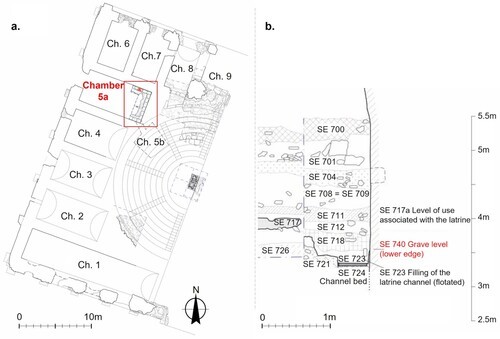
Archaeological plan and stratigraphic section showing the location of Chamber 5a within the Roman Odeion at Ephesus and the excavation profile documenting the insertion of the Middle Byzantine cist grave (SE 740) into the abandoned Roman latrine channel. The sequence demonstrates that the burial occurred centuries after the public latrine had fallen out of use. (C. Partiot & L. Zabrana/OeAW–OeAI)
Location and Dating Present Problems for Archaeologists
The grave’s location in the sanctuary of Artemis presented dating and interpretation problems for researchers. Study co-author Lilli Zabrana explained that there was little information about the sanctuary after it fell out of use. Radiocarbon dating placed the burial in the eighth or ninth century, in the Early Middle Ages. This meant that the Artemision was accessible even after it was no longer a religious site. The grave was found beneath more than 20 feet of river sediment from major flooding in the 13th and 14th centuries.
- The Grand and Sacred Temple of Artemis, A Wonder of the Ancient World
- Perfectly Preserved Byzantine Business and Gastronomy District Discovered in Turkey
Early Christian Burial Practices in the Byzantine Period
The manner of burial conformed to early Christian practices during the Byzantine period in Ephesus. The children were positioned beside each other, wrapped in burial shrouds, and facing west. There were no grave goods in their grave. The researchers believe that the children were twins who died before birth, given their similar body size and shared grave. One of the children had an extra cervical rib that developed in the neck, a rare condition that may lead to developmental disorders and miscarriage. Zabrana pointed out that this is only the second time that this condition has been documented in perinatal remains.
- The Wonders of Ancient Engineering: 15 Most Amazing Ancient Aqueducts
- The Celsus Library: 20,000 Scrolls Lost to History but Its Striking Architecture Remains
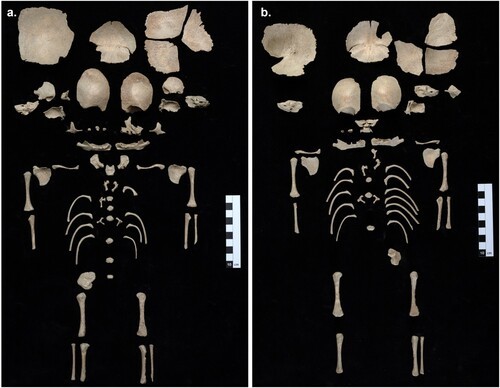
Osteological reconstruction of the two perinatal infants recovered from the Middle Byzantine cist grave beneath the Roman Odeion at Ephesus. Analysis of the skeletal remains showed that both infants died at approximately 33–34 weeks of gestation and may have been twins, providing rare insight into infant mortality and burial practices in medieval Anatolia. (C. Partiot/OeAW–OeAI)
Burial Reflects Transition from Roman Practices to Christian Customs
Partiot maintains that the unusual grave site shows a deliberate, respectful burial. Other discoveries of children’s remains in ancient sewer systems, such as Ashkelon in Israel and the Agora Bone Well in Athens, Greece, are viewed as evidence of infanticide. The Ephesus burial is quite different. Carefully built in the Artemision, undisturbed and peaceful, it is part of changing burial traditions at a time when Roman practices transitioned to Christian customs. It also indicates the increased value of children, even those born prematurely, especially during a perilous time for childbirth and disease.
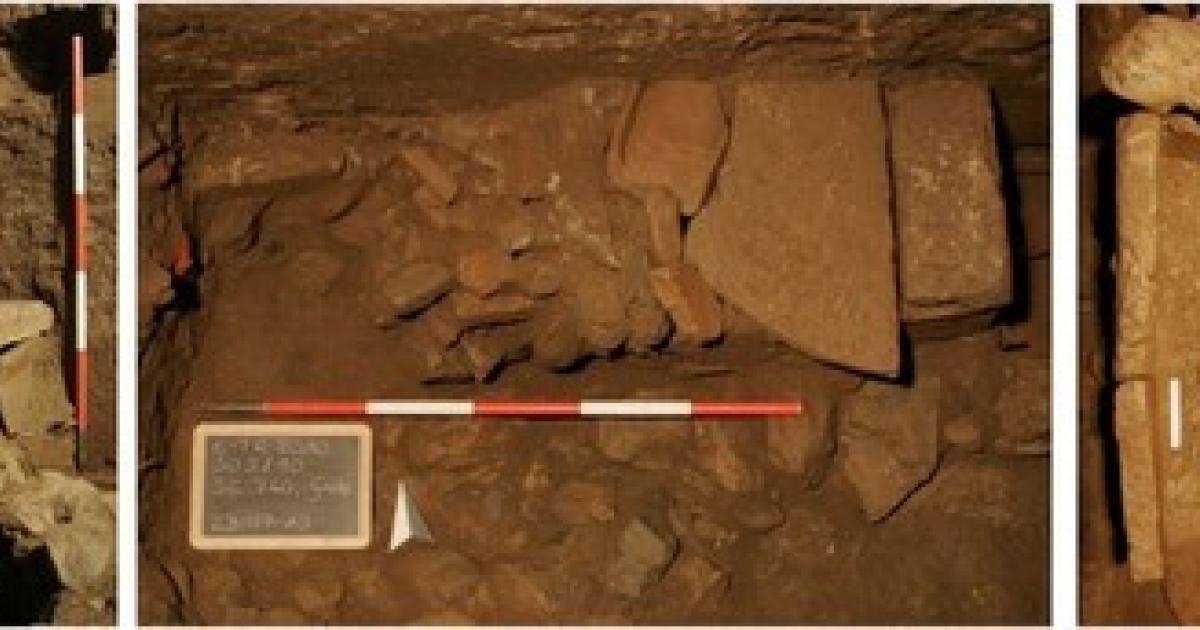
Top Image: Excavation sequence showing the stone-and-brick cist grave of two newborn infants discovered inside a disused Roman latrine channel beneath the Odeion in the Artemision at Ephesus. Archaeological and osteological analyses indicate the infants, possibly twins, received a carefully constructed Early Byzantine burial despite the unusual location. Source: L. Zabrana/OeAW–OeAI)
By Ramsey Hardin
References
Austrian Academy of Sciences. 2026. “Grave of two newborns discovered in an antique latrine at Ephesos.” Austrian Academy of Sciences. https://www.oeaw.ac.at/en/news/grave-of-two-newborns-discovered-in-an-antique-latrine-at-ephesos
Carvajal, Guillermo. 2026. “Two babies were buried in an ancient Roman latrine at the sanctuary of Artemis in Ephesus in the 8th century, centuries after the building’s abandonment.” LVB Magazine. abrujulaverde.com/en/2026/07/two-babies-were-buried-in-an-ancient-roman-latrine-at-the-sanctuary-of-artemis-in-ephesus-in-the-8th-century-centuries-after-the-buildings-abandonment/.
Partiot, C., & Zabrana, L. (2026). “Peace in Unexpected Places: The Middle Byzantine Burial of Two Perinates, Possibly Twins, in a Latrine Canal of the Odeion in the Artemision of Ephesos.” Childhood in the Past, 1–21.
DOI: https://doi.org/10.1080/17585716.2026.2682804
Radley, Dario. 2026. “Two newborns buried in an abandoned Roman latrine reveal
care in medieval Ephesus.” Archaeology Magazine.
https://archaeologymag.com/2026/07/two-newborns-buried-in-roman-latrine/
Zahid, Nisha. 2026. “Newborn Twin Burial Found Inside Roman Sewer at Ancient City of Ephesus.” The Greek Reporter. https://greekreporter.com/2026/07/23/newborn-twin-burial-roman-sewer-ancient-greek-city-ephesus/