

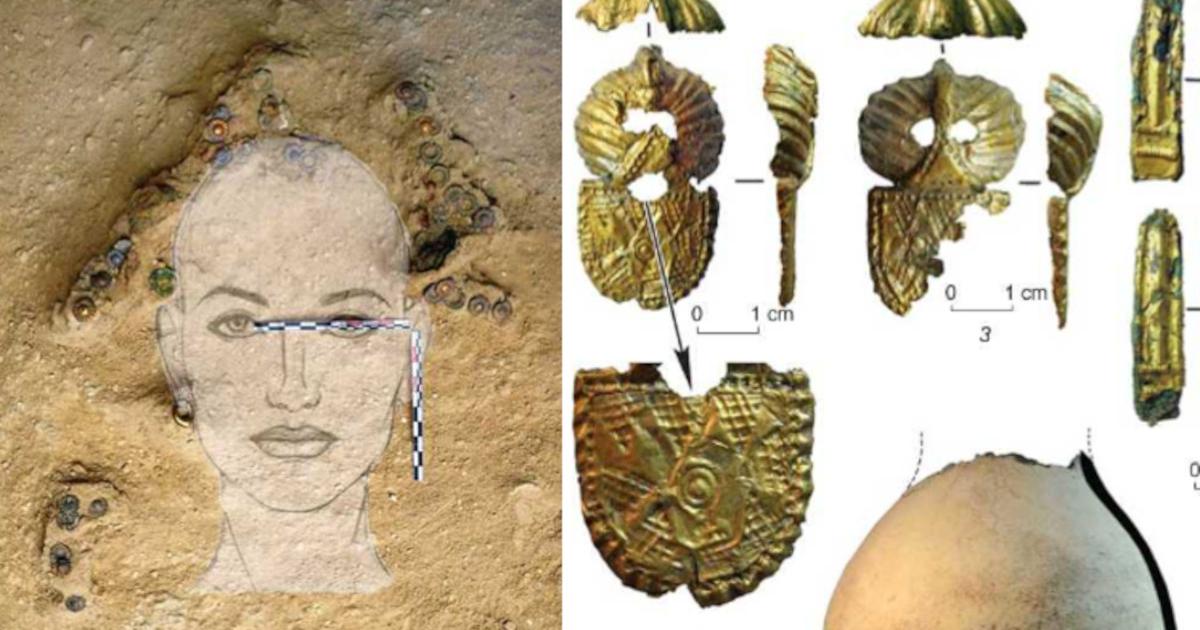

Archaeologists working in the Karakabak cemetery on the Mangyshlak Peninsula, near the modern city of Aktau in western Kazakhstan, have discovered the grave of an elite young woman of Hunnic-period nomadic traditions, buried in ornate ceremonial clothing. She wore a remarkable set of 1,500-year-old gold-covered shoe fittings, popularly described as “golden shoes.” The shoes offer a glimpse into the wealth, craftsmanship, and long-distance connections of communities living along the Caspian Sea during the post-Hunnic period.
Gold Covered Shoes Reveal the Status of an Elite Young Woman
Archaeologists Andrei Astafyev and Evgeny Bogdanov excavated the burial site in 2019 and made a detailed study of the grave. Their research dated Burial 11 at Karakabak-10 to the second half of the fifth to early sixth century AD and identified the deceased as a girl/young nomadic noblewoman, dressed in intricate clothes designed to imitate royal vestments. One of the most striking elements was a pair of “golden shoes” decorated with gleaming gold fittings, accompanied by equally elaborate ornaments on her belt and headdress. The remaining pieces consisted of thin gold coverings applied to buckles and fittings made from wood or other organic materials, creating the appearance of richly adorned “golden shoes.”
- Nomadic Tribes of the Eurasian Steppes: Lifestyle and Impacts on Settled Societies
- Rethinking Stereotypes: Were Scythian Warriors Really Nomadic?
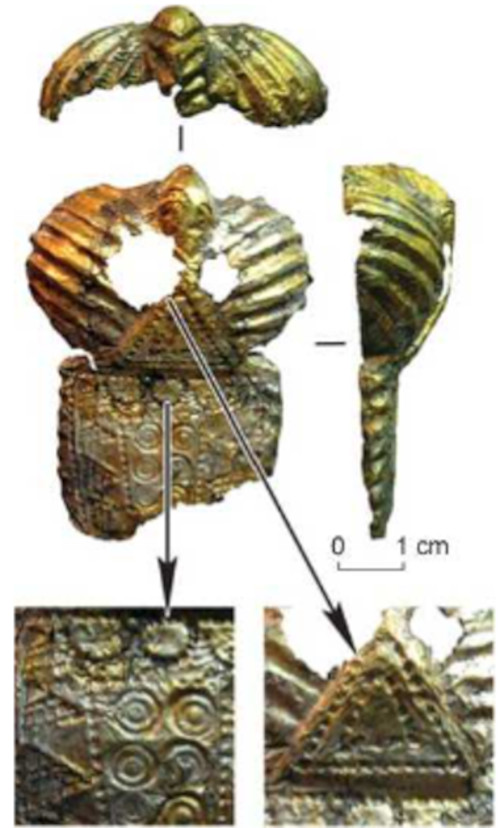
Some of the gold covering for the shoes found at the burial. (Astafyev and Bogdanov/Archaeology, Ethnology & Anthropology of Eurasia)
A Royal-Inspired Costume Created Specifically for Burial
The shoes formed only one key element of a much more elaborate ensemble. The woman also wore a constructed headdress consisting of a cape decorated with round gold plaques along with a red-cloth diadem fitted with unique mask-shaped ornaments. A central forehead plaque imitated a Hellenistic gorgoneion - the image of a Gorgon’s head traditionally used as an apotropaic or protective motif. Other gold-covered wooden ornaments draw on far older Scythian traditions. The buckle frames were shaped to imitate stylized birds of prey with outstretched wings. Another detail of the clothing is unusual: archaeologists concluded that neither the belt nor the shoe buckles was functional. Both pieces lacked the critical attachments needed for ordinary use and were likely manufactured specifically for the burial ceremony.
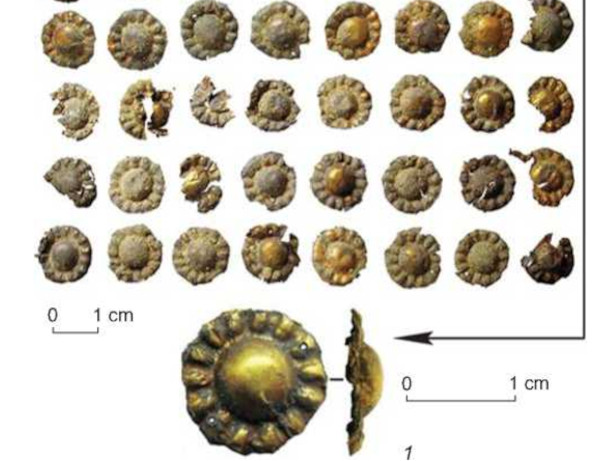
Small embossed gold plaques from the elaborate headdress of the young woman buried at the Karakabak-10 cemetery in western Kazakhstan. The ornaments formed part of a ceremonial costume created for the elite burial aproximately 1,500 years ago. (Astafyev and Bogdanov/Archaeology, Ethnology & Anthropology of Eurasia)
Golden Fittings May Have Been Made at Karakabak
The artifacts belong to what archaeologists call the Shipovo horizon– a group of objects associated with the late Hunnic and post-Hunnic world. The woman’s burial is dated broadly to the second half of the fifth or first half of the sixth century AD. Similar clothing and grave goods have been discovered at nearby Altynkanzgan, suggesting that communities across the region shared craftsmen, technologies, and ceremonial traditions. The most intriguing possibility is that nearby craftsmen created these elaborate objects. Astafyev and Bogdanov also argue that these costume fittings were likely produced in workshops at the nearby Karakabak settlement, which was part of the development of an important craft and trading center on the eastern Caspian coast.
Karakabak Emerged as a Major Ancient Craft Center
Prior archaeological research at Karakabak has produced evidence of metallurgy, jewelry production, glassmaking, and pottery manufacture. Studies of other burials within the immediate area have revealed cloisonné-style jewelry demonstrating technological influences associated with Byzantine-style craftsmanship. Researchers have proposed that many of these finds were locally produced. Karakabak has emerged as a key archaeological site in western Kazakhstan.
- The Fierce Warriors of the Steppes: Who Were the Sarmatians?
- The End of the Huns: The Death of Attila and the Fall of the Hunnic Empire
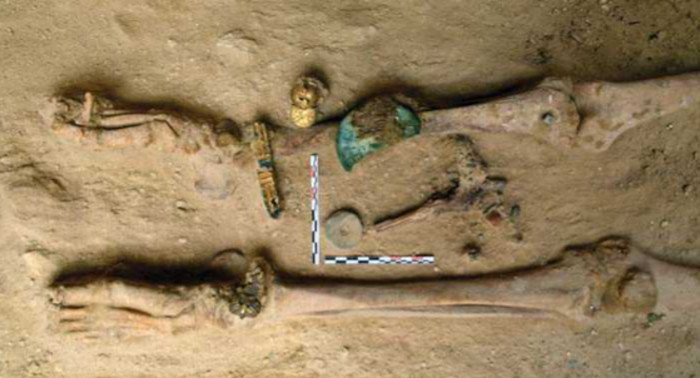
Bones of legs and feet with remains of shoe straps and accompanying goods at the approximately 1,500-year-old burial of a young elite woman at the Karakabak-10 cemetery in Mangystau, Kazakhstan. (Astafyev and Bogdanov/Archaeology, Ethnology & Anthropology of Eurasia)
Coins from Six Empires Reveal Karakabak’s Vast Trade Connections
The Karakabak archaeological site was discovered in 2006 and has been dated from the first to the sixth century AD. Recent excavations by the Margulan Institute of Archaeology have revealed an important production and commercial center near maritime and overland routes crossing the Caspian region. More than 150 coins dated from the first century to the first half of the sixth century have been recovered from this same site. The collection includes coinage issued in Parthia, ancient Khorezm, Bukharan Sogdia, Sasanian Iran, the Kushano-Sasanian realm, the Byzantine Empire, and China. The extraordinary geographical range illustrates the interconnections of this remote settlement.
- A Millennium of Glory: The Rise and Fall of the Byzantine Empire
- The Sasanian Empire: Iran's Ancient Might (Video)
Karakabak Linked Central Asia to the Wider Eurasian World
Archaeologists now believe the settlement located at Karakabak may have operated as an important node in an ancient Azov-Caspian trade corridor, linking Central Asia with the northern Caucasus, the Volga region, the southern Urals, and territories even further west. The cemetery where the elite woman was buried reinforces that interpretation. Recent research indicates that the Karakabak population was culturally diverse. Some groups maintained deeply ingrained burial customs from the Late Sarmatian nomadic world. Others displayed post-Hunnic/Shipovo material culture, Hellenistic/Late Roman models, Scythian elements, and possible Central Asian connections.
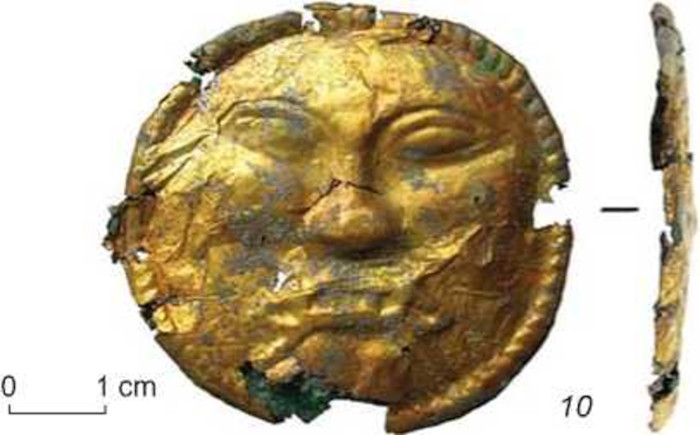
Gold forehead plaque from the ceremonial headdress of the elite woman buried at Karakabak in western Kazakhstan. The ornament formed the centerpiece of an elaborate funerary costume and reproduces a motif derived from the Hellenistic gorgoneion tradition. (Astafyev and Bogdanov/Archaeology, Ethnology & Anthropology of Eurasia)
Was Karakabak the Ancient Settlement of Aspabota?
One hypothesis among researchers is that Karakabak is the ancient settlement of Aspabota. Since no inscription has been found at Karakabak confirming the settlement’s original name, archaeologists have, thus far, no direct evidence that Karakabak and Aspabota were the same place. Kazakhstan’s Ministry of Science and Higher Education likewise describes the connection as a possibility rather than a confirmed identification. Nevertheless, Karakabak fits the Aspabota profile of an influential settlement with an impact beyond the immediate Caspian coast. Karakabak had a fortified craft center and marketplace, and it served as a transfer point between nomadic communities and long-distance commercial networks.
- Ancient Sarmatian Warrior Unearthed During Russian Road Works
- A Tale of Silk and Faraway Lands: Did the Romans Meet the Chinese?
Gold, Trade, and Craftsmanship Converged at Karakabak
Within the context of community and commercial networks, the ‘golden shoes’ acquire greater significance. The thin sheets of gold buried with one elite woman are not just another extravagant decoration. Viewed alongside evidence for jewelry workshops, imported coins and the culturally varied burial traditions documented around Karakabak, the gold-covered shoe fittings reveal a Caspian world in which steppe elites, local craftspeople and long-distance trading networks intersected around 1,500 years ago.
Top Image: Gold ornaments discovered in situ around the head area of the elite woman buried at the Karakabak-10 cemetery in western Kazakhstan. Archaeologists used the position of the surviving plaques and other ornaments to reconstruct an elaborate headdress worn by the woman approximately 1,500 years ago. Source: Astafyev and Bogdanov/Archaeology, Ethnology & Anthropology of Eurasia
By Ramsey Hardin
References
Astafyev, A., and Bogdanov, E. An Ancient City on the Eastern Coast of the Caspian Sea. Available at:
https://www.e-anthropology.com/English/Catalog/Archaeology/STM_DWL_t6dE_4LDX0dZZ6yFD.aspx
Astafyev, A. E., and Bogdanov, E. S. Hunnic Antiquities from the North-Eastern Caspian Region. Available at:
https://www.e-anthropology.com/English/Catalog/Archaeology/STM_DWL_AhRx_4Lrezo1DHRgY.aspx
Astafyev, A. E., and Bogdanov, E. S. 2020. Polychrome Style in Mangystau, Kazakhstan. Archaeology, Ethnology & Anthropology of Eurasia 48 (2): 80–88. Institute of Archaeology and Ethnography, Siberian Branch of the Russian Academy of Sciences. Available at:
https://archaeology.nsc.ru/en/publications/jr-aeae-en/20-48-2/annot-09/
Astafyev, A. E., and Bogdanov, E. S. 2021. Burial of a Hunnic Period Noblewoman at Karakabak, Mangystau, Kazakhstan. Archaeology, Ethnology & Anthropology of Eurasia 49 (4): 57–68. Institute of Archaeology and Ethnography, Siberian Branch of the Russian Academy of Sciences. Available at:
https://archaeology.nsc.ru/en/publications/jr-aeae-en/21-49-4/annot-06/
Ismailov, V. 2026. Kazakhstan’s Ancient Karakabak Reveals New Silk Road Links. Available at:
https://timesca.com/kazakhstans-ancient-karakabak-reveals-new-silk-road-links/
Margulan Institute of Archaeology. 2024. The Margulan Institute of Archaeology Has Begun Its Field Season of 2024. Available at:
https://archeo.kz/en/novosti/institut-arheologii-im-ah-margulana-nachal-polevoj/
Qazinform. 2026. 2,000-Year-Old City in Mangistau Region Reveals Silk Road Legacy. Available at:
https://qazinform.com/news/2000-year-old-city-in-mangistau-region-reveals-silk-road-legacy-537b83
Zhexenbekov, A. 2026. Archaeological Excavations Begin at Karakabak Settlement in Mangistau. Available at:






















