
Fact Check verdict: Unverified. Is Göbekli Tepe the world's oldest temple?
In the autumn of 2017 a team at Göbekli Tepe cut a narrow trench across the western slope of the mound for a rainwater drainage pipe. The trench ran into a cluster of small round houses, built wall to wall. Verdict: the age of the site is Established, because UNESCO's World Heritage listing and the excavation team at the German Archaeological Institute (DAI) give the same window, roughly 9600 to 8200 BCE. The idea of a temple with no settlement is Disputed, because the excavators themselves now report houses, hearths, a burial, large-scale cereal grinding and rock-cut water collection on the site. The claim that it is the world's oldest temple is Unverified, because none of our sources tests it. UNESCO calls the site "one of the first manifestations of human-made monumental architecture".
- Göbekli Tepe was built about 9600 to 8200 BCE: Established.
- Göbekli Tepe was a temple with no one living there: Disputed.
- Göbekli Tepe is the world's oldest temple: Unverified.
What the evidence says
UNESCO inscribed Göbekli Tepe in 2018 as World Heritage property 1572. Its listing describes structures "erected by hunter-gatherers in the Pre-Pottery Neolithic age between 9,600 and 8,200 BCE". Lee Clare of the DAI, who co-leads the project, gives a close match in his 2020 summary of work from 2015 to 2019. He dates the site to about 9500 to 8000 cal BC. He splits it into a Pre-Pottery Neolithic A phase of about 9500 to 8700 cal BC and an Early Pre-Pottery Neolithic B phase of about 8700 to 8200 cal BC.
The ritual reading is on the record too. UNESCO calls the enclosures "monumental communal buildings", with T-shaped pillars up to 5.50 metres tall. It says they were "probably used in connection with rituals, most likely of a funerary nature". None of the sources we read tests whether an older building anywhere could count as a temple, so the "world's oldest" superlative goes further than our sources do.
A 2012 paper in Antiquity by Oliver Dietrich, Klaus Schmidt and colleagues set out the gathering side of the story. The journal's summary says hunter-gatherers meeting at the site "created social and ideological cohesion through the carving of decorated pillars, dancing, feasting". It adds that they were "almost certainly" drinking beer made from fermented wild crops.
Newer fieldwork changes the picture of who was there. Clare reports a deep sounding dug in 2015 and 2016 in the north-west of the mound. It exposed small round-oval buildings packed together, a larger round-oval building with several phases, and an open work area with a sequence of hearths. The team found stone and bone bead making and unusually high numbers of bone tools. These levels probably belong to the oldest phase, although radiocarbon dates were not yet available in 2020. The 2017 drainage-pipe trench then turned up more of the same round houses.
The later rectangular buildings point the same way. Clare writes that they could "point to a dense domestic occupation". The stone tool types found with them are "wholly characteristic of domestic contexts". In autumn 2017 the team found a kidney-shaped grave cut beneath the floor of one rectangular room. It held the disturbed remains of at least three people. Clare notes that such burials are common at Pre-Pottery Neolithic domestic sites.
Water was part of the old argument. A pit carved into the bedrock, about 8 metres across and 2.8 metres deep, may have been a cistern. Clare calls that "a distinct possibility". Twelve metres away, a channel cut into the rock had been covered with limestone slabs. Schmidt himself found that channel in 2013.
Two more revisions follow from Clare's report. Radiocarbon dates from the mud mortar show the big enclosures stayed in use far longer than once thought. Some final building phases date to the middle of the ninth millennium BC, more than five centuries after they were founded. The team has dropped Schmidt's three-layer sequence as a result. The fill inside the enclosures was once read as deliberate, ritual backfilling. The team now reads it as settlement debris that slid in from higher parts of the mound.
A 2019 study in PLOS ONE by Laura Dietrich and colleagues looked at food. They analysed more than 7,000 food-processing tools, such as grinding slabs, handstones, pestles and mortars, a number they call "unusual for contemporary sites". Most had been used on cereals, and plant microfossils confirm a "massive presence of cereals". Food preparation clusters around the rectangular buildings. The team found no large stores, so they read the output as food for immediate use at seasonal "large work feasts".
The alternative view, fairly
The temple-first reading was the excavators' own. The site's late excavator, Klaus Schmidt, put it plainly in 2010. Göbekli Tepe, he wrote, "was not used for habitation". It "consists of several sanctuaries in the form of round megalithic enclosures". He added, "Remarkably, no residential buildings have been discovered." Even the smaller rectangular buildings of the younger layer, he wrote, are "not a settlement". He saw them as "a series of sanctuaries".
His case was strong for its time. The mound covers about nine hectares, with deposits up to 15 metres deep. Schmidt found no domesticated animals or plants. He worked out that some 500 cubic metres of debris would have been needed to fill Enclosure D alone, and he read that filling as a deliberate act. Clare lists three observations behind the temple reading. There were the special buildings with their carved T-shaped pillars. No houses had been found. The site also lacked a reliable water source.
Clare is frank about where the popular label came from. He writes that "it was the archaeologists themselves who delivered and subsequently cultivated the now popular opinion that Göbekli Tepe is the site of the 'World's First Temples'."
Not every specialist accepted that reading. In 2011 the archaeologist E. B. Banning argued in Current Anthropology that the evidence for cult buildings at such sites is "often equivocal or depends on ethnocentric distinctions between sacred and profane spaces". He proposed that the buildings at Göbekli Tepe "may actually be houses, albeit ones that are rich in symbolic content".
The current team has not gone as far as Banning. The 2019 PLOS ONE paper reports possibly Neolithic cisterns on the limestone plateaus west of the site, with a combined capacity of 153 cubic metres found so far. The authors say this "limits the possible number of people permanently present". They still describe Göbekli Tepe as "a specialized site" with many special buildings. But they add, "This does not rule out the possibility that a smaller group of people actually lived at Göbekli Tepe permanently." In 2019 they also wrote that they did not yet know of houses as old as the earliest enclosures. Clare's 2020 report probably places the round houses in that oldest phase, but only on the evidence of building style, layers and flint tools.
Where this leaves it
The dates are secure. The idea of an empty ceremonial hill is now open to question, including among the people who dig there. The big enclosures still look special. Among our sources, only Banning argues they may have been houses. The open points are how many people lived on the mound, for how much of the year, and whether the oldest houses really sit alongside the first enclosures. Radiocarbon dates for those houses were still pending in 2020. If they arrive, this label may change. So were the people who raised the pillars visitors, or neighbours?
How we checked this
We read in full the UNESCO listing for property 1572, Clare's 2020 report, Schmidt's 2010 paper and the 2019 PLOS ONE study. For the 2012 Antiquity paper we read the journal's summary only, and for Banning (2011) the abstract only. Links were checked on 20 October 2026. How we label claims: see How we check evidence. For Göbekli Tepe alongside the Sphinx and Atlantis, see our evidence page Göbekli Tepe, the Sphinx and Atlantis: what the evidence says. Our news report New Göbekli Tepe Finds May Reveal Ancient Homes covers the house finds.
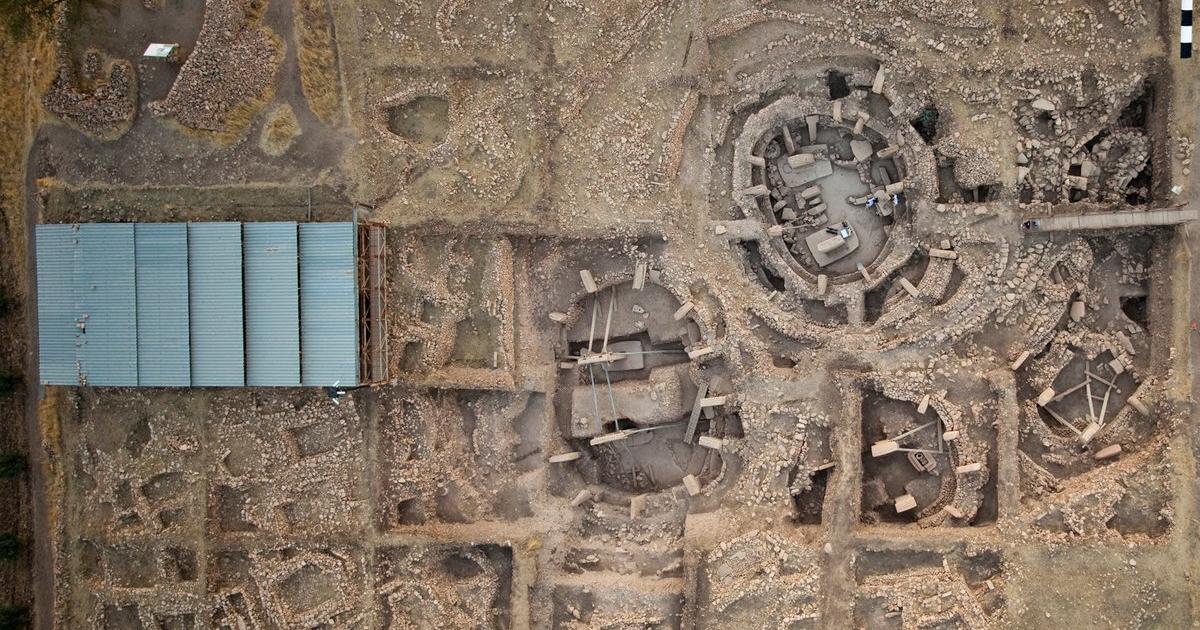
Image: Göbekli Tepe, main excavation area. Photo: E. Kücük, German Archaeological Institute (DAI), via Dietrich et al. 2019, PLOS ONE. Wikimedia Commons, CC BY 4.0. Resized from the original.
By Aris Manus
Claim by claim
- Established: Age (about 9600 to 8200 BCE).
- Disputed: Temple with no settlement.
- Unverified: World's oldest temple.
Sources
- UNESCO World Heritage Centre. "Göbekli Tepe." Property 1572, inscribed 2018. Listing page, including the statement of Outstanding Universal Value. Read in full.
- Clare, L. (2020). "Göbekli Tepe, Turkey. A brief summary of research at a new World Heritage Site (2015 to 2019)." e-Forschungsberichte des DAI 2020 (2): 81 to 88. Read in full.
- Schmidt, K. (2010). "Göbekli Tepe: the Stone Age Sanctuaries. New results of ongoing excavations with a special focus on sculptures and high reliefs." Documenta Praehistorica 37: 239 to 256. Read in full.
- Dietrich, L., Meister, J., Dietrich, O., Notroff, J., Kiep, J., Heeb, J. et al. (2019). "Cereal processing at Early Neolithic Göbekli Tepe, southeastern Turkey." PLOS ONE 14 (5): e0215214. Read in full.
- Dietrich, O., Heun, M., Notroff, J., Schmidt, K. and Zarnkow, M. (2012). "The role of cult and feasting in the emergence of Neolithic communities. New evidence from Göbekli Tepe, south-eastern Turkey." Antiquity 86 (333): 674 to 695. Journal summary read.
- Banning, E. B. (2011). "So Fair a House: Göbekli Tepe and the Identification of Temples in the Pre-Pottery Neolithic of the Near East." Current Anthropology 52 (5): 619 to 660. Abstract read.