
A newly opened excavation area north of Göbekli Tepe’s protected core has yielded rectangular structures that may have been homes, adding an important domestic dimension to one of the world’s best-known Neolithic sites. Turkey Today reports that the buildings belong to the site’s second phase and sit just below the modern surface. The claim is deliberately provisional, but if floor samples confirm domestic activity, the Göbekli Tepe homes could help recast the site as a place where ritual architecture and ordinary life stood side by side.
A Newly Opened Northern Sector
The excavation team began work after olive trees were moved from roughly 1,500 square meters north of the main archaeological zone. Erosion had already removed the upper parts of the walls, allowing excavators to reach surviving plans and, in some cases, floor levels quickly. Professor Necmi Karul, coordinator of the Taş Tepeler Project and head of the Göbekli Tepe excavation, said the olive trees had caused far less damage than feared.
Karul explained that the team is stripping the surface across the newly accessible ground before investigating deeper layers. That broad, horizontal approach should reveal whether the buildings formed an isolated cluster or belonged to a larger neighborhood. It also makes the new trench especially valuable, because the familiar monumental enclosures represent only part of the settlement’s long history.
- Taş Tepeler: Anatolia’s Land Of Great Transformation
- New Statues and Fresh Insights from Karahan Tepe

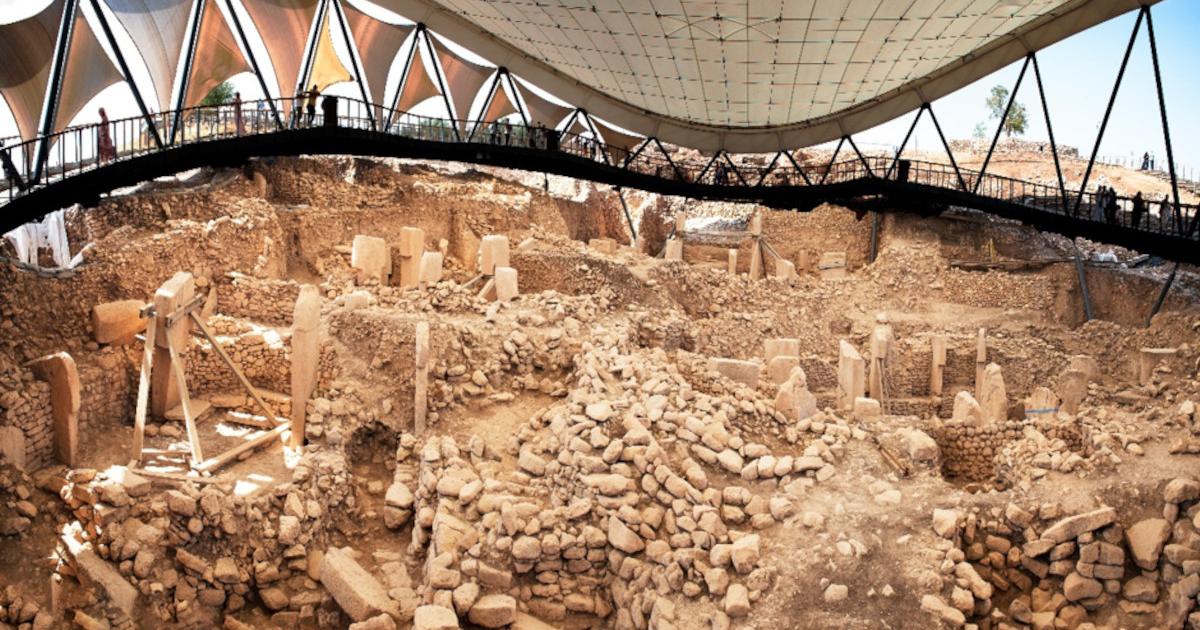
Aerial view of stone walls and structural remains exposed by excavations at Gobekli Tepe in Sanliurfa, Turkey. (IHA)
Why the New Layouts Matter
The new structures appear to contain fewer standing-stone pillars than Göbekli Tepe’s celebrated monumental buildings, and their internal arrangement looks more compatible with domestic use. UNESCO describes the site’s major round-oval and rectangular megalithic constructions as Pre-Pottery Neolithic monuments built between 9600 and 8200 BCE, while noting that more recent work has also identified non-monumental buildings that appear domestic. The contrast between these forms gives the Göbekli Tepe homes hypothesis real weight, without turning it into a conclusion before the evidence is in.
“Our first impression is that they were used as residences,” Karul told Türkiye Today, while stressing that walls alone cannot establish a building’s function.
Soil and sediment from the floor levels will now be examined for microscopic remains, plant material, food-preparation traces and other residues. Those results may show what people did inside, rather than simply what the architecture looks like from above. The distinction matters at a site whose striking T-shaped pillars and complex planning have long inspired debate, including discussions of a hidden geometric pattern and the symbolism of the Vulture Stone.
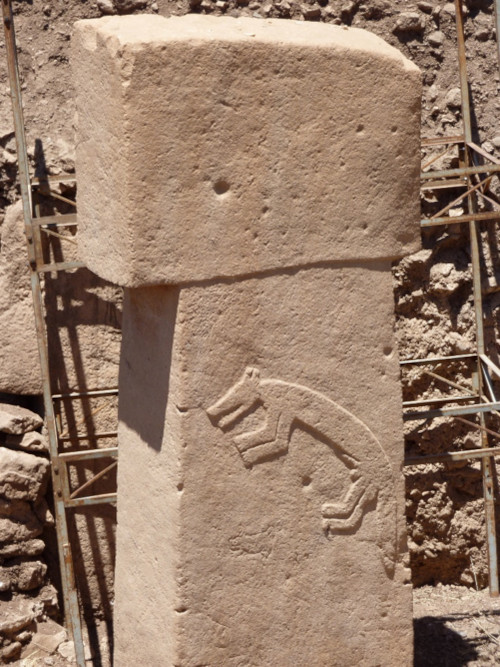
A T-shaped pillar at Göbekli Tepe bearing an animal relief; the original photograph is mirrored. (Zhengan / CC BY-SA 4.0)
Beyond a Ritual-Only Interpretation
The findings matter because they add to a wider shift in how archaeologists understand the Taş Tepeler region. The Archaeological Institute of America recently reported that nearby Sayburç produced more than 50 early Neolithic buildings, most interpreted as residential, with evidence for food preparation and craft work. Across the region, therefore, the question is not simply whether special buildings existed, but how communal spaces, houses and daily activities were arranged together.
The German Archaeological Institute once argued that the excavated monumental enclosures at Göbekli Tepe were best understood as special-purpose buildings rather than conventional houses, while recognising the difficulty of separating ritual from domestic life in the Neolithic. The northern-sector discovery does not overturn that interpretation; instead, it may fill in the less visible settlement landscape around the famous stone circles. It is a useful context for revisiting the broader Taş Tepeler landscape, the discoveries at Karahan Tepe, and the recently reported human figure set within a Göbekli Tepe wall.
The Evidence Still to Come
Excavation will continue northward, and a visitor walkway is planned around the new work area so that the public can follow the project without entering the trench. Elsewhere, conservation has moved from Structure C to Structure D, while work continues around circular buildings on the slope. For now, the strongest conclusion is not that archaeologists have proven houses at the site, but that they have opened a promising new route towards understanding where its builders may have lived.
Top image: Visitors overlook the Göbekli Tepe excavation site beneath its protective roof. Source: Philrock / CC BY-SA 4.0
By Gary Manners
References
Archaeological Institute of America. 2025. Neolithic Structures Found at Site Near Göbeklitepe. Available at: https://archaeology.org/news/2025/09/04/neolithic-structures-found-at-site-near-gobeklitepe/
Altuntaş, L. 2026. 10,000-Year-Old Rectangular Buildings Unearthed at Göbeklitepe May Have Been Homes. Available at: https://arkeonews.net/10000-year-old-rectangular-buildings-unearthed-at-gobeklitepe-may-have-been-homes/
German Archaeological Institute. 2017. A Sanctuary … or so fair a House? Available at: https://www.dainst.blog/the-tepe-telegrams/2017/01/24/a-sanctuary-or-so-fair-a-house/
Newsroom. 2026. New discovery at Gobeklitepe sheds light on where people may have lived. Available at: https://www.turkiyetoday.com/culture/new-discovery-at-gobeklitepe-sheds-light-on-where-people-may-have-lived-3226003?s=1
UNESCO World Heritage Centre. n.d. Göbekli Tepe. Available at: https://whc.unesco.org/en/list/1572/