
For decades, archaeologists at Göbekli Tepe found human bones scattered through its monumental buildings but no intact graves to explain them. Now the first two excavated Göbekli Tepe burials offer a way to read that puzzle differently, according to a new PLOS One study by Julia Gresky and Lee Clare. The bones inside the graves bear some of the same damage as 928 loose fragments recovered elsewhere on the mound. At least some of those fragments, the researchers suggest, may have come from burials disturbed by soil sliding downhill—not from bones deliberately strewn around the famous T-shaped monuments.
A Shared Grave and a Woman Buried Alone
The graves date from the Pre-Pottery Neolithic B Period (approximately 8700–8000 BC) within the general area of Taş Tepeler in southeastern Turkey. The first grave discovered was in 2017 and consisted of a kidney-shaped pit dug underneath the plaster floor of a rectangular structure. The grave held at least three individuals, which included a female older than 35, a male aged around 20’s and a young girl of around 11-14, whose bones were found in one place. Their skulls lay together at one end while long bones had been moved toward the other, suggesting the grave was reopened as later burials made room for the dead.
It was in the year 2012 that the other burial was discovered, made secure, and later, after a period of 10 years, excavated alongside monumental Building A. The remains belonged to a person who is believed to be a female age between 20 to 30 and lying on her left side on a stone platform in an easterly direction. The skeletal remains were mostly undisturbed, however, the flooring that had once been used was in a bad condition. Some skull pieces found above her could belong to another person, so the researchers avoid treating every nearby fragment as hers.
- New Göbekli Tepe Finds May Reveal Ancient Homes
- Evidence of the Earliest 'Skull Cult' Activity: Drilled and Carved Skulls Found at the World's Oldest Temple
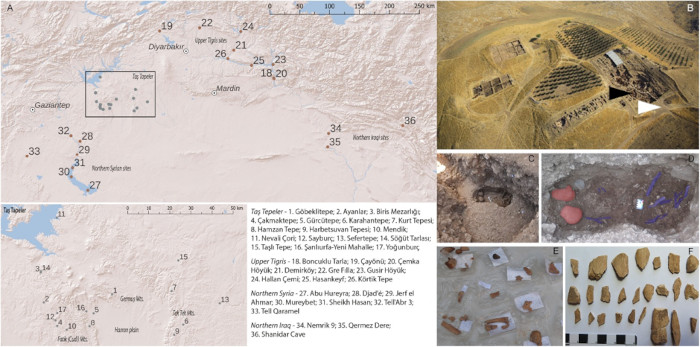
The excavation plan, collective grave, and examples of loose human bones at Göbekli Tepe. (E. Küçük, C. Lelek-Tvetmarken, and J. Gresky / DAI/PLOS One/ CC BY 4.0).
What the Broken Bones Reveal
The lone skeleton holds significance due to the fact that it has remained largely intact and, thus, has suffered less destruction over time. The larger bones have missing ends and fractures filled with mineral deposits. Possible marks from rodents chewing the bones can be detected on a number of surfaces. Bones from the grave sharing the site of the discovery also has fractures, deposits of calcium and evidence of gnawing, but, in this case, human interference can be found. That combination lets researchers separate damage that can happen in a grave from evidence of deliberate handling after death.
- Red Ochre Colored Skeletons Revealed in Çatalhöyük Burials, New Study
- First Human Face Carved on Ancient T-Pillar Discovered at Karahantepe
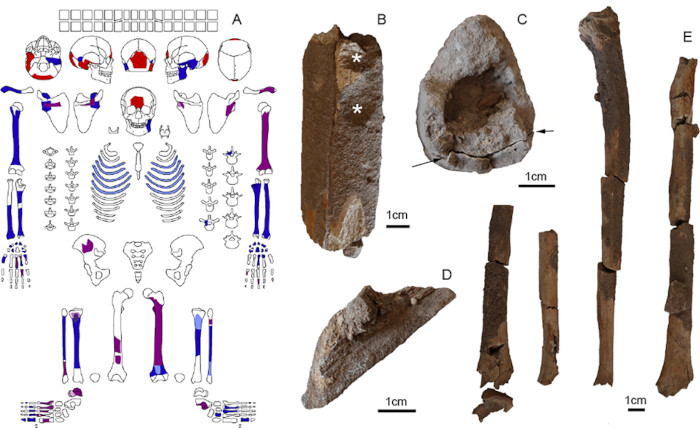
The young adult's surviving bones, possible gnawing marks, and mineral-coated breaks. (J. Gresky / DAI; PLOS One/ CC BY 4.0)
According to the German Archaeological Institute, these similarities might suggest a possible source of the dispersed discoveries. As Phys.org mentions, the graves allow archaeologists to make a comparison which they didn't have before. The monumental structures can be found on land lower than the settlement deposits surrounding the structures; the movement of the inclining ground could have brought the soil, stone, and bones into their fills. However, this is just a plausible route, not proof that all of the 928 fragments came from an eroded grave.
Erosion Does Not Erase Mortuary Ritual
There is evidence that some dead received very different treatment. In a 2017 Science Advances study, Gresky and colleagues documented three skulls carved with deep grooves, one also drilled. The new paper identifies such incisions on fragments from five individuals. Those cuts cannot be explained by soil pressure or rodents, and their precise purpose remains uncertain. It is still unknown what those cuts were meant for.
The wider context involves various possible practices rather than limiting it to the ritual versus the accident. For example, at nearby Karahantepe, some human skulls have been cut, scraped, or burned, and at Sefertepe archaeologists discovered a chamber with more than 21 skulls.
Göbekli Tepe is known for its depiction of humans without heads and there is a human statue embedded in a wall. Nevertheless, these do not resolve the question about possible funerary practices, and so the new study explicitly leaves open whether different treatments of the dead happened side by side or centuries apart.
More Than a Gathering Place
Burial below a stone floor was already known in Neolithic Anatolia and the Levant; Göbekli Tepe burials support this wider trend. But their discovery reinforces the emerging case for habitation in these monumental enclosures rather than just a site that was visited only for ceremonies. The discovery does not change the wonder of the carved pillars; it rather casts the people who built them as a community that needed living quarters and tombs. Much about the mound's history depends on layers and the identification of structures associated with various remains.
For now, the best answer to the scattered-bone mystery is a measured one: erosion could have moved some damaged bones from graves higher up the settlement. The deliberately altered skulls warn against applying that answer to every fragment. Further analysis and absolute dating, the researchers say, will be needed to untangle when each burial practice took place. The two graves have not closed the case, but they have finally given the loose bones a possible starting point.
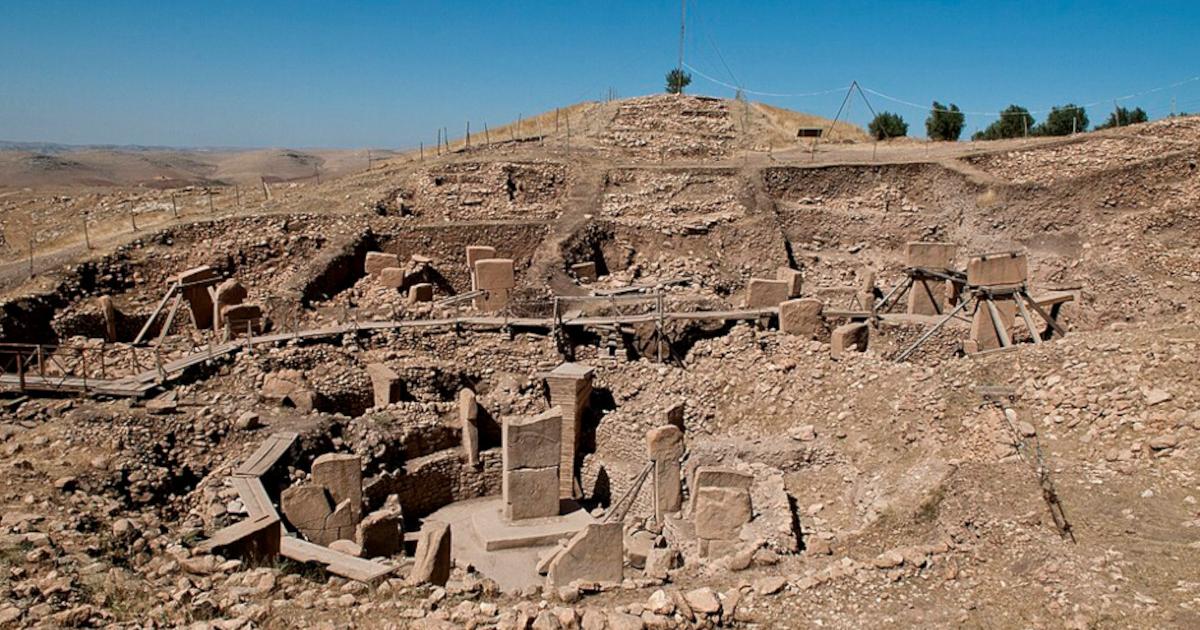
Top image: Göbekli Tepe's excavated stone enclosures and surrounding hill in southeastern Turkey. Source: Teomancimit / CC BY-SA 3.0
By Gary Manners
References
Arnold, P. 2026. Two ancient burial sites may explain mystery of Göbeklitepe's scattered human bones. Available at: https://phys.org/news/2026-09-ancient-burial-sites-mystery-gbeklitepe.html
German Archaeological Institute. 2026. New publication: Human remains and burial practices at Göbeklitepe. Available at: https://www.dainst.org/en/newsroom/neue-veroeffentlichung-menschliche-ueberreste-und-bestattungsbraeuche-in-goebeklitepe/924
Gresky, J., Haelm, J., and Clare, L. 2017. Modified human crania from Göbekli Tepe provide evidence for a new form of Neolithic skull cult. Science Advances. Available at: https://www.science.org/doi/10.1126/sciadv.1700564
Gresky, J., and Clare, L. 2026. First burials give insights into mortuary rites at Göbeklitepe, Early Neolithic Türkiye. PLOS One 21(9 ): e0358979. Available at: https://journals.plos.org/plosone/article?id=10.1371/journal.pone.0358979