
A fractured skull and much of an adult gomphothere skeleton have emerged from the bed of Chile's long-vanished Tagua Tagua lake. Archaeologists suspect people may have opened the skull to eat the brain, but the newly recovered animal's age and the precise cause of the break remain to be established. The Pontificia Universidad Católica de Chile's report provisionally places the find at about 12,500 years old, adding a fresh lead to the story of megafauna hunting in the Americas.
- Female Woolly Mammoths Were Preferred Targets for Ice Age Hunters
- Hunted by Neanderthals: Giant Elephants Traveled Hundreds of Miles

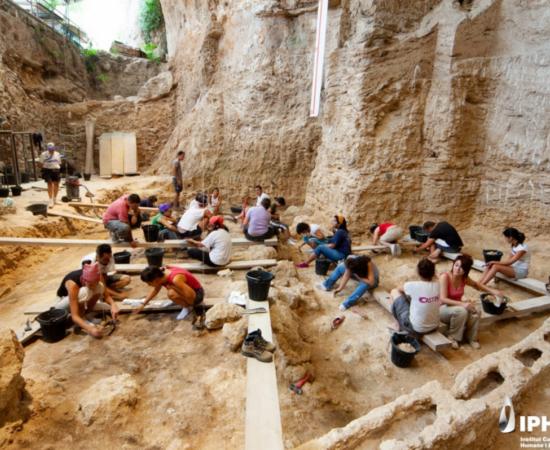
Earlier excavations at Taguatagua 3 documented gomphothere bones, a hearth and stone tools; these are not photographs of the 2026 discovery. (Labarca et al., PLOS One, Fig. 9 / CC BY 4.0)
A Broken Skull, but No Final Verdict
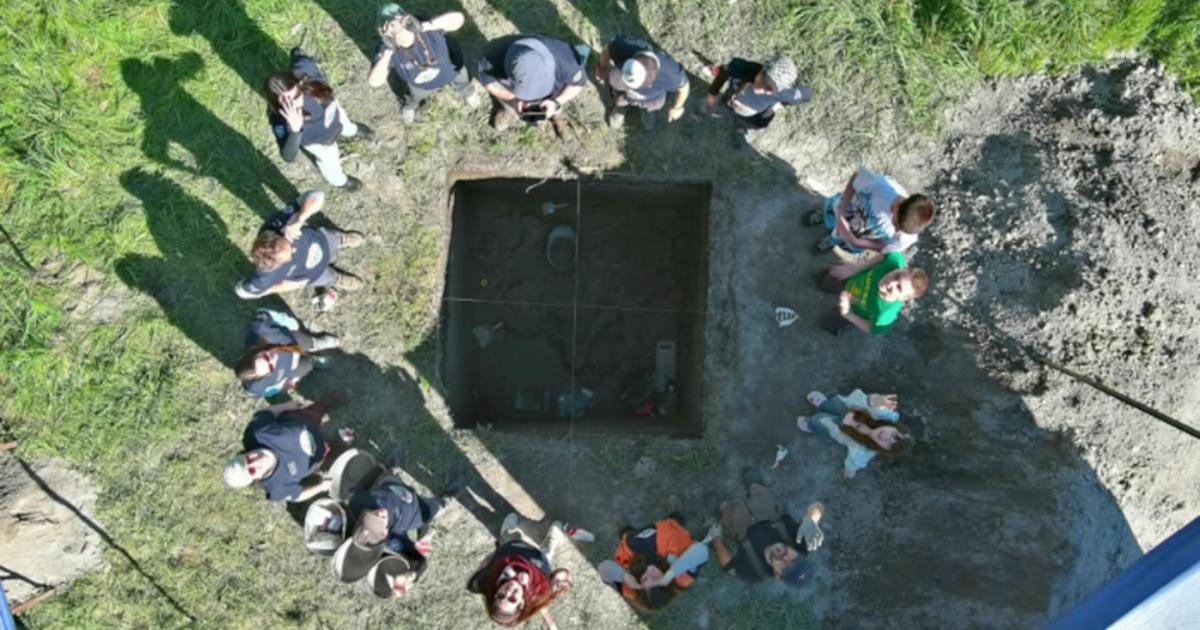
Rafael Labarca of the university's School of Anthropology led the August 31–September 14, 2026 campaign at the former lakeshore in Chile's O'Higgins Region. His team recovered well-preserved remains, including a large humerus (upper-arm bone), and wrapped the fragile pieces in gauze and Japanese paper for lifting.
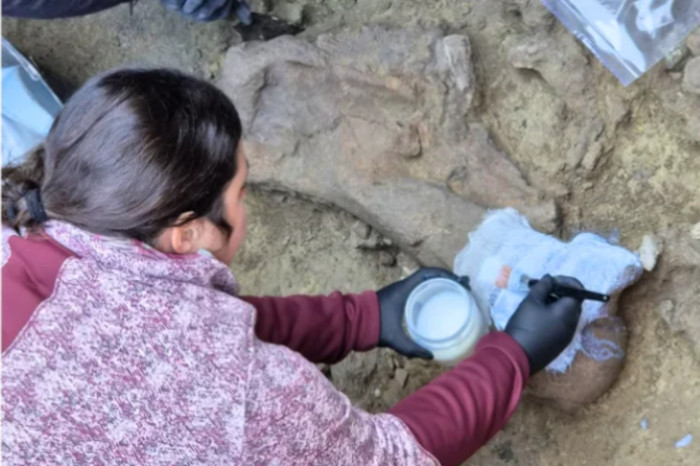
Large gomphothere humerus being prepared for lifting from its location. (Mauricio Álvarez/Pontificia Universidad Catolica de Chile)
The adult's fractured skull which was found in an earlier excavation raises the possibility of deliberate opening, although a break alone cannot settle how it happened; questions of human involvement require close study, as other South American butchery claims show.
The new excavation lies across from a site Julio Montané investigated in 1967, hinting that the archaeological area may extend farther than previously recognized. Trial pits dug from 2023 onward had already exposed extinct animal remains beside stone artifacts; the excavations expanded in 2025 and 2026. There are no consolidated radiocarbon dates yet for this new context, the university says, so the estimated age must not be confused with securely dated discoveries nearby or taken as proof that people broke this particular skull.
- 28,000-Year-Old Mammoth Kill Site Discovered in Austria
- New Evidence Pushes Back Peopling of the Americas Almost 20,000 Years
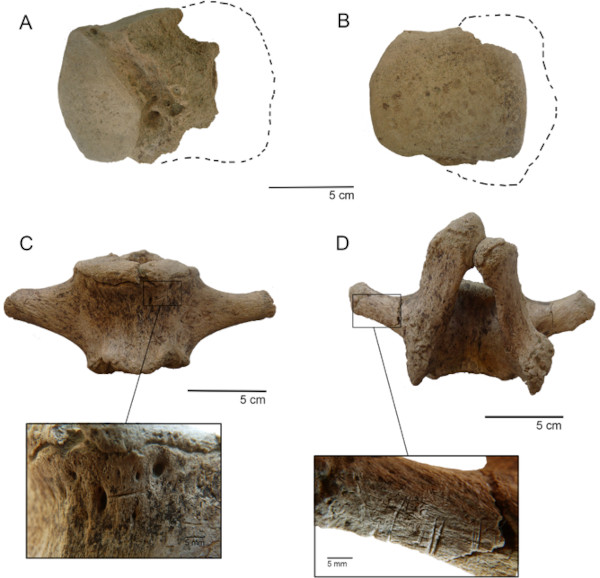
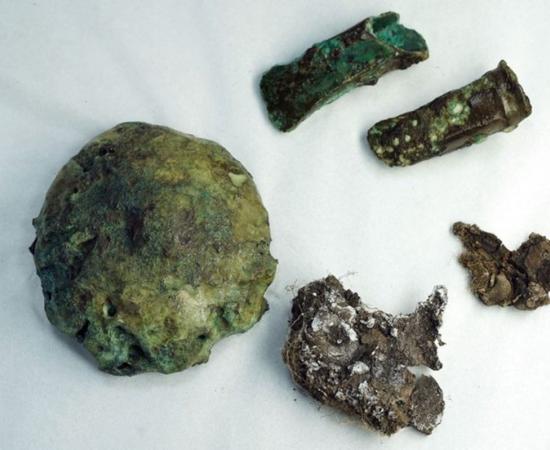
At Taguatagua 3, earlier investigators documented a carnivore-marked bone and gomphothere tail vertebrae with cut marks; these are not the newly found skull. (Labarca et al., 2024. PLOS One/CC BY 4.0)
Many Visits to a Vanished Lake
The current dig has yielded abundant gomphothere material, some horse remains, burned bird bones and stone artifacts, according to Labarca. Together they point to activity along a productive lakeshore, rather than a single isolated fossil. This was a landscape visited intermittently by people near the end of the Pleistocene, and the finds offer another angle on the wider debate about Chile's earliest sites, not a new date for the first arrival of humans.
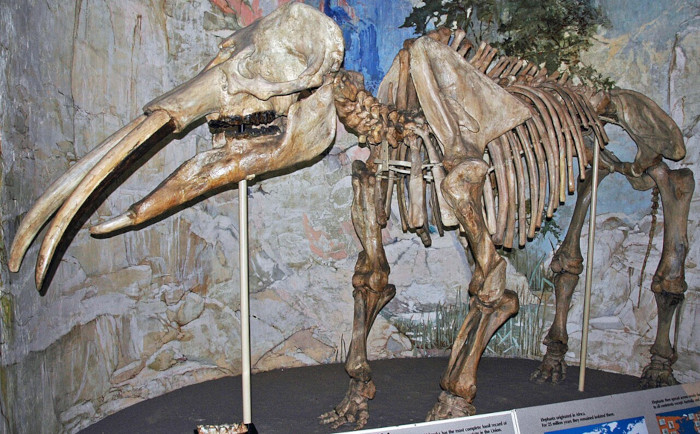
A mounted North American Gomphotherium osborni skeleton illustrates this extinct elephant relative; it is not the Chilean animal. (James St. John / CC BY 2.0)
The setting has changed radically: the lake was drained in the nineteenth century, and its old shoreline now lies beneath farmland. Excavators hope to reconstruct that shore and learn how groups returned to collect food and other resources over time. The evidence of burned birds and stone artifacts complicates any picture of these people as solely big-game hunters; forensic work on Ice Age weapons elsewhere shows why different kinds of evidence matter when reconstructing ancient diets.
What Earlier Excavations Can Tell Us
A 2024 peer-reviewed study led by Labarca analyzed Taguatagua 3, a separate lakeshore site, and dated a short human occupation to about 12,440–12,550 calibrated years ago. There, researchers documented cut marks on gomphothere tail bones, burned bone fragments, a hearth and stone tools. They interpreted the site as a temporary camp where a young animal was butchered, alongside the processing of smaller animals and plants; those findings cannot automatically be transferred to the newly excavated adult.
The new work, known as Tagua Tagua 1 Oriente, could help connect scattered discoveries around the basin into a clearer history of repeat visits. Until dating and bone analyses are complete, however, the most intriguing part of the Tagua Tagua gomphothere find remains a testable possibility rather than a settled account of a meal. Comparable mammoth bone concentrations in Mexico underline how much careful excavation can reveal about ancient animals—and how cautiously human actions should be inferred.
Top image: The most recent bones were in excellent condition and correspond to an adult specimen with a fractured skull, possibly to extract the brain and consume it. Source: Mauricio Álvarez/Pontificia Universidad Catolica de Chile
By Gary Manners
References
Burgos, R. 29 September 2026. Encuentran restos de gonfoterio de 12.500 años de antigüedad con signos de manipulación humana en Tagua Tagua. Available at: Visión Universitaria UC.
Labarca, R., et al. 22 May 2024. Taguatagua 3: A new late Pleistocene settlement in a highly suitable lacustrine habitat in central Chile (34°S). Available at: PLOS One.
Moore, C. R. 19 June 2023. Blood Residue Found on 13,000-Year-Old Ice Age Weapons. Available at: Ancient Origins.