The discovery of a massive Germanic settlement dating from the 2nd to 5th centuries AD in Bielefeld-Sieker, Germany, is challenging previous assumptions about ancient living patterns in the region. The archaeological team of the Regional Association of Westphalia-Lippe (LWL) has discovered a rare settlement with 30 longhouses and evidence of trading connections, thus indicating a well-established community that flourished during the Roman period.
The Settlement in Ancient Germania
Previous research indicated that during the Roman period the settlements in East Westphalia were inhabited by only a few families living in scattered farmsteads located far from each other. The evidence from Bielefeld-Sieker proves this thesis wrong. The discoveries at this archaeological site have shown the close arrangement of the buildings, including longhouses with a length of up to 30 meters and width of 8 meters.
They were reconstructed several times, proving that people lived there for about 200 years. Dr. Sven Spiong, the director of LWL archaeology stated that this settlement was an important center of this period. The concentrated buildings of this settlement show that it was much bigger than the neighboring settlements.
Strategic Location and Trade Links
Bielefeld-Sieker was prosperous mainly due to its favorable location. It was situated on fertile loess soils on the northern slopes of the Teutoburg Forest. A stream, (Mühlenbach) was nearby and provided people with fresh water. Besides this, it was situated near the ancient route known as the Roman Way that was used by the Roman army on its way to Weser River. It was also near the Roman army camp in Sennestadt, which indicates that the site played a significant military and logistical role.
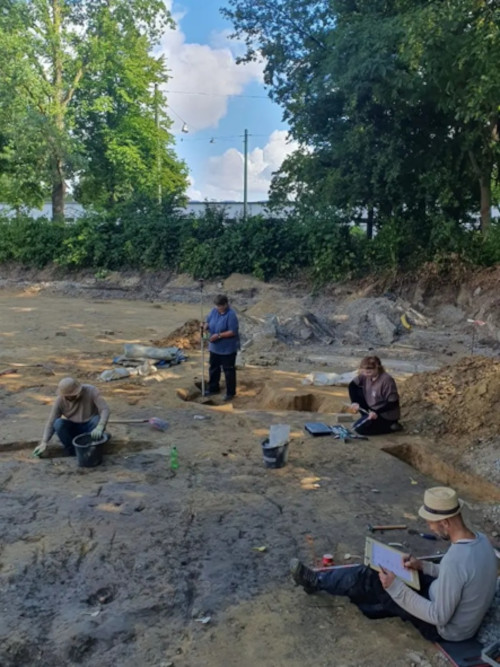
The excavation team documents and excavates the former pit fills in the soil (LWL Archaeology for Westphalia/Sebastian Düvel)
Archaeologists have discovered numerous Roman objects at the site, particularly in an associated cemetery. These finds, which include Roman coins and imported goods, indicate that the Germanic tribes maintained long-standing trade connections with areas west of the Rhine. The discovery of a 2nd-century Roman coin in a posthole provided a crucial date for the construction of one of the buildings.
Safety in Numbers
The unusual density of the settlement has raised questions among researchers. Germanic communities of this era typically preferred to live in dispersed farmsteads. Since the Bielefeld-Sieker site lacks known fortifications or a nearby hillfort, archaeologists speculate that the close living arrangements may have been a defensive strategy.
Living along a busy trade route brought wealth, but it also likely attracted unwanted attention. Grouping their homes closely together may have provided the inhabitants with a measure of safety against raiders or hostile groups.
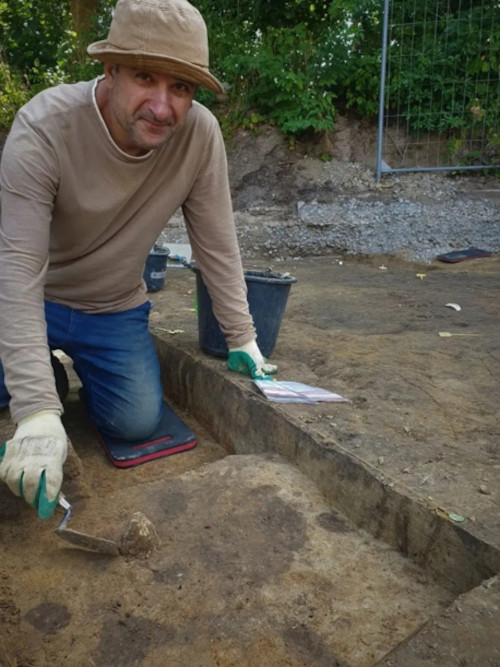
Excavation team member Ristam Abdo uncovers one of the discolorations in the soil. (LWL Archaeology for Westphalia/Sebastian Düvel)
The Decline of a Regional Hub
The settlement's prosperity was closely tied to the broader geopolitical landscape. As the Western Roman Empire began to collapse in the 5th century AD, the long-distance trade networks that had sustained the community weakened and eventually faded. Without the flow of goods and merchants along the Roman Pass, the settlement lost its economic foundation and was eventually abandoned.
The findings from Bielefeld-Sieker are now part of a broader research initiative called "West Germania in Transition." This project aims to understand the societal changes in western Germanic communities during and after the Roman period. Further analysis of the artifacts and structures will provide deeper insights into the lives of the people who inhabited this extraordinary settlement.
Top image: Aerial view of the current excavation area ahead of the construction of a new school in Bielefeld-Sieker. Source: LWL Archaeology for Westphalia/Arne Koch
By Gary Manners
References
Archaeology News Online Magazine. 2026. Large Germanic settlement from the Roman period uncovered in Bielefeld with 30 longhouses and trade links. Available at: https://archaeologymag.com/2026/07/germanic-settlement-from-the-roman-period-in-bielefeld/
La Brújula Verde. 2026. A Large 2nd-Century AD Germanic Settlement with Thirty Longhouses Eight Meters Wide Discovered Next to the Teutoburg Forest. Available at: https://www.labrujulaverde.com/en/2026/07/a-large-2nd-century-ad-germanic-settlement-with-thirty-longhouses-eight-meters-wide-discovered-next-to-the-teutoburg-forest/
LWL. 2026. Archäologische Arbeiten in Bielefeld-Sieker beendet: Germanische Siedlung war "bedeutendes Zentrum". Available at: https://www.lwl.org/pressemitteilungen/nr_mitteilung.php?urlID=64343