
Nearly 3,000 years ago, dozens of people were laid to rest in deep rectangular pits at Matelica, in Italy's Marche region, curled on their right sides as though asleep. When archaeologists reopened those graves, they found something unexpectedly familiar: more than four in ten of the skulls carried a flat spot at the back. New research, reported by Phys.org, argues these are the earliest documented cases of flat head syndrome in Italy, and that the condition is far older than the modern parenting advice usually blamed for it.
urnal of Paleopathology, examined 26 individuals from two Iron Age cemeteries used by the Picene people at Matelica — Crocifisso and Brecce — dating to the mid-ninth to eighth century BC. Eleven of them, or 42.3%, showed asymmetry consistent with deformational plagiocephaly, the clinical name for flat head syndrome. Seven were male and four female, and the flattening sat on the right side in eight cases, echoing the pattern paediatricians see in infants today.
"The presence of plagiocephaly in ancient individuals shows that this is not exclusively a modern condition," Beck De Lotto said. "Rather than being alarming, I think this makes the condition particularly interesting from a bioarchaeological perspective."
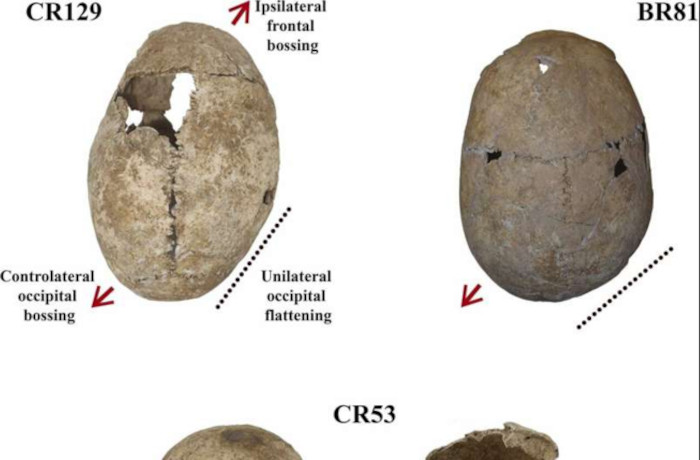
Flattened crania of Iron Age adults from Matelica, Italy (CR129, BR81 and CR53), showing unilateral occipital flattening and frontal bossing. (Beck De Lotto et al. 2026/Science Direct)
A Pattern the Soil Cannot Explain
Flat spots are easy to misread in ancient bone. Soil pressure and moisture can distort a skull long after death, and deliberate head binding can flatten an infant's head into a cone or wedge, as it did for the elongated skulls of the Carpathian Basin. The team worked through each alternative before settling on a diagnosis.
Every individual at Matelica was buried lying on their right side, yet flattening appeared on both sides, so the grave itself was not responsible. Fragments of the flattened crania also refitted cleanly — unlike soil damage, which leaves edges that no longer meet — indicating the reshaping happened in infancy, while the bone was still soft. CT scans then ruled out craniosynostosis, a rare birth defect in which the skull's sutures fuse prematurely.
Head binding was dismissed too. The practice leaves pitting and a hollow at the back of the skull, none of which appeared at Matelica, and it has never been documented in Iron Age Italy. What the researchers did find were lopsided neck vertebrae and collarbones in some individuals, possible signs of wryneck — a muscular condition that frequently accompanies flat head syndrome in babies.
- Picene Prince's Tomb Reveals a Chariot and 150 Other 7th Century BC Artifacts
- 2,700-Year-Old Iron Age Pit Tomb Necropolis Unearthed in Italy
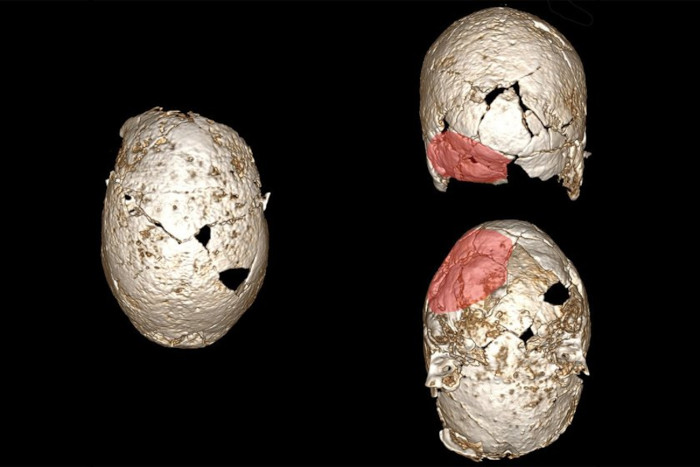
CT scans of a Matelica cranium, with the flattened area highlighted in red, one of the lines of evidence used to rule out birth defects and burial damage. (M.A. Beck De Lotto et al./Science Direct)
Pillows, Swaddling and the Iron Age Cradle
Some skulls were flattened low on the back of the head, an angle the authors link to infants resting against pillows. No Picene pillows survive, but a later Etruscan or Roman-era terracotta figurine shows a tightly swaddled baby with its head propped on one. Cradleboards and swaddling bands and spouted feeding pots may all have limited a baby's head movement, much as car seats, prams and prolonged bottle feeding do today. Because mild cases usually correct themselves as a child grows, and only the most severe persist into adulthood, the true rate among Picene infants was probably higher still.
"The 42% prevalence at Matelica is certainly high, but it is not without precedent," Beck De Lotto said, noting that a study published before the Back to Sleep campaign recorded a comparable figure.
Not Just a Modern Problem
The 1992 American Academy of Pediatrics "Back to Sleep" campaign, which advised placing infants on their backs to reduce sudden infant death syndrome, is often credited with a rise in flattened heads. Modern studies put the rate at 37.8% to 46.6% in babies aged seven to twelve weeks. Pre-campaign estimates, however, ranged from 0.3% to 48%, so there was never a clean baseline. Earlier finds hint the condition is older still: a Czech ossuary produced 93 probable cases, and a flattened cranium has even been proposed for the small-bodied hominin Homo floresiensis.
- From Tattoos to Elongated Skulls: A History of Body Modification
- Ancient Mass Grave Filled With Up To 89 Children Found in Israel
"Identifying it in archaeological finds can provide insights into how infants were cared for," Beck De Lotto said. "In past societies, infant care was largely shaped by experience and traditions transmitted within families and communities, and some practices may have persisted even when they occasionally affected cranial shape."
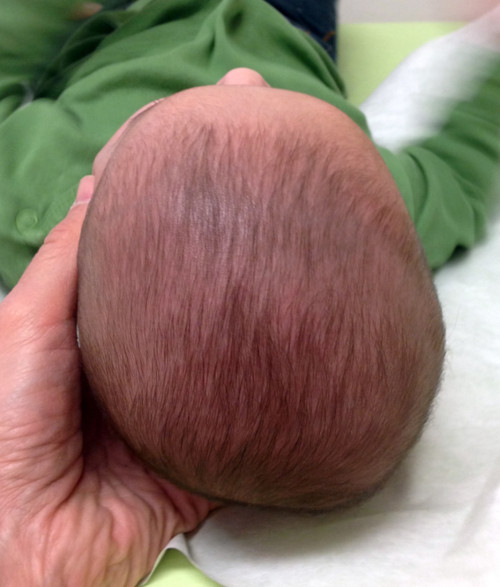
The flattened back of an infant's head, the modern presentation of the same condition identified at Matelica. (Gzzz / CC BY-SA 4.0)
What It Means for Modern Parents
The sample is small, and the researchers are careful not to overreach: how Picene families handled their babies can only be inferred indirectly. Excavations of infant cemeteries elsewhere show how much the youngest members of a community can reveal about the world they were born into. Even so, the Matelica skulls suggest more than simple back-sleeping is at work, and that a condition many parents worry about today has been shaping human heads for millennia.
Top image: Matelica in the Marche region of central Italy, where two Iron Age cemeteries produced the flattened crania. Source: Erminio Burzacca / CC BY-SA 2.5 IT
By Gary Manners
References
Anthropology.net. 2026. Flat Head Syndrome in 42% of Iron Age Italians. Available at: https://www.anthropology.net/p/flat-head-syndrome-in-42-of-iron
Beck De Lotto, M.A., Zanatta, A., Paladin, A., Zink, A. and Pacciani, E. 2026. Before "Back to Sleep": Deformational plagiocephaly and pediatric insights from Iron Age Italy. International Journal of Paleopathology. Elsevier. Available at: https://www.sciencedirect.com/science/article/abs/pii/S1879981726000495
New Scientist. 2026. Flat head syndrome discovered in Iron Age skeletons. Available at: https://www.newscientist.com/article/2582200-flat-head-syndrome-discovered-in-iron-age-skeletons/
Oster, S. 2026. Iron Age skulls reveal some babies had flat head syndrome—long before the 'Back to Sleep' campaign. Phys.org. Available at: https://phys.org/news/2026-10-iron-age-skulls-reveal-babies.html