A collaborative mission of Egypt and Spain has discovered a tomb from the Fifth Dynasty, whose painted reliefs retain most of their original colors. The tomb was discovered in Saqqara’s Mariette Cemetery, and comprises two funerary chapels, one of a very powerful judge called Yunmin and the other his father called Ity. The tomb features agricultural scenes, offering processions and well-preserved inscriptions on its walls giving a rare insight into public life during the reign of King Djedkare Isesi. This discovery is yet another significant addition to the long list of archaeological findings at Saqqara.

Painted reliefs adorning the walls of the tomb. (MOTA)
A Two-Chapel Tomb for Father and Son
As stated by the Egyptian Ministry of Tourism and Antiquities, the medium-sized mastaba was excavated during the 2026 season of the mission. The chapels are located on the eastern wall of the tomb, with the principal chapel of Yunmin on the north side and the chapel of Ity on the south side. Yunmin was an important official working in the capacity of judge, director of the court, as well as head of scribes who were checking complaints and petitions. Ity was in charge of scribal work related to agricultural land and managing offerings.
- Egyptian Tomb Dating To 4,400 Years Ago Has Hidden Shafts Which Might Hold The Treasures Of The ‘Divine Inspector’
- 4300-Year-Old Egyptian Tomb Discovered in Saqqara Hold Keys to Secrets of World’s First Alchemists
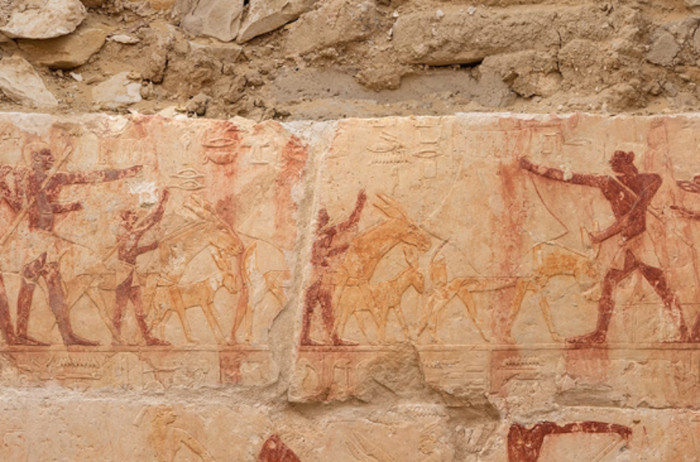
One of the well-preserved reliefs at the tomb depicting agricultural practices. (MOTA)
The site of Saqqara, located approximately 40 kilometers (25 miles) southwest of Cairo, was one of the main burial sites of ancient Memphis. For over 2000 years, many royal pyramids, mastabas for rich people and decorated chapels were constructed at the site. The newly discovered monument is dated back to the time of Djedkare Isesi, at the end of the Fifth Dynasty, and mentions the names and titles of two individuals who belonged to one family.
Original Colors Survive in the Fifth Dynasty Tomb
The chapel of Yunmin has a signature façade imprinted with messages related to burial, along with offering sequence and an elaborate depiction of the owner of the grave. The walls contain sophisticated, raised reliefs depicting agricultural labor and processions with offerings to the dead person, where colors are still intact in some places. The hieroglyphic inscriptions provide information about the identity of the deceased, while the pictures of the offerings represent the idea of providing for life after death.
The chapel of Ity consists of a false door and various colored offering scenes, while the majority of decorations are in a state of decay.
- Who Is Buried at Abusir Necropolis, the Funerary Jewel of Ancient Egypt?
- Mastaba With Stunning Murals Unearthed in Dahshur Necropolis
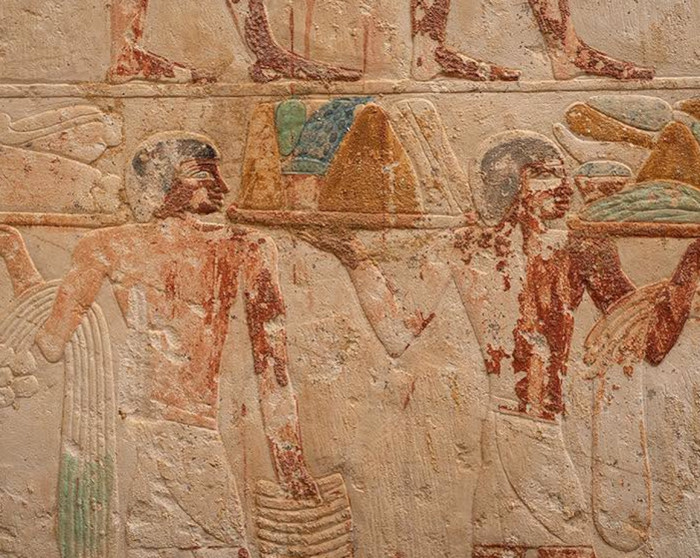
Relief in Yunmin chapel of processions bringing provisions to the tomb. (MOTA)
This imagery corresponds to the general Old Kingdom tradition, as explained by the Metropolitan Museum of Art, where images depicting agricultural practices, hunting and food preparation have become prevalent in the elite mausoleums of the Fifth Dynasty. The false doors and offering scenes are also part of the construction through which the living maintained the funeral cult, although the release from the Ministry does not mention the finding of bodies or grave goods in this tomb. These ideas evolved in the context of the wider Egyptian beliefs regarding the afterlife.
Old Ground, Newly Documented Evidence
The location of the mastaba has been known since 19th century with the work of French archaeologist Auguste Mariette in the area, yet it has not undergone scientific archaeological excavation and registration. According to Hisham El-Leithy, Secretary-General of the Supreme Council of Antiquities, the work provides evidence about architecture, art and administration of the time of the late Fifth Dynasty. The mission, a partnership between the Autonomous University of Barcelona and Egypt’s Supreme Council of Antiquities, has now completed excavation and documentation of both chapels. It also carried out conservation and restoration to protect the surviving architecture, inscriptions and color.
What the Saqqara Tomb Tells Us
This find is significant as it brings together the art and the technical apparatus of the Old Kingdom. The duties of Yunmin, who was in charge of the courts, petitions, and submissions, as well as the work of Ity in the field and offerings show that administration followed an elite family even into the underworld. Other discoveries from Saqqara, including clues regarding the process of mummification and the papyrus of the Book of the Dead, belong to a much later period in history. The contents of this burial place, on the other hand, provide a narrow view of life and observation about 4,400 years ago, with the preserved colors bringing this world very close to the audience.
Top image: The Fifth-Dynasty mastaba tomb found at Saqqara in 2026, with inset, one of the painted reliefs. Source: MOTA
By Gary Manners
References
Bárta, M. 17 November 2017. Egypt’s Old Kingdom: The Latest Discoveries at Abusir South. Harvard Museum of the Ancient Near East. Available at: https://www.youtube.com/watch?v=XVRwVnOR-s0
Daily News Egypt. 7 September 2026. Spanish-Egyptian mission unearths late Fifth Dynasty tomb of a judge in Saqqara. Available at: https://www.dailynewsegypt.com/2026/09/07/spanish-egyptian-mission-unearths-late-fifth-dynasty-tomb-of-a-judge-in-saqqara/
Ministry of Tourism and Antiquities, Egypt. 7 September 2026. A joint Spanish-Egyptian archaeological mission discovers a tomb from the late Fifth Dynasty in the Saqqara archaeological area. MOTA. Available at: MOTA
Ministry of Tourism and Antiquities, Egypt. 2019. Saqqara. Available at: https://egymonuments.gov.eg/en/archaeological-sites/saqqara
Prakash, T. 1 February 2019. Egypt in the Old Kingdom (ca. 2649–2130 B.C. ). Available at: https://www.metmuseum.org/essays/egypt-in-the-old-kingdom-ca-2649-2150-b-c
Sánchez, E. 8 September 2026. Spanish archaeologists find 4,400-year-old tomb in Egypt with original colours intact. Available at: https://www.euronews.com/culture/2026/09/08/spanish-archaeologists-find-4400-year-old-tomb-in-egypt-with-original-colours-intact