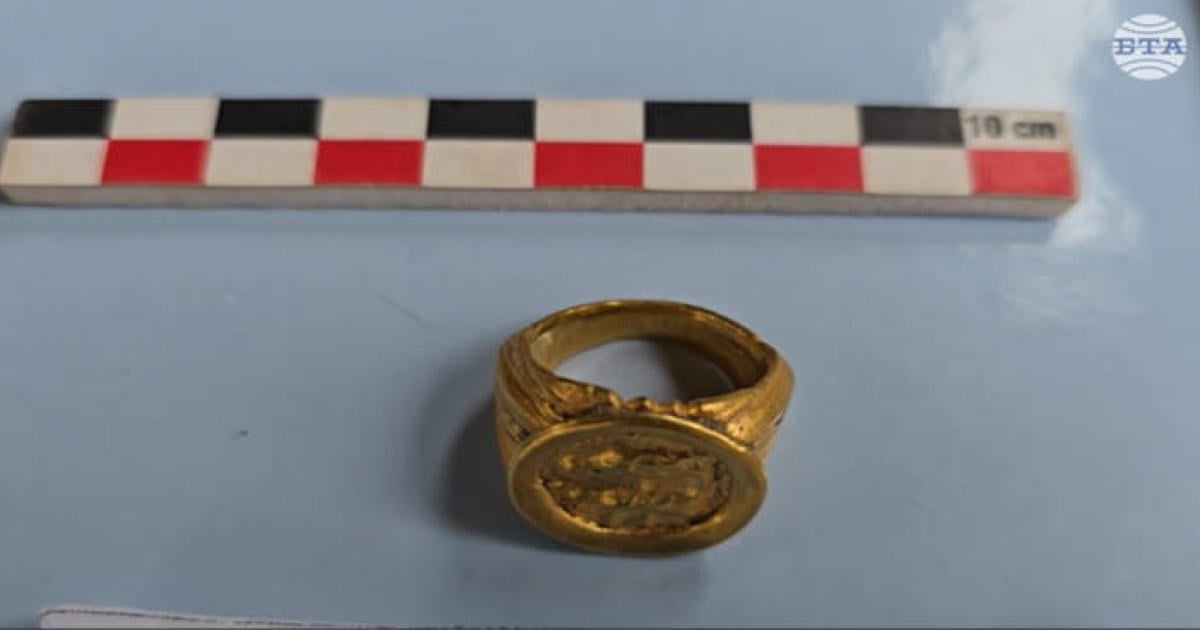

Exceptionally Heavy Roman Gold Ring Unearthed in Bulgaria's Ancient Bononia
Archaeologists working at the Ancient Bononia site in Vidin, Bulgaria have made a remarkable discovery that offers fresh insight into Roman marriage customs. A substantial gold ring weighing 23.63 grams was unearthed on December 4, 2025, during the final day of this season's excavations. The artifact, dating to the late 2nd or early 3rd century AD, was found nearly six meters below the surface, testament to the depth of history buried beneath the modern Danube city.
- Roman Engagement and Wedding Rings: Joining Hands and Hearts
- Oldest known Gold Jewelry in Europe Discovered at Bronze Age Bulgarian site

Archaeological excavations at Ancient Bononia in Vidin, Bulgaria, where a 2nd-3rd century AD Roman gold wedding ring was discovered. (BTA News Screenshot)
A Symbol of Marital Fidelity
The ring's design speaks volumes about its purpose in Roman society. According to excavation director Zdravko Dimitrov, this piece served as a symbol of marital loyalty exchanged between newlyweds during the height of the Roman Empire. An oval plaque depicting a married couple has been expertly soldered to the band, creating an intimate portrait frozen in precious metal. Both sides of the ring feature decorative fluted grooves—parallel channels that catch the light and add dimension to the piece, reported BTA.
The craftsmanship suggests local production, likely from one of the renowned goldsmith workshops in nearby Ratiaria, an important Roman city in the province of Moesia Superior. The substantial weight of the ring indicates it belonged to someone of considerable means, as gold remained a luxury material reserved for the wealthy even in prosperous Roman settlements along the Danube frontier.
- Archaeologists Unearth First Century Roman Refrigerator in Bulgaria
- Ancient Luxury Outpost with Heated Jacuzzi served Roman Emperor in Bulgaria
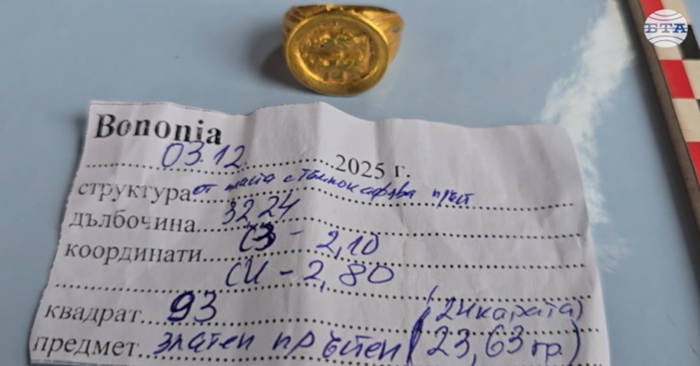
The ring, with notes of the details of the find. (BTA News Screenshot)
Ancient Bononia: A Frontier Fortress
The discovery took place at Ancient Bononia, a significant Roman fortification that formed part of the empire's Danube frontier defense system. The city's origins stretch back to the 3rd century BC when Celtic settlers established a settlement called Dunonia, meaning "fortified hill." Under Roman control from 46 AD, the site became an important military and administrative center in Upper Moesia, controlling trade routes and defending against threats from across the Danube.
Much of modern Vidin sits atop the ruins of this ancient fortress, making archaeological work both challenging and rewarding. The 2025 excavation season has now concluded, with conservation work underway to protect the site through the winter months. Vidin Deputy Mayor Martin Donchev confirmed that funding will continue for future archaeological work at both Ancient Bononia and the nearby Baba Vida fortress moat, according to the BTA report.
Window into Roman Life
The timing of this discovery carries particular significance. Found on the last day of the 2025 excavation season, the ring emerged from depths that required careful excavation through multiple historical layers. At nearly six meters below the modern surface, the artifact had remained undisturbed for approximately 1,800 years, protected by the accumulated sediments of centuries.
Bulgaria's archaeological landscape has yielded numerous Roman treasures over recent decades, from the Varna gold to rare medallions of Emperor Caracalla. However, each discovery adds unique details to our understanding of daily life in the Roman provinces. This wedding ring, with its depiction of a married couple, provides tangible evidence of personal relationships and social customs at the empire's edge.
The workshops of Ratiaria, where this ring was likely crafted, were renowned throughout the region for producing fine jewelry and metalwork. Located approximately 30 kilometers south of Vidin, Ratiaria served as the capital of Moesia Superior and boasted a thriving economy supported by Danube trade routes. The city's goldsmiths would have catered to wealthy military officers, merchants, and local aristocracy who sought to display their status through elaborate personal adornments.
Top image: Archaeological excavations at Ancient Bononia in Vidin, Bulgaria, where a 2nd-3rd century AD Roman gold wedding ring was discovered. Source: BTA News Screenshot
By Gary Manners
References
Bulgarian Telegraph Agency (BTA). 2025. Archaeologists in Vidin Find Gold Ring from 2nd or 3rd Century AD. Available at: https://www.bta.bg/en/news/culture/1021645-archaeologists-in-vidin-find-gold-ring-from-2nd-or-3rd-century-ad
The Archaeologist. 2025. Archaeologists in Vidin Find Gold Ring from 2nd or 3rd Century AD. Available at: https://www.thearchaeologist.org/blog/archaeologists-in-vidin-find-gold-ring-from-2nd-or-3rd-century-ad