
Modern scholars generally regard the Odyssey as legend rather than historical record, yet the line between myth and memory in the ancient world was never clearly drawn. As the New York Times reported just before the film's release, archaeologists working on the Greek island of Ithaca have uncovered compelling evidence that to the Greeks of antiquity, Odysseus was not merely a literary creation but a figure of genuine, abiding devotion.
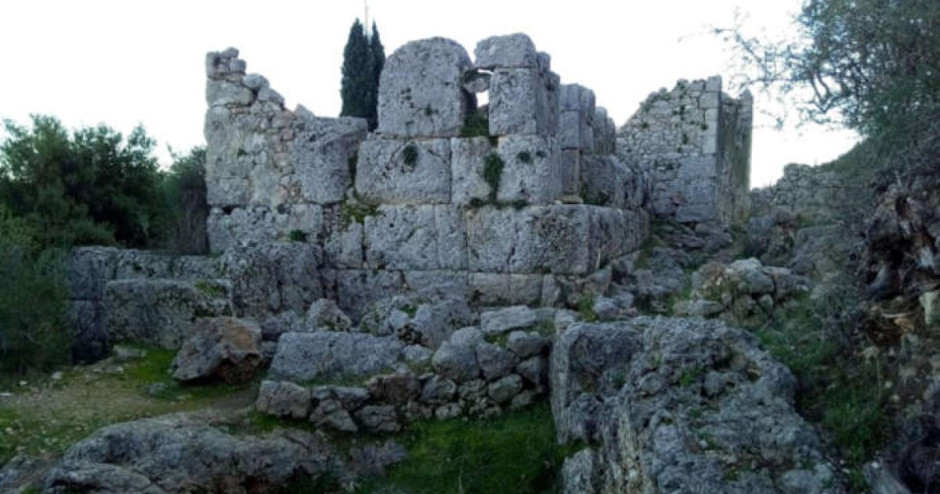
Ithaca, St. Athanasios-Homeric School. View of the tower-like structure of the Hellenistic period at Ano Andiros, from the north. (C. Marampea/Greek Ministry of Culture)
The Odysseion: A Sanctuary for a Legendary King
High on the terraces of Mount Exogi, at a site long known locally as the School of Homer, excavations led by archaeologist Giannos G. Lolos of the University of Ioannina have revealed the ruins of a sprawling 2,400-year-old sanctuary. Referred to by scholars as the Odysseion, the complex dates to around the third century BC — roughly 500 years after Homer composed his epics, and a full millennium after the hero supposedly began his journey home from Troy. Yet the artifacts recovered from its soil speak of a cult that was anything but casual.
Within the complex, the excavation team uncovered polished black cups, jewelry, private prayer vessels, and thousands of shattered pottery fragments. Among the most extraordinary finds were roof tiles stamped with the name of Odysseus himself. One translates as "of Odysseus," implying that the mythical hero owned the grounds; another reads "to Odysseus," a direct dedicatory gift to the king
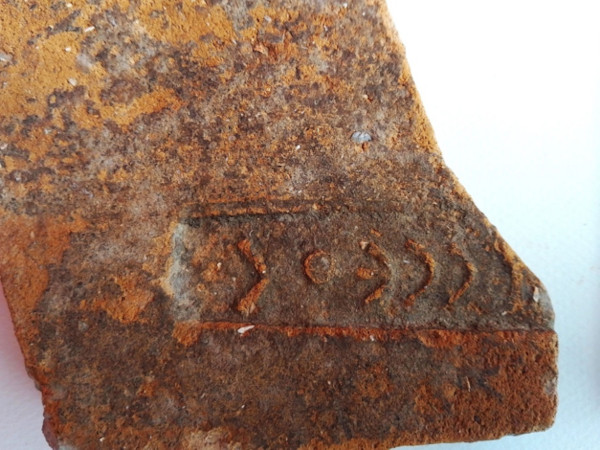
Fragment of a stamped tile, with part of the name of Odysseus, Hellenistic period. (C. Marampea/Greek Ministry of Culture)
More than 100 bronze and silver coins minted in city-states across the Hellenistic and Roman worlds were also recovered, pointing to a constant flow of sailors, merchants, and pilgrims from distant places. The presence of dozens of spindle whorls and loom weights suggests that women played a central role in the rituals, perhaps venerating Penelope alongside her famous husband.
Homer's Ithaca: Poetry or Geography?
The question of where Homer's Ithaca actually was has long perplexed scholars. In the epic, the island is described as lying low and furthest to the west — a description that sits awkwardly with the modern Greek island of the same name, which is mountainous and lies to the east of its neighbor, Cephalonia. Various theories have proposed that a Bronze Age channel once separated the Paliki peninsula from Cephalonia, making it a distinct island, though two decades of geological research found no evidence for this. A recent article in the journal Antigone by classicist James Diggle and geologist John Underhill argues instead that early translators misread the original Greek, which never explicitly identifies Ithaca as an island.
Dr. Lolos, however, contends that the excavations at the Odysseion strongly validate modern Ithaca as Homer's true Ithaca. He points to the description "lying low and far to the west" as a matter of poetic perspective rather than literal cartography, noting that seen from the sea, Ithaca's dramatic coastline mirrors Homeric vistas. The site also yielded a fragment of a late Hellenistic clay prayer mask scratched with a vow to Odysseus, a small bronze bust echoing the hero's silhouette from antique Ithacan coins, and a third-century BC decree from the people of Ithaca explicitly naming the Odysseia — an athletics and cultural festival held to celebrate the king.
- Homer: From Oral Tradition to Canon
- The Golden Age Of Heroes: The Glory Of The Mycenaean Civilization
A Vanished World Remembered
The site also contains evidence of a major Mycenaean settlement dating to the fourteenth or thirteenth century BC — the very era in which the historical Odysseus would have lived. This includes an intact underground cistern constructed from monolithic blocks, which formed part of a network of seven or eight Mycenaean sites that made up the island's Bronze Age urban landscape. While this does not prove the existence of a king named Odysseus, it does confirm that the island was a significant center of power during the period the epic describes.
Mainstream academic opinion holds that the Odyssey immortalizes a vanished era of Bronze Age chieftains who raided overseas, ruled stone citadels, and controlled wide trade networks. The stories were preserved through a rich oral tradition, shaped by roving performers who reinvented them for each new generation, before being codified around the eighth century BC. The legendary king of Ithaca, whether a singular historical figure or a composite of many, represents something that archaeology alone cannot fully excavate: the enduring human need to make heroes of the past. As classicist Daisy Dunn put it, "Myth, it turns out, may just be history waiting to be dug up."
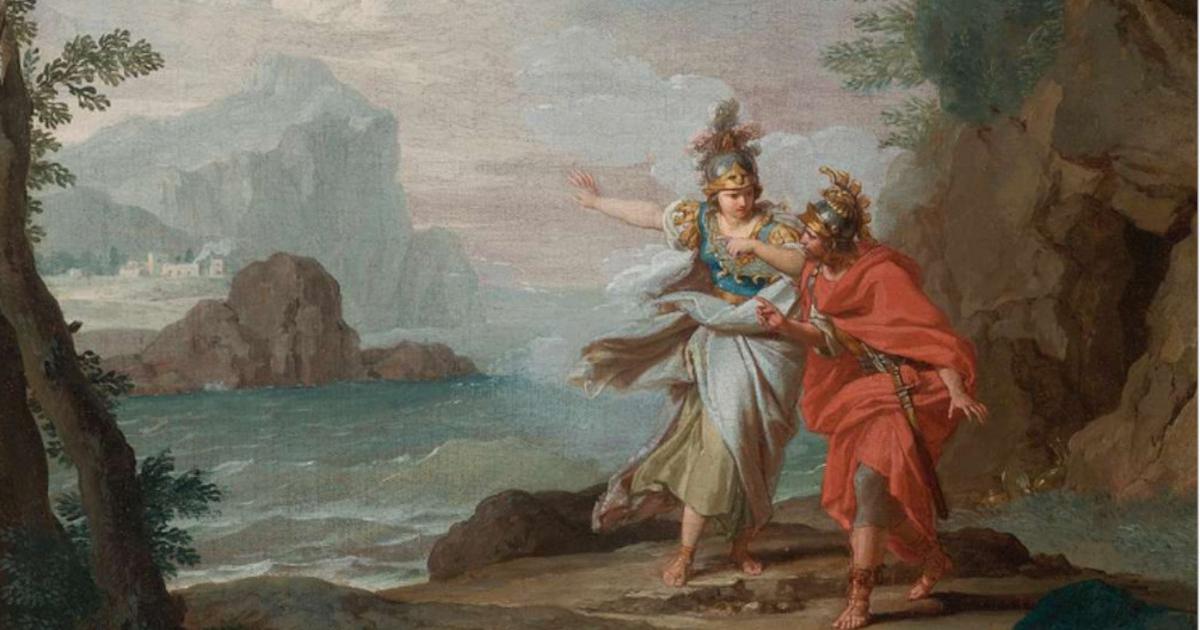
Top image: Athena Appearing to Odysseus, painting by Guiseppe Bottani. Source: Public Domain
By Gary Manners
References
Diggle, J. and Underhill, J. 2026. In Search of Ithaca. Antigone Journal. Available at: https://antigonejournal.com/2026/07/in-search-of-ithaca/
Encyclopædia Britannica. 2026. Is the Odyssey a True Story? Available at: https://www.britannica.com/topic/Is-the-Odyssey-a-True-Story
Lidz, F. 2026. Odysseus Wasn't Real. But He Had Real Worshipers in Ancient Ithaca. The New York Times. Available at: https://www.nytimes.com/2026/07/15/science/archaeology-homer-odyssey-ithaca.html
Staff Writer. 2025. Sanctuary Associated with Worship of Trojan War Hero Identified on Greek Island. Archaeology Magazine. Available at: https://archaeology.org/news/2025/06/17/sanctuary-associated-with-worship-of-trojan-war-hero-identified-on-greek-island/