
Archaeologists have uncovered a remarkably preserved ritual well in the ancient Etruscan city of Kainua, revealing spectacular bronze votive offerings and human remains. The astonishing discovery, located near Marzabotto in Italy, provides unprecedented insight into the foundation rites of Etruscan civilization and the sacred role of water in their ancient religion.
The University of Bologna successfully directed the 39th archeological excavation at the Etruscan site. The archeological team was led by Professor of Archeology, Elisabetta Govi, and during this dig, the important discovery related to Etruscan studies was made. The dig revealed a "well" found within an urban sacred precinct that was created to honor the most important Etruscan goddess, Uni. Uni was a powerful deity that was believed to be equivalent to Hera from Greece, and Juno from Rome. The site where the well was found already has two major temples dedicated to the main couple of the Etruscan religion, Tinia and his consort, Uni.

The preserved ritual well in the ancient Etruscan city of Kainua. (Museo Nazionale Etrusco di Marzabotto)
A Sanctuary of Ancient Secrets
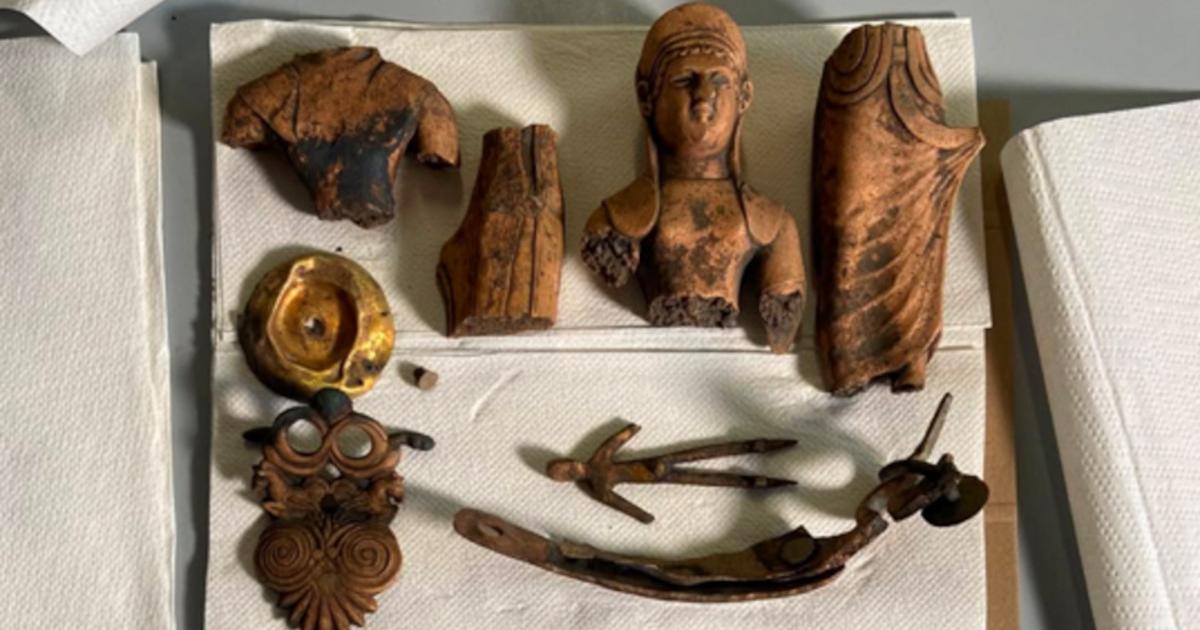
While excavating an ancient well, the excavation team uncovered two unique bronze female figurines and a rare bronze plate. Even after being buried for over 2,500 years, the items have retained their original finish of metallic sheen due to their use as a set of dedicated Etruscan votive offerings. This deposit was done as part of a formal foundation ceremony for the well at the end of the 6th or beginning of the 5th century BC. This corresponds with when the city of Kainua was first established by Etruscans.
- Longest Ancient Etruscan Inscription Reveals Name of Virtually Unknown Goddess
- A Boy, to Vei, to Venus? Piecing Together the Puzzle of an Etruscan Necropolis
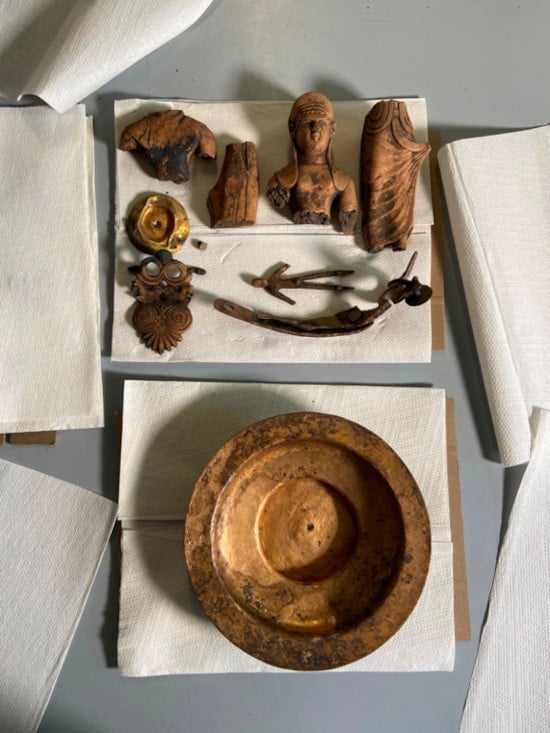
Collection of Bronze artifacts found in the Etruscan ritual well. (Museo Nazionale Etrusco di Marzabotto)
The significance of the well extended far beyond a simple water supply. The discovery of two adult human skeletons associated with the structure indicates a ritual closure, marking the definitive end of the well's function. This practice highlights a profound religious significance tied directly to the founding of the city and a broader Etruscan cult of water, demonstrating how these ancient communities marked the birth and ceremonial death of their sacred infrastructure.
- Ancient well sheds light on 1500 years of Etruscan, Roman and Medieval history
- Rare Untouched Etruscan Tomb Unearthed by University of Baylor Team
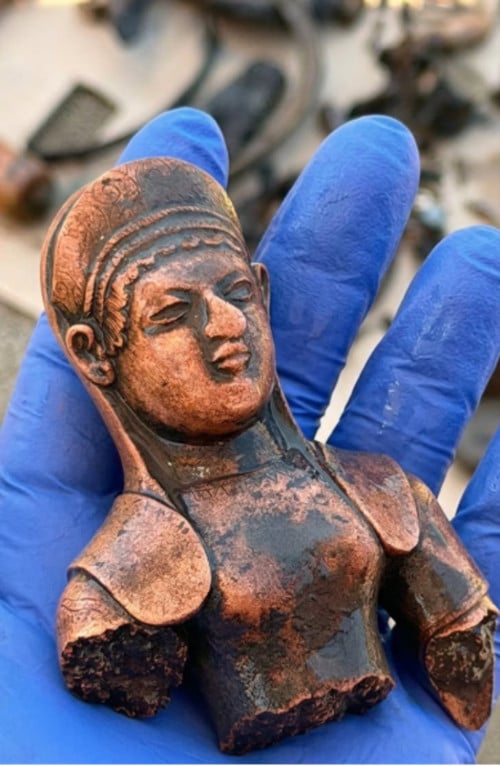
Bronze statuette of a young woman found in the well. (Museo Nazionale Etrusco di Marzabotto)
Unlocking Etruscan Foundation Rites
Professor Govi emphasized that the results of this excavation campaign significantly enrich our understanding of the foundation rites of Etruscan cities and their complex religiosity. The strategic placement of the well within the existing cultic framework of the sanctuary strengthens the undeniable connection between water veneration and urban foundation ceremonies across ancient Etruria.
The University of Bologna has been conducting continuous archaeological research at the Kainua site since 1988, gradually assembling one of the most comprehensive pictures of daily and religious life in an Etruscan city. The recent campaign was supported by a substantial grant from the Italian Ministry of Culture’s Directorate-General for Museums, allowing the excavation season to be extended. This crucial extension provided the additional time needed to bring the ritual well and its intact artifacts to light.
A Dynamic Approach to Ancient History
This extraordinary discovery arrives at a pivotal moment for the National Etruscan Museum of Marzabotto (MNEMA), which recently reopened following a major renovation. The museum has embraced a new identity as a dynamic cultural laboratory, moving away from static historical collections to connect more closely with ongoing fieldwork. Museum director Denise Tamborrino plans to incorporate the newly discovered artifacts into the exhibition as soon as scientific analysis and conservation permit.
This innovative approach will offer visitors a rare opportunity to witness an active excavation process in near real-time. As restoration work on the bronze statuettes and plate continues, the Kainua ritual well stands as a vital reference point for understanding how the enigmatic Etruscans sanctified water, celebrated the founding of their cities, and ritually closed structures that had fulfilled their sacred purpose.
Top image: Two bronze statuettes and a rare bronze plate recovered from the well, remarkably preserved after 2,500 years underground. Source: Bronze artifacts found in the ritual well. Source: Museo Nazionale Etrusco di Marzabotto
By Gary Manners
References
Arkeonews. 2026. Bronze Votive Offerings to Goddess Uni Found in Ancient Etruscan Well at Kainua, Near Bologna. Arkeonews. Available at: https://arkeonews.net/bronze-votive-offerings-to-goddess-uni-found-in-ancient-etruscan-well-at-kainua-near-bologna/