
Blue glass set into a British chariot fitting may have begun life as Egyptian beads, according to a new Diamond Light Source report. Curators brought the 2,000-year-old bronze rein guide from Oxford’s Ashmolean Museum to an X-ray facility, where its colors told different stories. As Greek Reporter notes, the Egyptian glass may reveal Iron Age Britain’s wider connections. Its proposed origin comes from the glass’s composition, not a recorded journey or an identified Egyptian workshop.
- Why Did Iron Age People Bury a Chariot and Two Horses?
- 2,500-Year-Old Celtic Chariot Proves Iron Age Links with Mainland Europe

The 2,000-year-old bronze rein guide from Oxford’s Ashmolean Museum. (Diamond Light Source)
A Rein Guide Under the X-Rays
The subject of this study is a terret, a circular device which helped the driver of a chariot to guide the reins at the neck of the horse. It belongs to the period between 50 BC and 75 AD, which encompasses the events associated with the Roman invasion of Britain in 43 AD. With the aid of the bright red and blue glass inlays, the terret definitely stands out. Other decorative components of chariots found in Leicestershire demonstrate the degree of sophistication of the techniques which British craftsmen applied in manufacturing chariots.
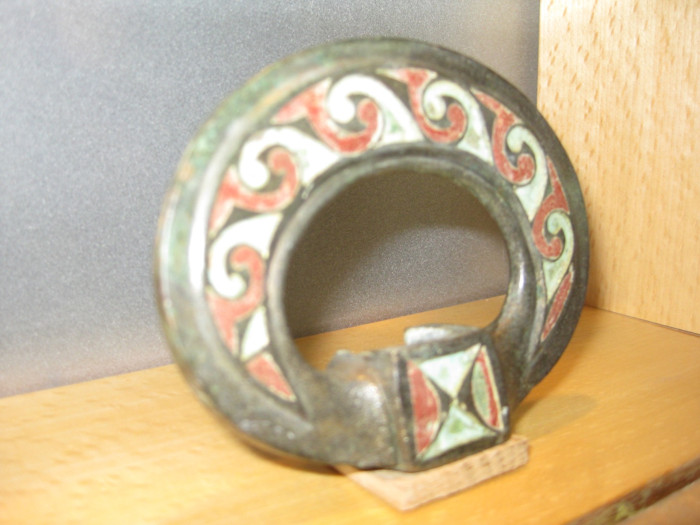
Another enameled Romano-British rein-guide ring, made in Britain and found in France; not the Ashmolean fitting. (Tyssil / CC BY-SA 3.0)
In late 2025, the curators of Ashmolean Museum brought the terret to Diamond center for analysis. The analysis was conducted using the I18 microfocused beamline map the elements of the colored inlays. The study found copper to be the main metal used for producing the solid terret structure, with a significant contribution of lead as well. The presence of lead in the red glass was found to be remarkably high.
- Scientists Prove Rome’s Ancient Glass Was Not From Rome!
- The Beautiful and Complex Artisanship of Glass-making in the Ancient World
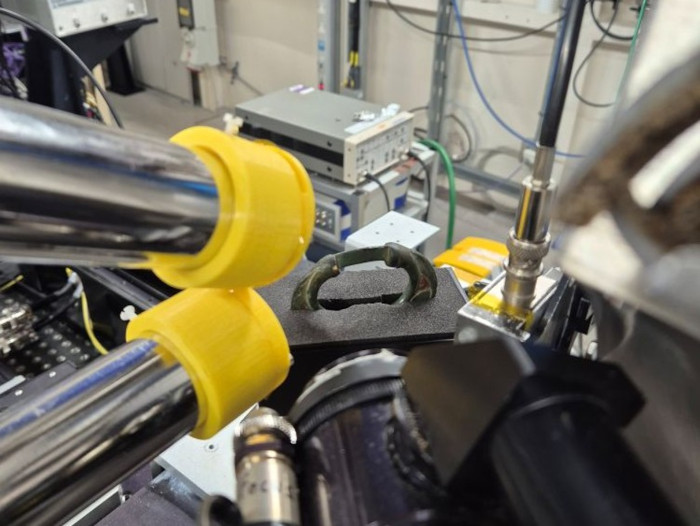
Setting up the terret at I18's microfocus beamline. (Diamond Light Source)
Egyptian Glass, British Craft
The blue glass was different. Researchers found an iron-rich elemental signature with smaller amounts of copper, unlike the lead-rich red inlay. Diamond’s team argues that its composition rules out manufacture in Britain and proposes Egyptian beads reworked into the fitting as the likeliest explanation. Their interpretation puts Egyptian glass in Britain, without tracing the people or markets through which it traveled.
The colors were found on the same object but apparently had very different histories. Red glass resembled a kind used in Britain from Middle Iron Age to the first century AD, while the blue had origins from afar. This analysis could not provide information on who the beads from this era belonged to, their route or their arrival to Britain before or after 43 AD.
The decision to use different colored glass in a reins guide appears intentional but the analysis is unable to determine the reason. Its possible Egyptian origin does not point toward the creator being Egyptian. The journey belongs to a blue piece of material rather than a whole chariot. The workshop and the route remain a mystery.
The Story a Small Fitting Can Tell
Its broad date makes the fitting a witness to change, not a timestamp for one journey. An ornate shield from a British chariot burial shows the quality of vehicle-associated craftsmanship, though this terret is not reported as a burial find. Later glassmaking workshops in the eastern Mediterranean illuminate production elsewhere, not this inlay’s source. Here, local craft appears to have incorporated far-traveled Egyptian glass.
For beamline scientist Susan Nehzati, sharing the analysis with museum visitors matters too. “The public are integral to the scientific process and play a vital role in shaping future discoveries,” she said in Diamond’s report. The terret is on view in the Ashmolean’s Harnessing Power display in its Conservation Gallery. A rein guide that is easy to overlook has made the reach of Iron Age craftsmanship harder to ignore.
Top image: The 2,000-year-old bronze rein guide from Oxford’s Ashmolean Museum. Source: Diamond Light Source
By Gary Manners
References
Diamond Light Source. 22 September 2026. Diamond’s I18 beamline unlocks new insights into Iron Age craftmanship. Available at: https://www.diamond.ac.uk/Home/News/LatestNews/2026/Diamond-s-I18-beamline-unlocks-new-information-about-Iron-Age-craftmanship.html
Diamond Light Source. n.d. Welcome to I18 — The Microfocus Beamline. Available at: https://www.diamond.ac.uk/Instruments/Spectroscopy/I18.html
Zahid, N. 23 September 2026. Ancient Egyptian Glass Found on 2,000-Year-Old Chariot Artifact in Britain. Available at: https://greekreporter.com/2026/09/23/egyptian-glass-britain-chariot/