
A wall painting from the Roman Age discovered in Northern Italy has revealed a surprising secret: its creators blended the Egyptian blue into the plaster itself, rather than simply painting on its surface. This process established a pale and smooth base for the marine scene then painted on it, and may have made the accomplishment of the decoration an easier task. The discovery exposes a Roman painting technique that had remained concealed within the wall for nearly 2,000 years.
The finding comes from roughly 50 fragments unearthed at the Roman villa of Torre di Pordenone in Friuli-Venezia Giulia. According to the original study published in Archaeometry, the fragments likely came together to form a painted fishpond populated by mullets, octopuses, scorpionfish and lobsters between the late first century and the first half of the second century AD. The scientific testing they conducted revealed that the scene’s blue base was built into its finishing plaster from the start.
- Pompeii's Blue Walls: The Lavish Cost of a Prized Pigment
- 'Virgin' Frescoes Return to the Light at Nero's Wife's Villa
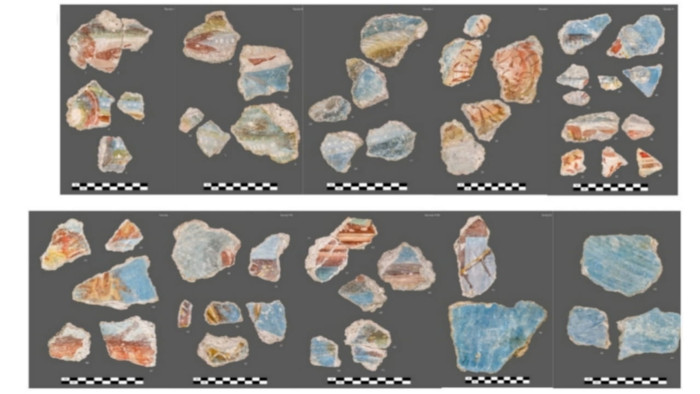
Some of the wall painting fragments constituting the “fishpond” decoration of Torre di Pordenone that have led to the findings. (S. Dilaria et al./ Archaeometry)
A Fishpond Preserved in Fragments
The pieces originated from secondary debris in Sector 2, a riverside belvedere overlooking the Noncello River. The pieces are reminiscent of the taste for painted fishponds and Nilotic landscapes. Comparisons with Rome, Brescia and Pompeii have helped to propose a dating of the paintings. Other relevant examples like Roman frescoes found in Arles have shown that even fragmentary walls offer intricate details of how elite interiors looked.
To analyze the selected fragments of the paintings, the researchers used optical microscopy, X-ray diffraction, scanning electron microscopy, Raman spectroscopy, and micro-X-ray fluorescence. These methods made it possible to identify the presence of cuprorivaite—the crystalline mineral responsible for Egyptian blue color—on the colored surface as well as in the thin layer of intonachino. Multiple techniques therefore pointed to the same material and ruled out a misleading result from a single instrument.
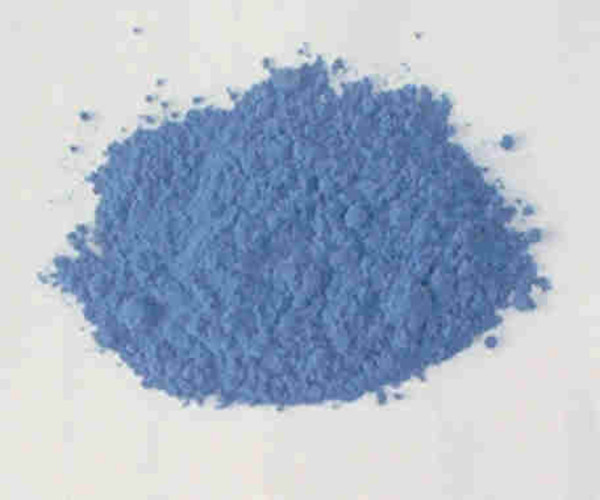
Egyptian blue pigment, the synthetic calcium-copper silicate identified throughout the Roman mortar layer. (FK1954 / Public Domain)
Blue Grains Buried Millimeters Deep
The most persuasive proof was depth. Cuprorivaite could be seen 1.5 millimeters below the upper layer through electron microscopy; in Raman testing, it reached more than 2 millimeters in depth and was located even as deep as 3 millimeters according to X-ray maps. Ordinary use of fresco pigment may only penetrate about 0.1 – 0.15 millimeters, which means that application in the surface layer cannot be the reason why grains were found at such a depth in the mortar.
The authors reached the conclusion that artisans mixed Egyptian blue together with lime and aggregates before applying the plaster. The article describes Torre di Pordenone as “a very rare example in the published record”, although peculiar applications are known when Egyptian blue was hidden under the layers of different colors, for example, in Roman mummy portraits. Micro-XRF mapping showed that blue pigments may constitute up to 5% of the studied layer.
- Stunning Roman Shrine With Rare Blue Paint Uncovered in Pompeii
- Large Egyptian Blue Ingot Recovered from Nero's Imperial Palace
An Ancient Pigment Used Differently
According to the Getty’s history of Egyptian blue, this pigment is a calcium-copper silicate made by heating quartz or sand, lime, copper-containing material and an alkali flux. This product, created in Egypt over 5,000 years ago, became very popular and was made as far away as Roman Italy, as indicated by its use in Hadrianic frescoes located below the Baths of Caracalla.
In Torre, the difference is not so much in the fact that this pigment is used as in that it has been used in the mortar itself. The technique of using colored mortar was common at that time; however, natural pigments such as red ocher were more commonly used in this manner.
Local Stone, Imported Know-How
The formulation of the plaster consisted of the combination of the synthetic blue with crushed regional limestone. Unlike the fine sparry calcite used for prestigious finishes, this is a more practical and economic solution. This useful combination of the well-known pigment and common material is similar to the technical options that can be found in Roman wall plaster discovered in London and preserved frescoes from the Roman period in Ashkelon. The case study shows how the decorators of that time were able to use the known materials for particular sites.
The researchers caution that one villa cannot establish how widespread the method was. They now recommend examining other blue fishponds, garden scenes and Nilotic paintings to determine whether Torre was truly exceptional or whether more Egyptian blue remains hidden inside Roman plaster. Either outcome would deepen the story of how ancient craftspeople managed color, labor and materials.
Top image: Representative part of wall painting from Room E, Baths of the Port of St Paul (Pietra Papa) Rome, 2nd century AD. Source: ArchaiOptix/CC BY-SA 4.0
By Gary Manners
References
Archaeology Magazine Staff. 13 September 2026. Rare Roman painting reveals an unusual use of Egyptian blue. Available at: https://archaeologymag.com/2026/09/roman-painting-reveals-unusual-use-of-egyptian-blue/
Dilaria, S., Sbrolli, C., Becker, H., Asscher, Y., De Zotti, A. and Salvadori, M. 8 September 2026. An Uncommon Instance of Egyptian Blue in the “Pigmented Intonachino” of the Fishpond Wall Painting From the Roman Villa of Torre di Pordenone (Northeast Italy ). Archaeometry. Wiley. Available at: https://doi.org/10.1111/arcm.70215
Thiboutot, G. 2020. Egyptian Blue in Romano-Egyptian Mummy Portraits. Getty Publications. J. Paul Getty Museum. Available at: https://www.getty.edu/publications/mummyportraits/part-one/5/