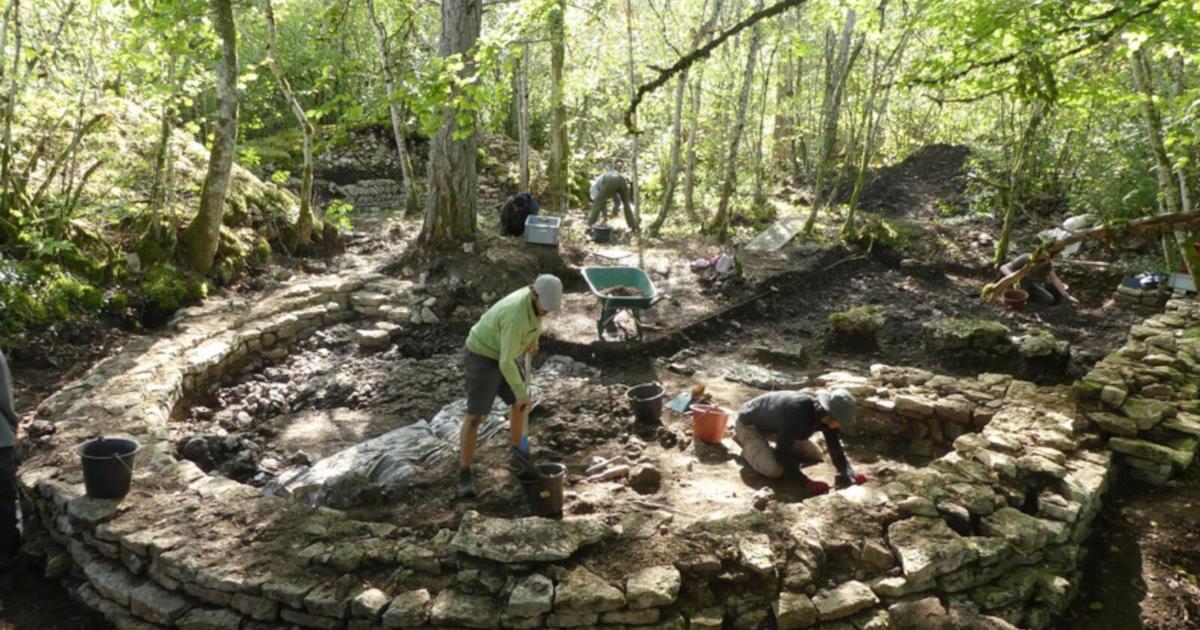

Archaeologists have uncovered an early medieval palace complex on a wooded hilltop near Dijon, revealing how wealthy communities in Burgundy maintained Roman-style comforts long after the western Roman Empire had fallen. The discoveries at Montagne de Saint-Laurent include a substantial church, carefully planned stone buildings and an underfloor heating system. Together, they point to a regional center where religious authority, elite residence and political power were closely connected.
A church at the center of the complex
According to Inrap’s account of the excavation, the site lies at Mesmont, around 20 kilometers west of Dijon, overlooking the Ouche valley. Research began in 2019, while a new three-year program launched in 2026 focuses on the highest part of the plateau, where the emerging buildings form an orderly complex of several hundred square meters. Independent accounts from La Brújula Verde and Heritage Daily likewise describe a high-status early medieval center, while cautioning that the precise identity of its occupants remains unknown.
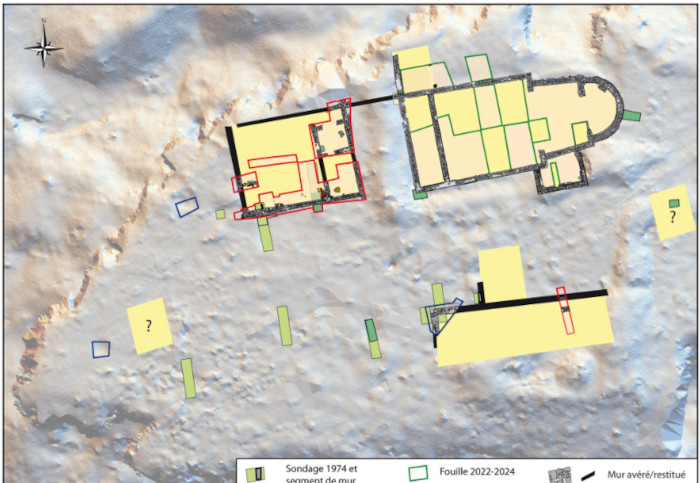
General map of the remains of the medieval palace complex revealed by Lidar. (© M. Thivet, J. Berthet et A. Guicheteau /Inrap)
The church, first identified in the 1970s and excavated between 2019 and 2024, measures 27.5 meters long and 12.4 meters wide. A chancel screen and the possible foundations of a liturgical bench helped archaeologists identify it as a place of worship, while a room along its southern side may have served as a presbytery annex. Its scale is a reminder that Christian buildings were central to the organization of power in the period, as seen in discoveries such as a Merovingian-era sarcophagus in France.
- “Astounding” 1000-year-old Medieval Castle Excavated in France
- The Fascinating History of Medieval Castles: From Emergence to Obsoletion
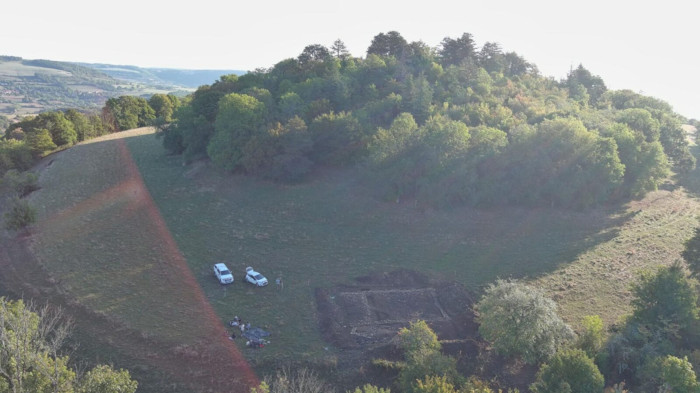
Aerial view of a large sixth- to seventh-century building excavated at Montagne de Saint-Laurent in Mesmont, France. (J. Berthet and A. Guicheteau / Inrap)
Roman comfort after Rome
West of the church, the 2026 campaign exposed a masonry building measuring 15 by 12 meters. Its thick walls and high-quality mortar suggest that it may once have supported an upper floor, while another structure south of the church extends for more than 20 meters. The strict alignment of these buildings, together with the church, gives the site an architectural coherence unusual for a settlement that is still being reconstructed.
Archaeologists also found pilae, pipe fragments and sections of suspensura—the raised concrete floor of a hypocaust. Heated air would have circulated beneath the floor, a technology associated with Roman baths and elite residences; Ancient Origins has previously explained how hypocaust heating worked. The installation required specialist craftsmen and considerable investment, suggesting that the occupants could afford a level of comfort far beyond that of most early medieval households.
- 2000-Year-Old Roman Villa Found in Germany had Luxurious Underfloor Heating
- Who Said Ancient People Had it Tough? Luxury Homes and Underfloor Heating Were a Part of Life in the Roman Province of Britannia
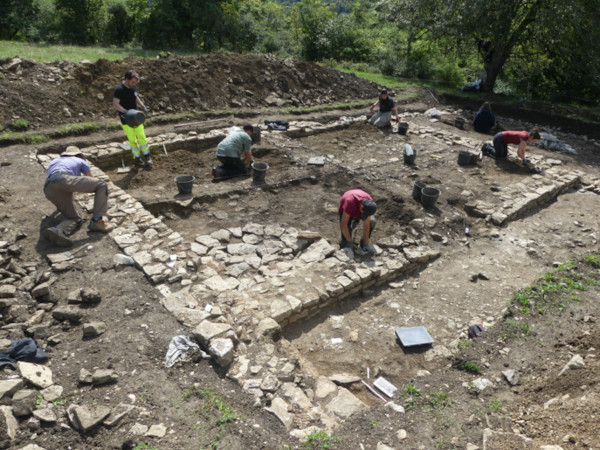
Excavation of the building’s probable kitchen on the plateau in 2024. (A. Guicheteau / Inrap)
A powerful settlement with unanswered questions
Pottery, including terra sigillata made in the Argonne region, and radiocarbon analysis place construction in the fifth century, with occupation continuing until the beginning of the eighth century. More than 500 fragments of glass have been recovered since 2019, including about 50 pieces of flat glass that may have belonged to the church’s windows, as well as lamps and tableware associated with privileged households. This picture fits the wider evidence for Merovingian communities in France, when older Roman traditions were being adapted to new political and religious realities.
Medieval texts identify Mesmont as the center of the pagus magnimontensis, a territorial district belonging to the episcopal city of Langres. The site is also linked to the influential Gregorii family and to Saint Antide, whose relics were reportedly transferred to Brescia in the ninth century, perhaps reflecting Mesmont’s decline as regional importance shifted towards Sombernon. The changing political landscape can also be compared with the later rise of the Carolingian Dynasty. As Medievalists.net reports, further excavation, geophysical survey and LiDAR mapping will be needed to establish exactly who lived in the complex and how its buildings functioned.
Top image: The apse and choir of the early Christian church at Montagne de Saint-Laurent during excavations in 2022. Source: A. Guicheteau / Inrap
By Gary Manners
References
Altuntaş, L. 2026. 1,500-Year-Old Palace With Roman Heating System Discovered on a Hilltop in France. Available at: https://arkeonews.net/1500-year-old-palace-with-roman-heating-system-discovered-on-a-hilltop-in-france/
García, A. 2026. A Large Palace has been Discovered Atop a Hill in France, where a Senatorial Family Continued to Live “in the Roman Style” in the Early Middle Ages. Available at: https://www.labrujulaverde.com/en/2026/10/a-large-palace-has-been-discovered-atop-a-hill-in-france-where-a-senatorial-family-continued-to-live-in-the-roman-style-in-the-early-middle-ages/
Inrap. 2026. Un palais sur la Montagne de Saint-Laurent à Mesmont (Côte-d’Or ) ? Available at: https://www.inrap.fr/un-palais-sur-la-montagne-de-saint-laurent-mesmont-cote-d-or-20983
Medievalists.net. 2026. Archaeologists Uncover Early Medieval Palace Complex in France. Available at: https://www.medievalists.net/2026/10/archaeologists-uncover-early-medieval-palace-complex-in-france/
Milligan, M. 2026. Archaeologists uncover early medieval palatial complex in France. Available at: https://www.heritagedaily.com/2026/10/archaeologists-uncover-early-medieval-palatial-complex-in-france/159662