

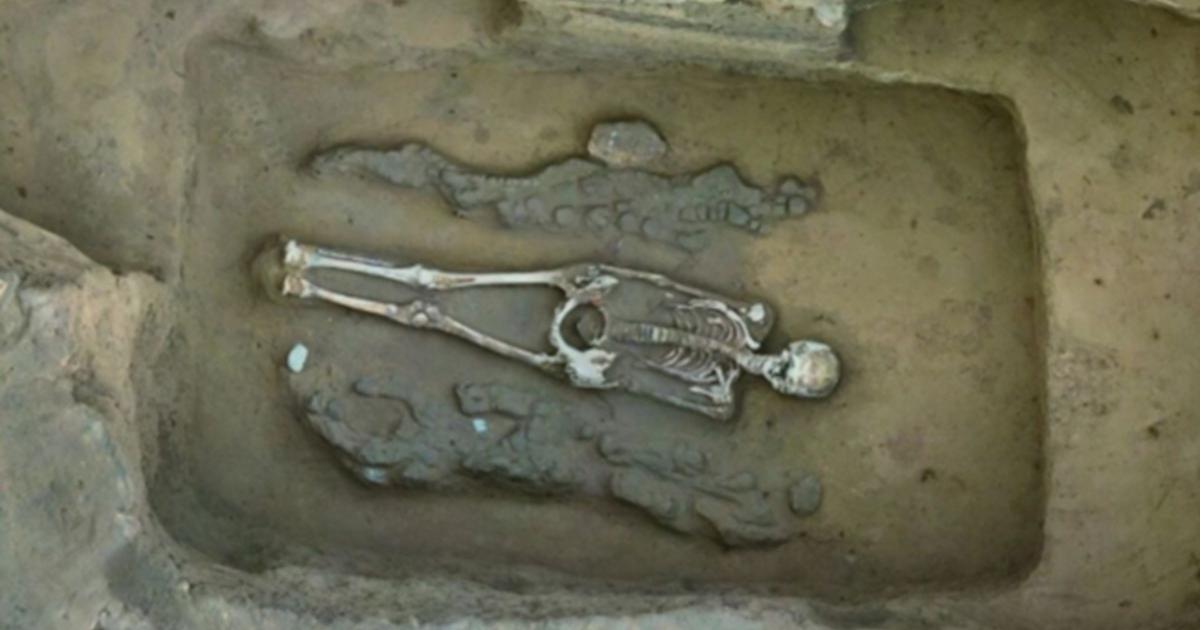

Archaeologists in Inner Mongolia have uncovered the earliest clearly recognizable pairing of dragon and phoenix figures yet found in northern China. The clay figurines came from a 4,300-year-old tomb at the Zhaizita Stone City site in Jungar Banner, Ordos City. Radiocarbon dating places the burial around 2300 BC, during the middle-to-late Yongxingdian Culture within the broader Longshan cultural horizon.
The rectangular earthen-pit tomb contained an individual buried face-up with limbs extended and head oriented northeast. A turquoise-inlaid jade bi disc lay beside the right side of the neck. On either side of the body, excavators found carefully positioned clay sculptures: a dragon-shaped figure on the right, aligned with the deceased’s head, and a phoenix-shaped figure on the left, rendered in a soaring or rising posture. The symmetrical arrangement creates a balanced ritual composition around the burial.
According to Global Times, Sun Jinsong, head of the Inner Mongolia Institute of Cultural Relics and Archaeology, described the find as highly significant:
“This is the earliest and most clearly defined dragon-phoenix combination found in northern China so far. It pushes back the materialized representation of dragon and phoenix to the Longshan era,” he said.
No earlier discovery in the region has provided such a clearly defined physical pairing of the two forms.
- Ancient Chinese Mythology: Dragons and Phoenixes
- Neolithic Cultures of Northern China and Early Civilization
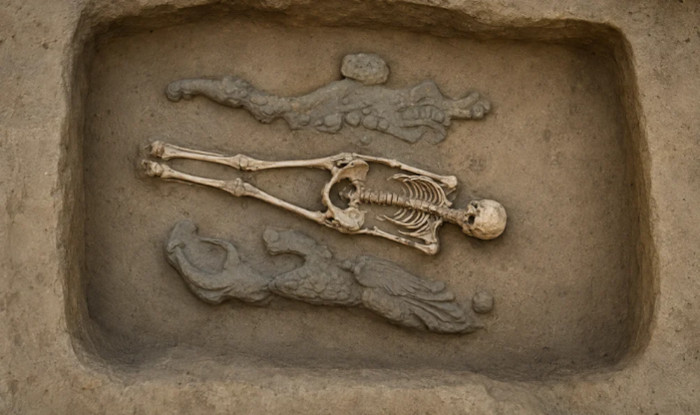
Enhanced image of the dragon and phoenix burial found in tomb M38 at the Zhaizita stone-walled site in North China's Inner Mongolia Autonomous Region. (Inner Mongolia Institute of Cultural Relics and Archaeology)
High-Status Burial and Ritual Symbolism
Based on stable isotopes, the occupant's diet was mainly based on millet-based agriculture but had significantly higher quantities of animal protein (or other high-status food items). The jade piece and the deliberate arrangement of the figurines suggests that this person had a high rank in society. The Zhaizita site itself is a large settlement of stone walls covering an area of approximately 420,000 m2, which represents the development of fortified settlements and specialization in craft production and more complex social and ritual structures throughout northern China during the late Neolithic period.
The dragon and phoenix have always played an important role in Chinese culture, with their symbolism taking on many forms over time. They were associated with the emperor's authority, the harmony between yin and yang, and the chance of success. Their appearance together within a funerary setting as far back as 4000 years ago gives us an insight into how these meanings began to take shape prior to the emergence of the first dynastic states of China.
- Largest Jade Dragon Unearthed at Hongshan Culture Mound
- Hongshan Culture and the Origins of Chinese Dragon Symbolism
The discovery adds an important northern Chinese reference point to the longer history of these motifs. Earlier jade carvings from the Hongshan culture (roughly 6500–5000 years ago) already featured dragon-like forms, yet the Zhaizita pairing is the first clear physical combination of dragon and phoenix in the region.
Insights into Longshan Beliefs
The research team interprets the position of the symbolic creatures in relation to the remains to demonstrate a relationship between the animals, with death, status and spiritual afterlife beliefs. The phoenix’s soaring pose and the dragon’s alignment with the body suggest intentional ritual meaning rather than random decoration. All of this has provided significant insight into the spirituality of the Longshan community at a time when larger settlement patterns and more hierarchical communities were beginning to emerge in the overall cultural area surrounding the Yellow River.
Further study of the figurines, the jade disc and the settlement context will help clarify how these symbols evolved and spread. For now, the Zhaizita tomb provides the earliest tangible proof that the iconic dragon-phoenix pairing was already meaningful in northern China by around 2300 BC.
The excavation was carried out by the archaeological team of the Inner Mongolia Institute of Cultural Relics and Archaeology. Official reports emphasize that the discovery enriches understanding of early Chinese civilization’s pluralistic yet unified development and supplies valuable material for research into Longshan-period spiritual beliefs and burial practices.
Top image: The dragon and phoenix burial found in tomb M38 at the Zhaizita stone-walled site in North China's Inner Mongolia Autonomous Region. Source: Xinhua News Agency
By Gary Manners
References
Arkeonews. 2026. 4,300-Year-Old Tomb in Inner Mongolia Reveals Earliest Known Dragon-Phoenix Pairing in Northern China. Available at: https://arkeonews.net/4300-year-old-tomb-in-inner-mongolia-reveals-earliest-known-dragon-phoenix-pairing-in-northern-china/
Chen, X. 2026. Rare dragon-phoenix clay relics found in 4,300-year-old tomb in Inner Mongolia. Global Times. Available at: https://www.globaltimes.cn/page/202608/1368098.shtml
Sun, J. et al. (Inner Mongolia Institute of Cultural Relics and Archaeology). 2026. Reports on Zhaizita Stone City tomb M38. Available via official channels such as http://www.goinnermongolia.com.cn/2026-08/13/c_1205453.htm






















