

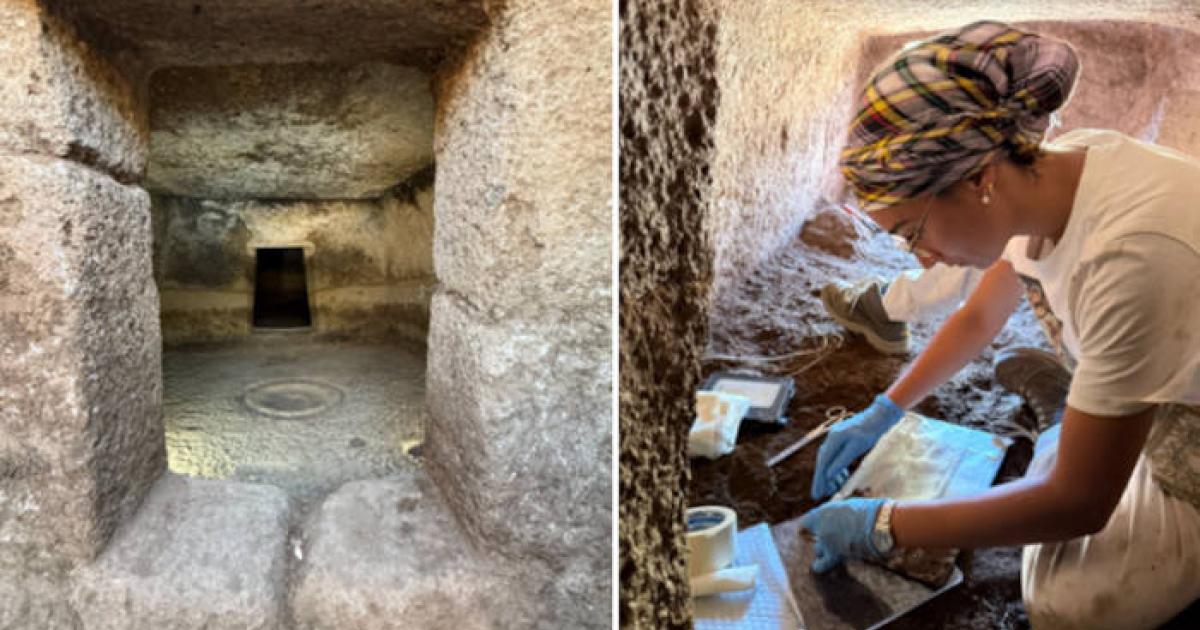

Archaeologists have made a remarkable discovery at the Sant'Andrea Priu archaeological complex in Bonorva, Sardinia, unearthing three previously unknown domus de janas that add significantly to our understanding of Neolithic funerary practices in the region. The discovery, which brings the total number of known ‘hypogea’ at the site to 20, represents a major breakthrough in the study of these enigmatic prehistoric burial chambers that have fascinated researchers for generations. These newly found "fairy houses," as they are known locally, contain numerous significant artifacts currently undergoing detailed analysis by specialists.
The excavation was conducted as part of a comprehensive Ministry of Culture project focused on the excavation, restoration, and enhancement of the Meilogu territory. This discovery gains additional importance following the recent UNESCO World Heritage Site inscription of Sardinia's domus de janas serial site in July 2025, acknowledging their outstanding universal value to humanity, reported Unione Sarda.
Thedy note that Bonorva boasts two of the seventeen necropolises inscribed on the prestigious UNESCO list: Sant'Andrea Priu and Sa Pala Larga.
- 6,000 Year Old Neolithic Burial Mounds were Later Used for Ritual Sacrifice!
- Neolithic Burial Mound Uncovered Near Stonehenge
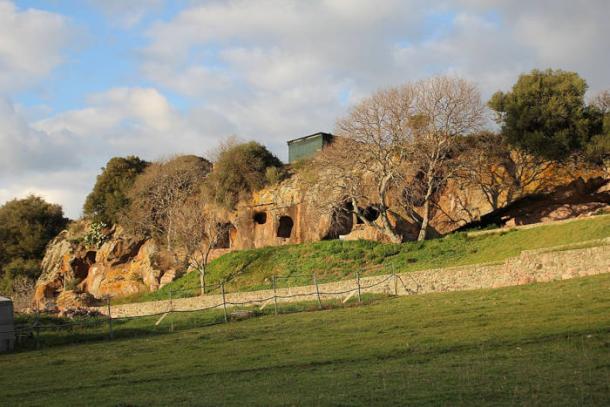
Sant'Andrea Priu necropolis showing the rocky landscape where three new domus de janas were discovered, carved into the hillside plateau near the distinctive "Campanile" formation. (Gianni Careddu/CC BY-SA 4.0)
Strategic Archaeological Investigation Reveals Hidden Chambers
The breakthrough came when archaeologists recognized promising terrain characteristics between the previously known Tomb XII and Tomb XIII, the latter famously called the "Tomb of the Hearth." The geological features of this plateau area, situated near the distinctive worked rock formation known as "Campanile" or "Toro," suggested the presence of unexplored burial chambers. This methodical approach to archaeological investigation demonstrates how careful observation of landscape features can lead to significant discoveries at well-studied sites.
The three newly identified tombs, designated XVIII, XIX, and XX, are arranged in a distinctive fan-shaped pattern radiating from the Tomb of the Hearth. This spatial organization provides valuable insights into the planning and social organization of the Neolithic communities that created these elaborate burial complexes between the 5th and 3rd millennia BC.
- 'Polish Pyramids': 5500-Year-Old Megalithic Tombs Found
- Mystifying Megaliths: Knowth, Keeper of Ancient Tombs
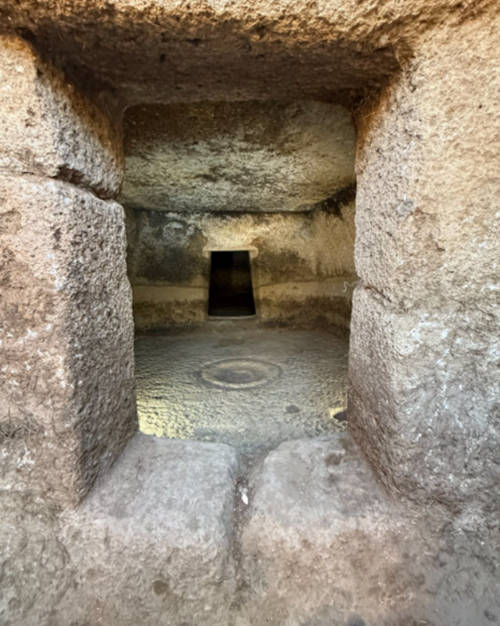
Tomb XVIII, with clean cut rock corridor, entrance chamber, and hearth. (Soprintendenza Sassari e Nuoro)
Remarkable Architectural Features and Rich Artifact Collections
Each of the three newly discovered tombs exhibits unique architectural characteristics that reflect the sophisticated burial practices of their Neolithic creators. Tomb XVIII, the first to be identified during the excavation, features an impressively clean-cut dromos (corridor) carved directly into the living rock. Archaeological investigation of this chamber yielded an exceptional collection of artifacts including stone pickaxes, a small greenstone axe, a spindle whorl, and numerous obsidian fragments that speak to the daily lives and technological capabilities of the ancient inhabitants.
The tomb's internal structure reveals careful planning, with a quadrangular entrance chamber containing a centrally located hearth carved in relief with an accompanying central cavity. This architectural feature connects to the main rectangular burial chamber, while a smaller third chamber branches off to the left side. These design elements suggest that the domus de janas served not merely as simple burial sites but as complex ritual spaces that may have facilitated ongoing connections between the living and the dead.
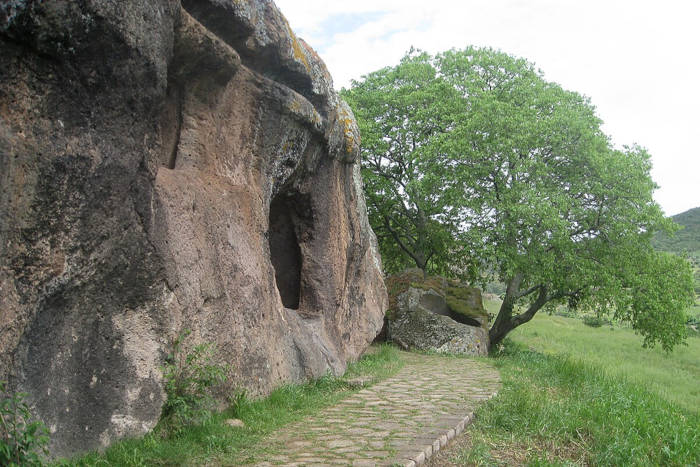
Carved entrance detail at Sant'Andrea Priu necropolis, showing the precision of Neolithic stonework. (Gianni Careddu/CC BY-SA 4.0)
Tomb XIX presents a more compact design, significantly smaller than its neighboring chambers but no less intriguing in its construction. The tomb features a small external pavilion that leads into a rectangular internal chamber, from which a second, rounded chamber opens like an architectural niche. Despite its smaller size, this tomb yielded important artifacts including obsidian fragments and ceramics, most notably a miniature vase that may have held particular ritual significance for the burial ceremonies conducted within these sacred spaces.
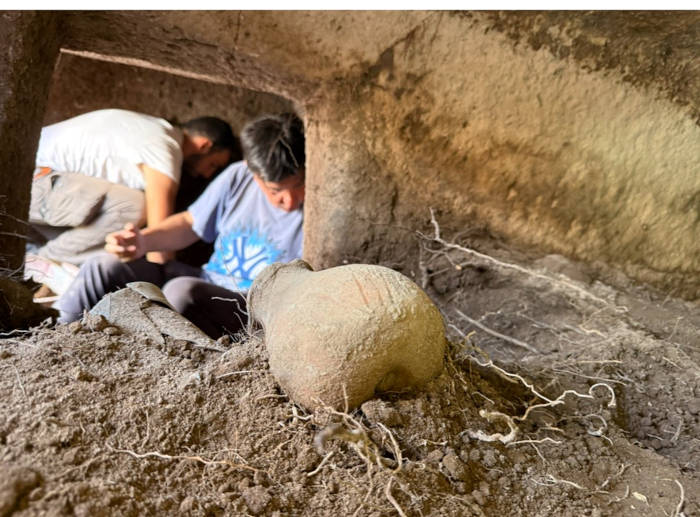
Dr. Franco Campus and Marco Campus pictured during the excavation. (Soprintendenza Sassari e Nuoro)
The 'Tomb of Roman Vases' Reveals Cultural Continuity
The most architecturally complex of the three discoveries, Tomb XX has been dubbed the "Tomb of the Roman Vases" due to its extraordinary collection of imperial-era funerary objects. This remarkable chamber system features an entrance chamber from which two lateral branches extend, creating a total of seven interconnected chambers that demonstrate the most sophisticated spatial organization yet discovered at the site. One chamber contains painted decorative bands that represent some of the earliest known artistic expressions within the Sant'Andrea Priu complex.

A large collection of pottery and vases has been retrieved at the site. (Soprintendenza Sassari e Nuoro)
The tomb's designation as the "Tomb of the Roman Vases" reflects its rich collection of over 30 ceramic artifacts in excellent condition, evidence of the site's continued use long after its Neolithic origins. This cultural continuity, spanning thousands of years from prehistoric times through the Roman period, illustrates how these sacred spaces maintained their significance across different civilizations. The exceptional preservation of these Roman-era objects provides archaeologists with unique insights into how later cultures adapted and reused these ancient burial sites for their own funerary practices.
Preservation and Future Archaeological Research
The artifacts recovered from all three tombs are currently undergoing conservation treatment at the Restoration and Conservation Centre of the Superintendency in Li Punti, where specialists will conduct detailed analysis to better understand their historical and cultural significance. The new tombs will be immediately accessible to visitors, adding to the site's value as both a research facility and tourist destination that helps preserve and share Sardinia's remarkable prehistoric heritage.
Archaeological research will continue in the lower sections of the Sant'Andrea Priu site, where evidence indicates a Roman and early medieval settlement once flourished. This ongoing investigation is part of a larger €2 million enhancement project funded by the Ministry of Culture, managed by the Regional Secretariat of the Ministry of Culture for Sardinia in collaboration with the Superintendency of Archaeology, Fine Arts and Landscape for the provinces of Sassari and Nuoro. The project encompasses not only Sant'Andrea Priu but also the nearby Nuraghe Oes and Nuraghe Santu Antine, creating a comprehensive archaeological research zone that spans multiple historical periods.
Top image: Left; Tomb XVIII, with clean cut rock corridor, entrance chamber, and hearth. Right; researcher cataloguing artifacts in situ in a domos. Source: Soprintendenza Sassari e Nuoro
By Gary Manners
References
L'Unione Sarda. 2025. Three new Domus de Janas discovered in Bonorva. Available at: https://www.unionesarda.it/en/three-new-domus-de-janas-discovered-in-bonorva-avrxt0td
UNESCO World Heritage Centre. 2025. Funerary Tradition in the Prehistory of Sardinia – The domus de janas. Available at: https://whc.unesco.org/en/list/1730/





















