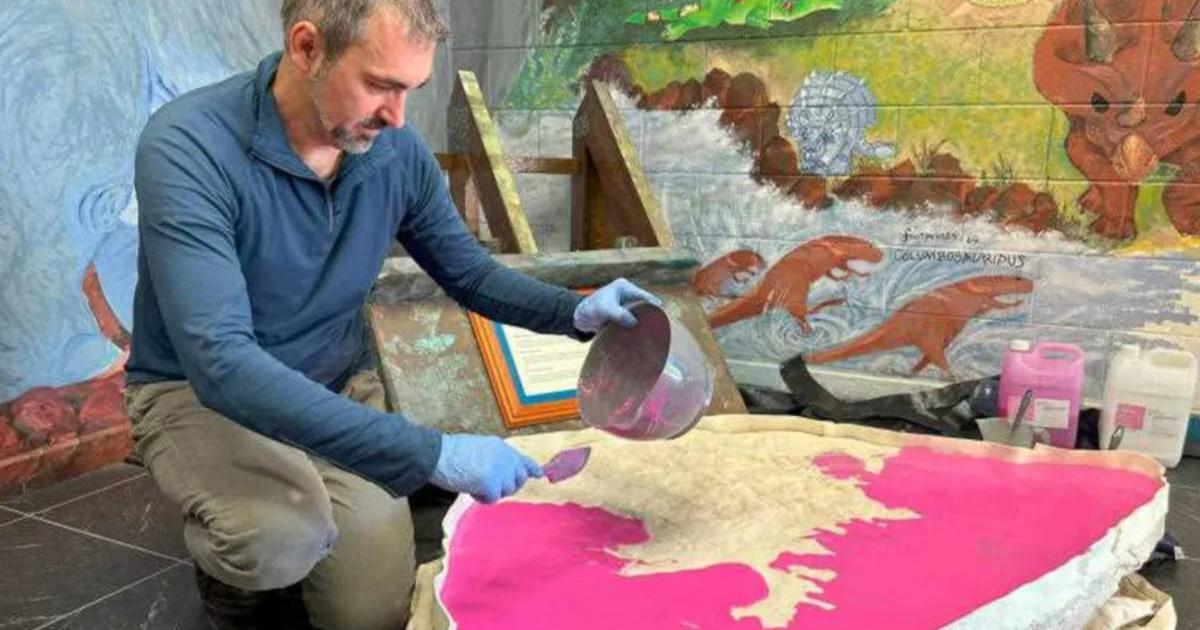

An astonishing and long-overlooked collection of fossilized dinosaur footprints has been found on a slab of rock on display inside a small-town Australian school, scientists announced recently.
Incredibly, the rock went largely unnoticed for two decades, until officials from the school in Queensland's rural Banana shire asked University of Queensland paleontologist Anthony Romilio (an active local fossil hunter) to examine the cluster of three-toed track marks that covered the surfaces of the heavy rock.
Much to his surprise and delight, Romilio discovered that the slab was covered with dozens of fossilized footprints dating to the early Jurassic period, some 200 million years ago. The rock was imprinted with "one of the highest concentrations of dinosaur footprints" ever documented in Australia, he said.
"It's an unprecedented snapshot of dinosaur abundance, movement and behavior from a time when no fossilized dinosaur bones have been found in Australia," said Romilio, in an interview published in Phys.org. "Significant fossils like this can sit unnoticed for years, even in plain sight. It's incredible to think that a piece of history this rich was resting in a schoolyard all this time."
- Dinosaur Tracks in Brazil Found to Have Petroglyph ‘Companions’
- Dinosaur Footprints of Unimaginable Age Found Romping Along England’s Coastline
An Unappreciated Gem
Coal miners dug up the magical slab of rock in 2002. After noticing the unusual footprints, they donated it to a school in the small town of Biloela, where it was eventually put on display in the school’s foyer. The rock sat there, essentially unnoticed and certainly unappreciated, until school officials got word that researchers (including Romilio) had been asking around for information about any dinosaur fossils that might have been discovered in the area. At that point, they decided to let Romilio know about what they had in their school, on the off chance that it might be something worth studying.
"Some of the teachers thought this was a replica rather than the real thing," Romilio said, with bemusement. "Everyone didn't quite realize what they actually have. They definitely knew it was a dinosaur footprint. But not the level of detail that a researcher like myself would go into."
- Scientists Find Massive Footprints, Here’s What Ancient Creatures It Belonged To
- Footprints on the Wall: Were Dinosaurs Actually Climbing the Cliffs in Bolivia?
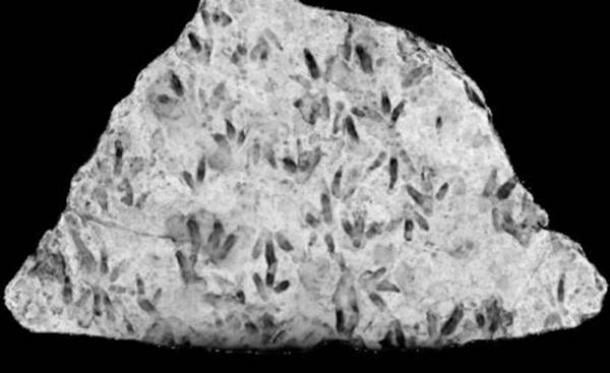
Photo from the University of Queensland displays a 3D-imaged boulder with light filters revealing dinosaur footprints. (University of Queensland)
Dinosaur Footprints, a Discovery for the Ages
Romilio said 66 separate track impressions were found on the slab, which had a surface area of less than one square meter (10.76 sq ft). They belonged to a dinosaur called Anomoepus scambu—a small and thickly-built plant eater that walked on two legs.
"Fossilized footprints, even though they are the most abundant of dinosaur fossils, tend to be cast aside by a lot of researchers,” he lamented. “They don't have the sex appeal of a fossilized bone.”
Together with colleagues, Romilio performed an extensive study of the rock and its imprints, which promise to revolutionize understanding of the movements of dinosaurs through the lands of ancient Queensland in the incredibly distant past.
“Dinosaur footprints have been reported from the Lower Jurassic Precipice Sandstone of the Callide Basin, Queensland, for over three decades, yet only a single track has been described until now, “ Romilio and his fellow researchers explained in an article about their study published in the journal Historical Biology. “This study reports additional tracks on three ex-situ surfaces not previously described. These pedal impressions are assignable to the ichnospecies Anomoepus scambus.”
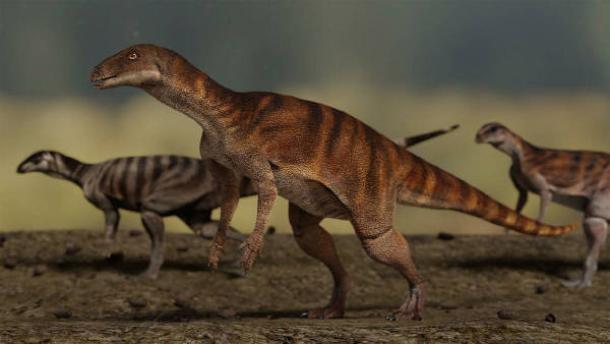
The footprints were made by Anomoepus scambus, a dinosaur that walked on two 50 cm-long legs. (Handout/University of Queensland)
The researchers found a single print on one rock surface, two tracks on a second, and a stunning 13 trackways and many more isolated prints on a third, which represents one of the most densely packed collection of dinosaur tracks found anywhere in Australia.
As the dinosaur was on the move at the time it left tracks, the researchers were able to make some determinations about its physical characteristics. They estimate that the creatures’ hip heights would have ranged from between eight and 30 inches (20 and 76 cm), and that their walking speeds would not have exceeded 3.6 miles (5.8 km) an hour.
Citizen Paleontologists Making Their Mark
According to Romilio, the way that these dinosaur tracks were found was not unusual.
"The vast majority of dinosaur fossils, they're not found by paleontologists. They're actually found by people on the ground."
What was surprising in this case was how long it took for the school where they were kept to realize they were in possession of something special.
Anecdotal evidence collected by Romilio reveals that hundreds of small dinosaur tracks were observed on the surfaces of discarded rock at a Queensland mine located near the school in Biloela. But it seems those rocks have disappeared, the treasures they held apparently discarded by mine employees with no interest in paleontology.
Meanwhile, Romilio's personal hunt for fossils in the region led to the discovery of a two-ton boulder marking the entrance to a coal mine car park.
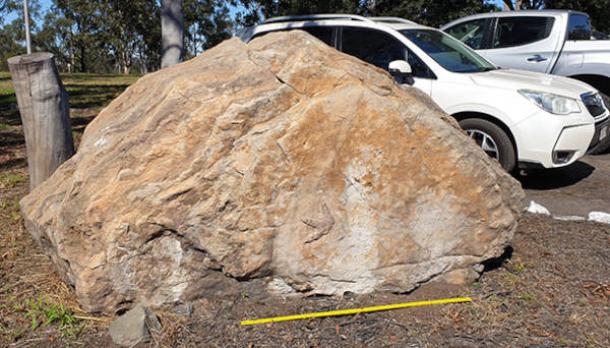
The boulder in the Callide Mine car park features two distinct dinosaur footprints analyzed by Dr. Anthony Romilio. (University of Queensland)
"As I'm driving into the car park, I see one of those car park boulders to stop cars from driving on the lawn. And it's got this clear-as-day dinosaur fossil. My jaw dropped when I saw that."
Discoveries like this show that incredible historical and prehistorical treasures are often hidden in plain sight, just waiting for the people around them to finally realize what they are.
Top image: Researcher Anthony Romilio found dinosaur footprints in a rock donated to a high school in Australia. Source: Handout/University of Queensland
By Nathan Falde