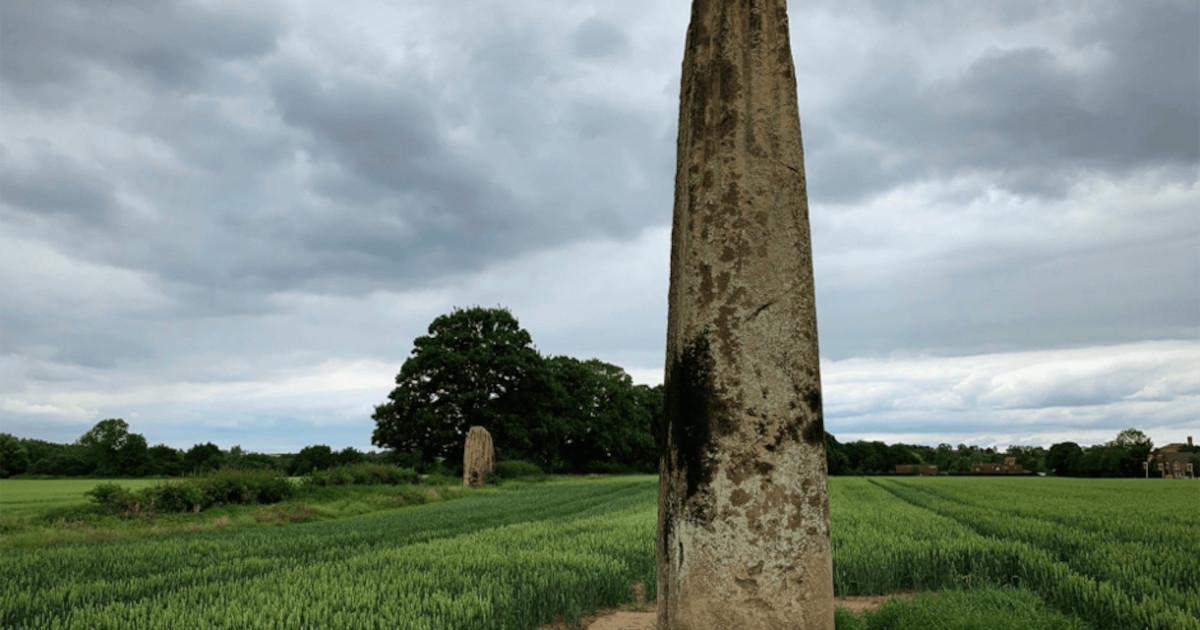

Three giant monoliths standing north of Boroughbridge in Yorkshire do not originate from the nearest rock supply. According to a new study by the Royal Society, the origin of the Devil’s Arrows can be traced to Brimham Rocks, which is located 11 miles (18 km) west of Boroughbridge, and which involved moving stones weighing 25 metric tonnes each. The study also solves a long-running geological debate as well as showing an impressive planning effort that lay in the landscape of Yorkshire for several thousand years. It also raises a more intriguing question: why was this particular stone worth the journey?
Tiny Grains Solve a Giant Stone Mystery
The three surviving Devil’s Arrows megaliths, the tallest of which stands at 6.86 meters (22.5 feet), are spaced out across a distance of 174 meters. The monument was likely constructed during the Late Neolithic or Early Bronze Age, although no modern investigation has found a specific date.
Together, the three monoliths comprise the tallest megalithic stone row in Britain, while the southernmost monolith is the second tallest in Britain after the Rudston Monolith in Yorkshire. A previous Ancient Origins article covers the topic of Devil’s Arrows in more detail, including its unusual spacing, eroded grooves and enigmatic purpose.
The researchers were not able to drill or cut the structure, as it is a protected monument, so they decided to apply 20-centimeter (8 inch) wide tape strips to the dry spots of the monument for five minutes. The tape lifted microscopic zircon and apatite grains, which were dated through uranium-lead analysis. This innovative method gives scientists the chance to study protected stone in a noninvasive way.
- Was Neolithic Stone Circle in Dorset, England the Model for Stonehenge?
- Discovery of First Standing Stone Circle in Over a Century in Dartmoor, England
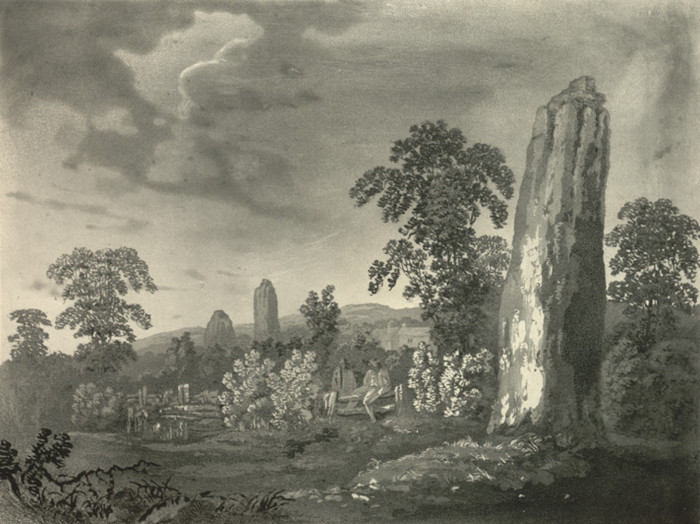
The Devil’s Arrows as depicted by I. Flintoff in 1798. (Public Domain)
Brimham Rocks Was a Deliberate Choice
Boroughbridge sits on Triassic Sherwood Sandstone, which differs in composition from the Devil’s Arrows stones that consist of the Pennine Basin Millstone Grit. The appropriate type of grit appears as close as three miles (five km) from Boroughbridge itself, while the Plumpton Rocks stone site is approximately 8 miles (13 km) away from Boroughbridge.
Historical references pointed to the Plumpton Rocks as the main source of stone for the three monoliths. However, a mineral age analysis has shown that the mineral age of all three structures resembles that of the Brimham Rocks and does not match the Plumpton Rocks.
According to the Curtin University announcement, Dr. Anthony Clarke, the lead researcher, said that the new evidence shows stones were deliberately chosen from a ‘challenging landscape 11 miles (18 km) away.’
Finally, reconstructed Ice Age flow also makes an 11 mile (18 km) glacial journey eastward from Brimham improbable, leaving human transport as the convincing explanation. So the question is, why were the rocks sourced from that particular spot?
- European Standing Stones: The Mute Witnesses of Forgotten Times
- The Neolithic Builder of the Aberdeenshire Recumbent Stone Circles
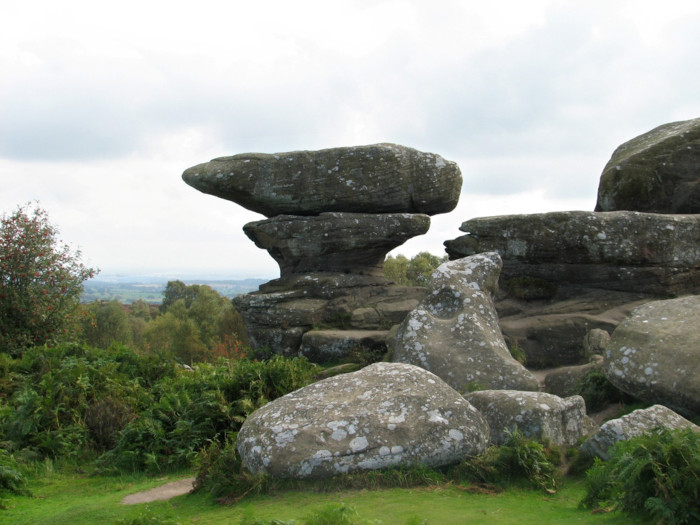
Undercut Millstone Grit at Brimham Rocks, the source landscape identified by the new analysis. (Ben Robbins/CC BY-SA 3.0)
The choice of rock source may have merged practical considerations with belief. Brimham's geological joints and bedding structure enable retrieval of long blocks of stone, and its sculptural tors also make for a remarkable otherworldly appearance, which could have been desirable.
Dr Clarke remarks in the Curtin University report:
“Each stone weighs more than 25 tonnes, so moving them would have required incredible planning, coordination and engineering skill. This tells us prehistoric people placed real importance on the landscape itself. It wasn’t just about convenience – the location the stones came from likely held meaning for them.”
This interpretation has a correlation with the evidence that far-reaching sources were important to the builders of Stonehenge as a shared monument and that specific stones of Stonehenge came from faraway places.
Possible cup-and-ring markings near Brimham and on the northern Arrow add a tantalizing, though unproven, cultural connection.
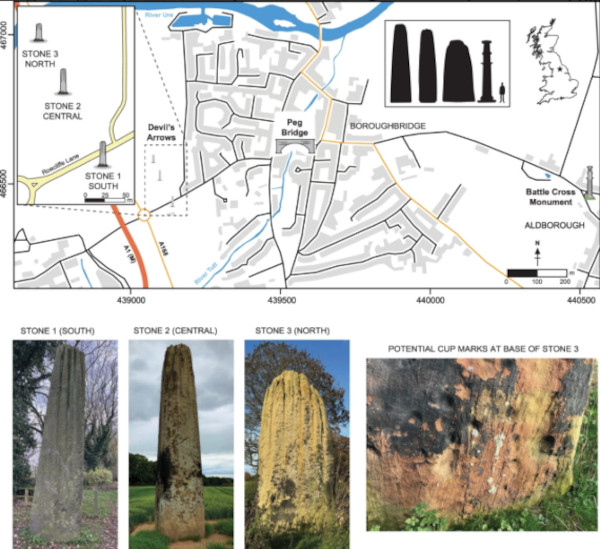
Location and appearance of the Devil’s Arrows on the western outskirts of Boroughbridge, Yorkshire. (A. Clarke et al./Proceedings. Mathematical, Physical, and Engineering Sciences)
A Missing Arrow Was Hiding in Plain Sight
The mineral results also support a historical suspicion regarding the 5.5 meters (18 feet) high Battle Cross that is situated in nearby Aldborough. Historical documents indicate that the stone row was once comprised of five monoliths that were disassembled and used in Peg Bridge and several other constructions. The Battle Cross that was probably hewn in the 15th century and meant to commemorate the Battle of Boroughbridge which took place in 1322, tested positive for zircon compatible with the surviving Arrows. The prehistoric stone may therefore have endured by acquiring an entirely new medieval identity.
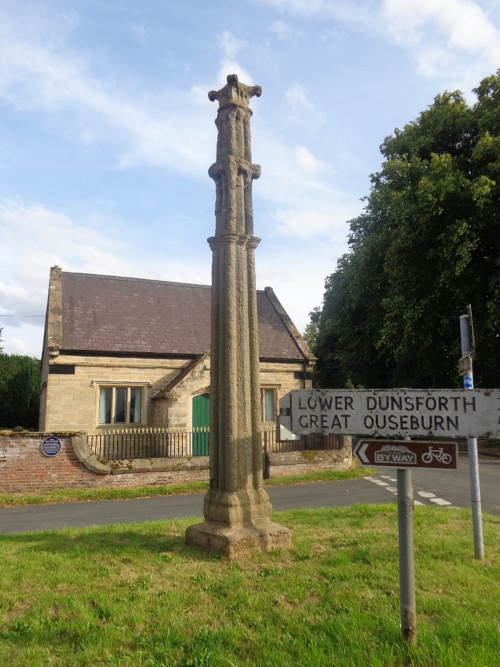
The Battle Cross at Aldborough, now supported by mineral evidence as part of a missing Devil’s Arrow. (Mtaylor848/CC BY-SA 4.0.JPG)
This discovery supports the five monolith monument biography, although it still doesn't explain its true original purpose. Some clues here are that the row points toward a possible prehistoric ford across the River Ure and also is located at the southern edge of a ceremonial zone containing seven Late Neolithic henges.
The University of York report quotes archaeologist Dr. Jim Leary:
“Megalithic architecture is among the most visually striking features of the Neolithic landscape across Britain and Ireland, from vast ceremonial complexes like Avebury and Stonehenge, to individual standing stones.
Sites in southern England and Scotland receive considerable attention, but monuments like the Devil's Arrows have remained comparatively understudied despite their significance.
We have now proved that Neolithic communities moved several 25-tonne stones 18km across Yorkshire, transforming a familiar site into an epic quest to create a sacred landscape.”
Engineering Skill and a Sacred Landscape
It is still a matter of speculation how the constructors moved the blocks weighing around 25 metric tonnes. While chains, wooden pathways, and sleds may seem possible, experiments and evidence have sparked ideas like lubricated sleds in prehistory. No transport method was examined in the study at hand, but, regardless of the system employed, a complex organization of labor, planning of the route, and method to lift each stone into its allotted foundation were necessary.
It is the ambition of researchers to apply their method of adhesive peeling to other monuments. They would also like to perform targeted excavations at Boroughbridge and Brimham Rocks. This will allow them to narrow the date of construction, discover quarrying marks and learn more about the transportation route. For now, the Devil’s Arrows stand as evidence that prehistoric engineering was inseparable from place: the destination mattered, but so did the landscape from which the stones were taken.
Top image: A Devil’s Arrow megalithic standing stone, Boroughbridge, Yorkshire. Source: Dr Jim Leary/York University
By Gary Manners
References
Clarke, A., Leary, J. and Kirkland, C. 2026. Deliberate prehistoric sourcing of the Devil’s Arrows, Britain’s tallest stone row. Proceedings of the Royal Society A, 482(2345), 20260504. The Royal Society. Available at: https://doi.org/10.1098/rspa.2026.0504
Curtin University. 2026. Prehistoric builders hauled 25-tonne stones 18km to build Britain’s tallest stone row. Available at: https://www.curtin.edu.au/news/media-release/prehistoric-builders-hauled-25-tonne-stones-18km-to-build-britains-tallest-stone-row/
University of York. 2026. Neolithic ‘Devil’s Arrow’ stones travelled 11 miles across Yorkshire, study reveals. Available at: https://www.york.ac.uk/news-and-events/news/2026/research/neolithic-devils-arrow-stones-travelled-miles/