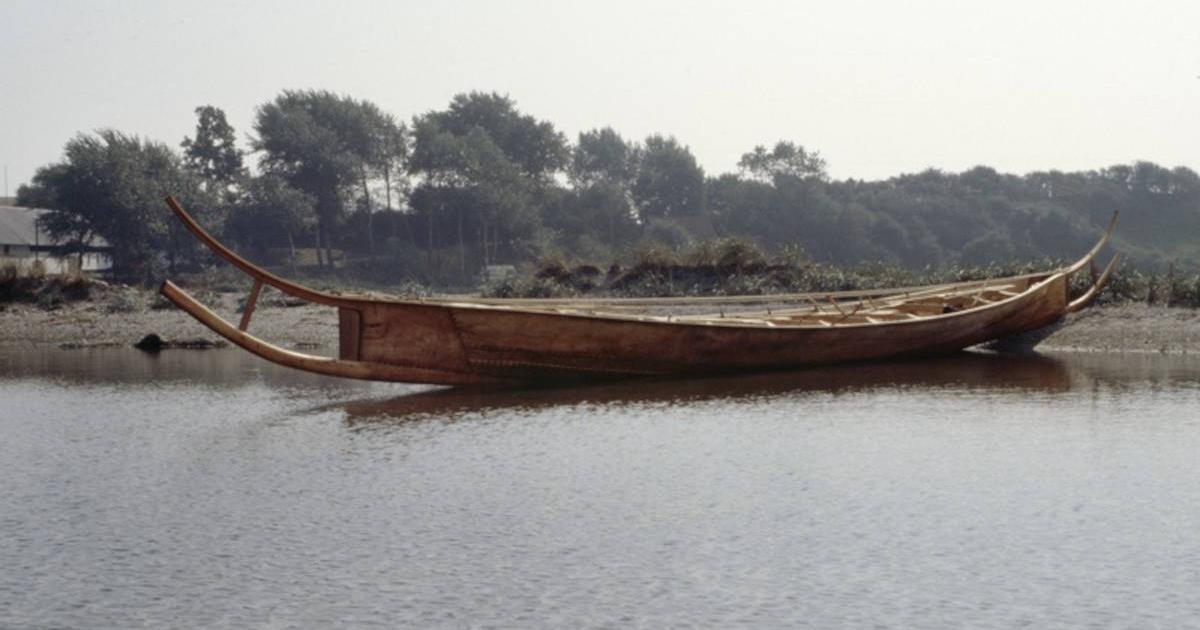

An eye-opening study published in the renowned open-access journal PLOS One has unveiled new evidence suggesting that Bronze Age inhabitants of Denmark were capable of directly navigating the open sea to Norway. Intriguingly, this breakthrough was made possible through the application of advanced digital technology, which revealed the hidden capacities of the Hjortspring boats that were commonly used in Denmark between the years 400 and 300 BC, long before anyone had ever thought it possible for Danish seafarers to undertake such a trip.
Led by Dr. Boel Bengtsson from the University of Gothenburg, the research team responsible for this find employed sophisticated computer modeling to simulate ancient maritime journey scenarios, to more deeply investigate seafaring practices in prehistoric Scandinavia. This innovative approach offered valuable insights into historical navigation, and paves the way for future studies on early maritime exploration in Scandinavia and elsewhere.
- 6 Discoveries that Show the Pre-Columbian Americas Traded Across the Oceans
- Controversy Surrounds Artifacts on Azores Islands: Evidence of Advanced Ancient Seafarers?
Simulating the Lost History of the Ancient Seafarers
Archaeological evidence has indicated striking similarities between Bronze Age societies in northern Denmark and southwestern Norway, reflected in their artifacts, burial customs, and architectural styles. Scholars have traditionally believed that maritime trade and cultural exchanges followed coastal routes spanning 700 kilometers along the Scandinavian shoreline. However, whether ancient seafarers dared to cross over more than 60 miles (100 kilometers) of open sea with Bronze Age technology remained a matter of speculation—until now.
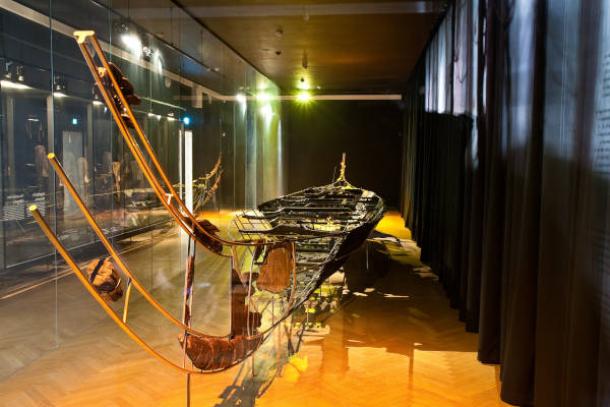
Rebuilt Hjortspring boat on display in the National Museum of Denmark in Copenhagen. (Knud Winckelmann/CC BY-SA 3.0).
To investigate this possibility, Dr. Bengtsson and her team applied advanced computational simulations to assess the feasibility of such voyages. They knew that if any vessel might be capable of traversing the Nordic waters it would be the Hjortspring boat, an ancient paddle-driven canoe dating back to Denmark’s fourth century BC.
By meticulously reconstructing this vessel based on archaeological findings and factoring in environmental variables such as ocean currents, wind speeds, and maneuverability, the researchers were able to replicate potential maritime scenarios faced by Bronze Age navigators, and determine that the obstacles preventing long-range travel on the sea were not as formidable as previously believe.
The results achieved during this research were astounding. The simulations demonstrated that not only was direct open-sea travel possible, but it may have been a necessary means of transportation. The study revealed that Bronze Age mariners possessed advanced navigational skills, an understanding of weather patterns, and the expertise to steer vessels through waves reaching one meter in height and winds of up to 10 knots. The findings suggest that such journeys were most feasible during the summer months, when conditions were relatively stable and favorable.
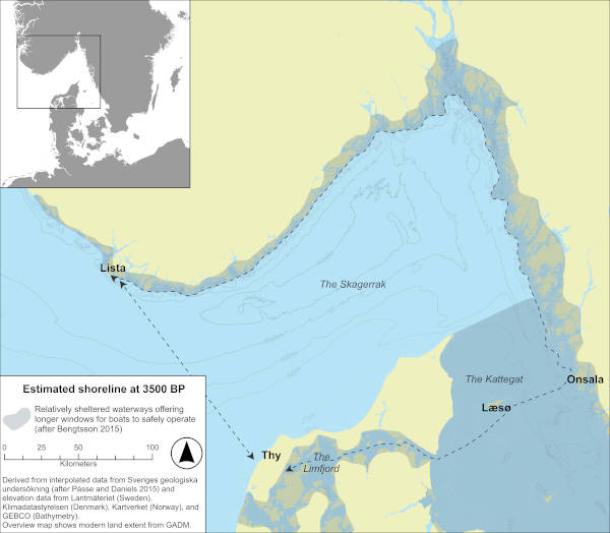
Map of shorelines of Denmark and Norway in ancient times, with shortest possible sea route indicated on the map. (Bengtsson, et.al/PLOS One).
Although coastal routes offered a safer alternative, they came with significant drawbacks. Traveling along the shoreline required frequent stops to replenish supplies, extending the journey over several weeks. This contrast underscores the careful strategic decisions made by ancient sailors, balancing the risks and rewards of an open-sea crossing versus a lengthier but safer coastal voyage.
- New Evidence Ancient Chinese Explorers Landed in America Excites Experts
- Astonishing Human Heads: Do Satellite Photographs Now Prove Existence of Humans on Antarctica…6000 Years Ago? – Part I
Expanding the Horizons of Maritime Research
Beyond revealing the hidden potential of ancient seafaring voyages, this research establishes a new framework for studying prehistoric maritime travel. The modeling approach developed by Bengtsson and her colleagues has broad implications, as it can be adapted to analyze various types of ancient vessels, provided sufficient data on their structure and capabilities exist.
The impact of these findings extends well beyond Scandinavian archaeology. The study highlights the complexity of prehistoric navigation, while showing that societies of the Bronze Age were far more interconnected than previously believed.
By proving that open-sea crossings were within their capabilities, researchers must now reassess long-standing theories regarding trade, migration, and cultural exchange during this era. This discovery challenges previous assumptions, positioning seafaring as a central factor in shaping social and economic interactions between distant communities.
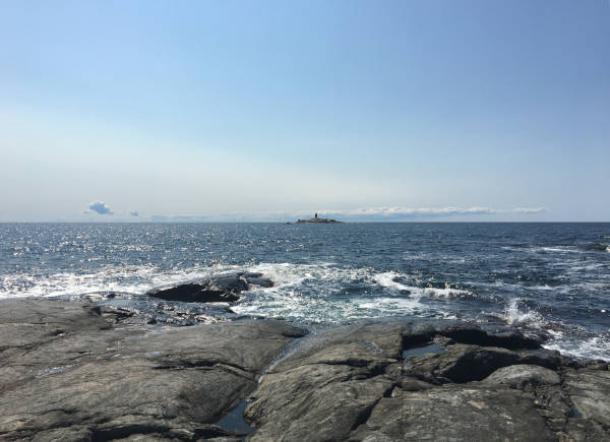
The sea route that would have allowed travel between Denmark and Norway more than 2,000 years ago (the shoreline of Denmark is in the distance). (Bengtsson, et.al/PLOS One).
Furthermore, the study offers a fresh perspective on how maritime knowledge contributed to cultural identity and technological advancement. The prospect that Danish navigators regularly journeyed across open waters to reach Norway provides a richer understanding of how ancient communities interacted, reinforcing the role of seafaring as a cornerstone of regional development.
In their PLOS One article, Dr. Bengtsson and her team conclude by emphasizing the importance of computational simulations in reconstructing historical navigation. Their findings encourage interdisciplinary collaboration among archaeologists, historians, and specialists in maritime technology to deepen our comprehension of human adaptation to marine environments. The potential for applying these techniques to other ancient cultures highlights the relevance of modern scientific tools in unraveling the mysteries of the past.
By blending technological innovation with historical inquiry, this study has unlocked a new chapter in our understanding of prehistoric navigation. It reaffirms the importance of continuous research and interdisciplinary approaches in unveiling the extraordinary achievements of our ancestors. Using the tools of modern science, the journeys of Bronze Age seafarers have been brought to life once more, opening a window into an ancient age of adventure on the high seas.
Top image: Reconstruction of a Hjortspring boat of the type sailed in Denmark 2,400 years ago.
Source: Flemming Kaul, Nationaluseet.
By Nathan Falde