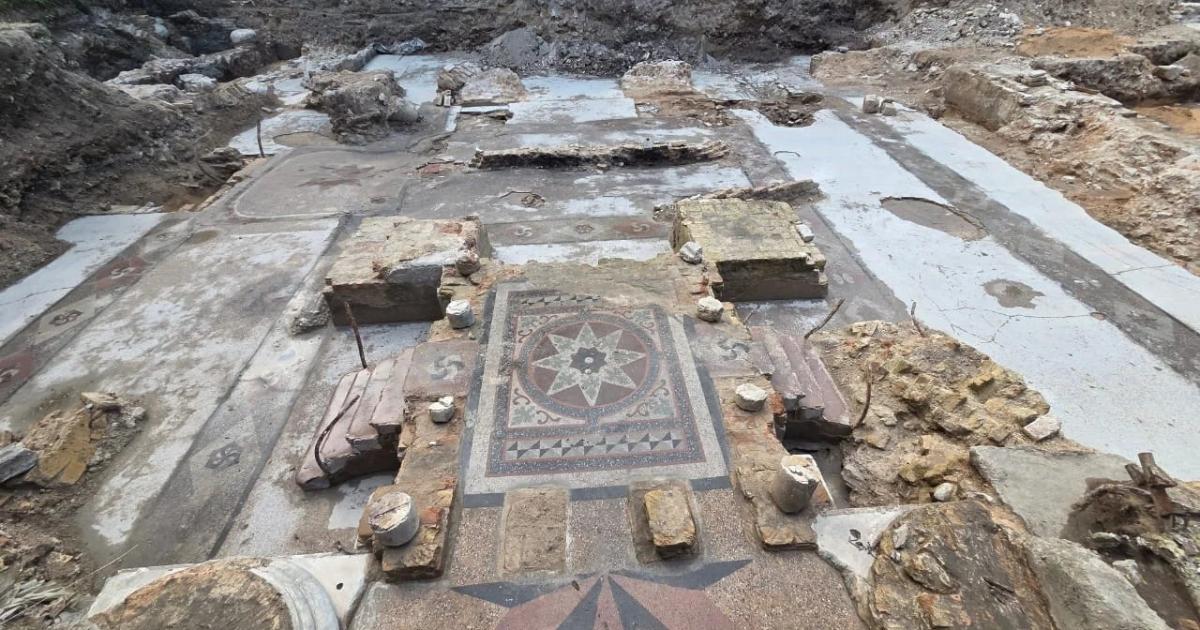

Beneath the ruins of a synagogue destroyed during the Holocaust, archaeologists have uncovered traces of a once-thriving Jewish community. Excavations at the Great Synagogue of Vilna in Lithuania have revealed remarkably preserved colorful mosaic floors and engraved seat plaques that identified where worshippers once gathered. Excavations have also revealed sections of the prayer hall and the women’s gallery, along with a plaque engraved with the Ten Commandments. A focus of the investigation was the size and placement of the Synagogue’s large central bimah, a raised platform for a reading desk used for reading the Torah and conducting parts of the service. Centering the bimah in the middle of the Synagogue is a historic tradition that emphasizes a communal focus on the study of the Torah.
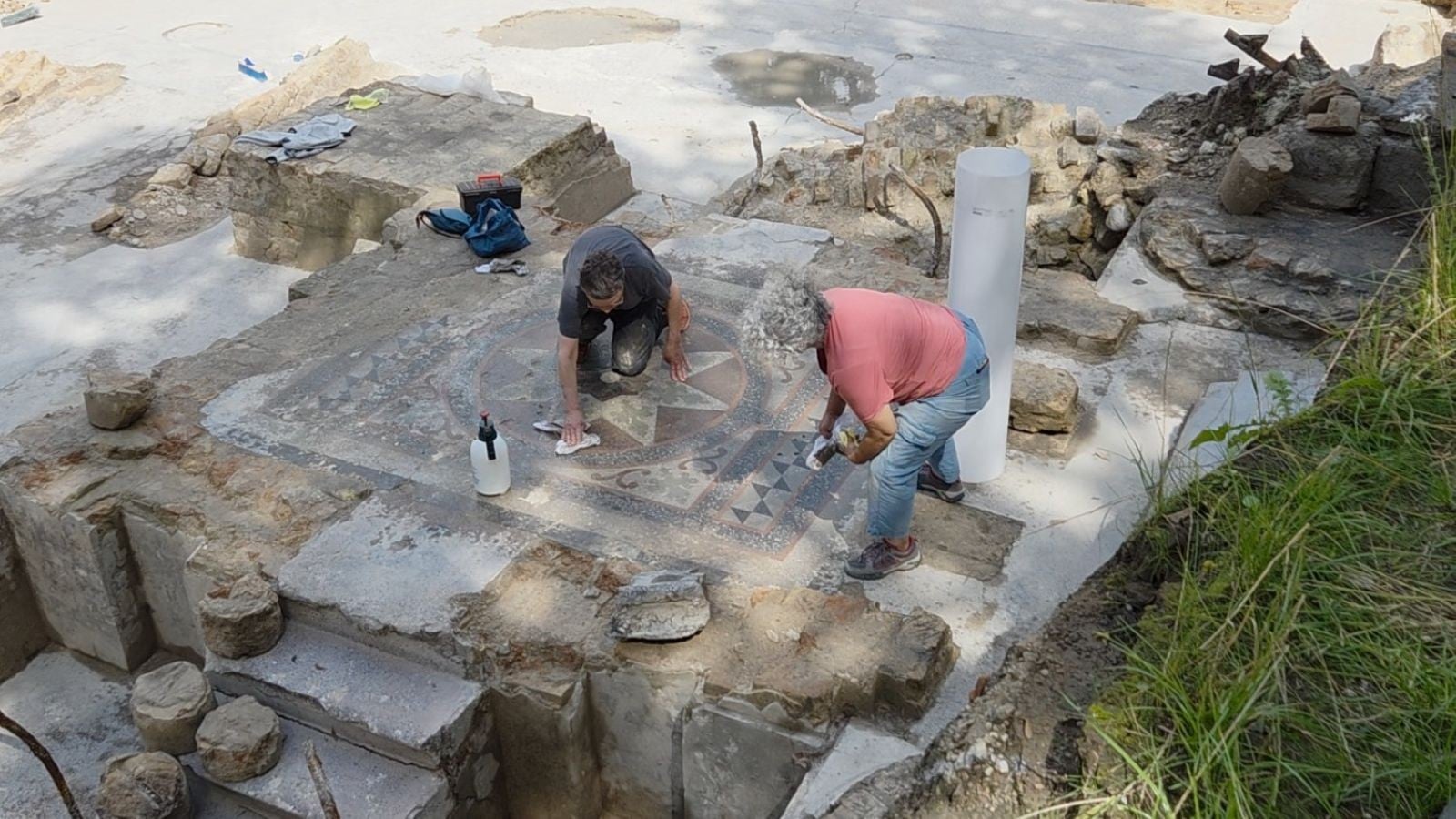
Conservators carefully clean the colorful terrazzo floor of the Great Synagogue of Vilna's central bimah after its complete exposure during excavations in Vilnius, Lithuania. The richly decorated geometric pavement once surrounded the synagogue's elevated Torah-reading platform, which served as the focal point of religious services for more than three centuries before the synagogue was destroyed during World War II and the Soviet era. (Vilna Great Synagogue and Shulhoyf Research Project/Israel Antiquities Authority)
A Global Effort to Preserve Vilna’s Jewish Heritage
The excavation is a coordinated effort between the Israeli Antiquities Authority and the Kulturos paveldo issaugojimo pajegos, with funding support from the Good Will Foundation in cooperation with the Lithuanian Jewish (Litvak) Community. The organizations intend to preserve the synagogue's remains, present them to the public, and develop the site for the benefit of the Jewish community in Lithuania.
- Can Jewish People be a Nation, and a Religion, and a Race?
- Hanukkah Origins: ‘Miracle of Oil’ Exalted a Religious Freedom Victory in Ancient Jewish Temple
Unearthing the Soul of the Great Synagogue
Dual excavation directors, Dr. Jon Seligman of the Israel Antiquities Authority and Justinas Racas of Kulturos paveldo issaugojimo pajegos, see an emtional mission in their project: “The removal of the old school building that covered the historic synagogue enabled us, for the first time, to expose additional extensive and continuous sections at the heart of the building: the main prayer hall, paved with colorful terrazzo floors decorated with floral and geometric patterns; plaques bearing names; and many other finds that offer us a moving, almost personal encounter with the people who prayed here and with the community life that developed around the synagogue over the course of centuries.”
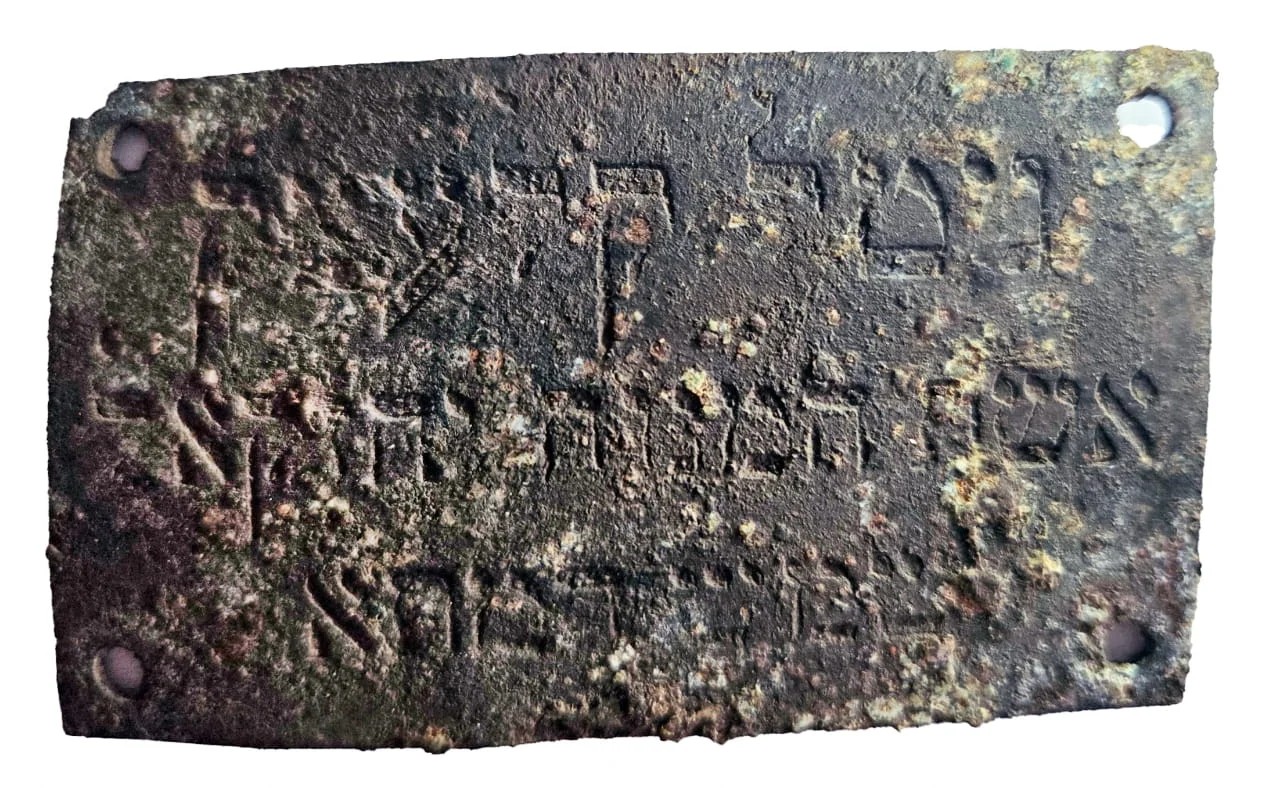
The reverse of a bronze synagogue seat plaque preserves Hebrew inscriptions identifying one of the worshippers who once occupied a designated place within the Great Synagogue. Jon Seligman (Vilna Great Synagogue and Shulhoyf Research Project/Israel Antiquities Authority)
Seat Plaques Reveal the People Behind the Great Synagogue
A large number of plaques marking these permanent seats of long-lost worshippers at the synagogue were uncovered during the excavations. Some seats even bore the names of women who prayed in the ezrat nashim, the women’s gallery; others bore the names of men. Additional plaques marked seats held by members of a major charitable society who were involved in the administration of the Jewish community of Vilna.
- Ancient Jewish necropolis in Israel given worldwide recognition
- The First Temple: Crowning Achievement of King Solomon and Home of the Legendary Ark of the Covenant
Conclusion
One of the most prominent plaques identified a seat donated by “Gitel Klacheck, wife of the late Yechezkel, Shamash d’mata,” the city sexton. The Klachek family was once a wealthy, influential family that owned several businesses in the streets surrounding the Great Synagogue of Vilna. Yechezkel, a public official who served Vilna’s Jewish Community, also handled practical matters, such as announcements and errands, on their behalf. These discoveries not only shed new light on the synagogue's architectural splendor and religious life before World War II, but also restore personal connections to a sacred place
Top Image: The exposed prayer hall of the Great Synagogue of Vilna reveals colorful terrazzo flooring with geometric floral decoration surrounding the synagogue's central bimah during the 2026 excavation season. Source: Vilna Great Synagogue and Shulhoyf Research Project/Israel Antiquities Authority
By Ramsey Hardin
References
Bartov, S. August 5, 2026.Archaeologists Uncover Treasures of Vilnius' Great Synagogue. The Jerusalem Post. Available at: https://www.jpost.com/archaeology/article-904608
Israel Antiquities Authority News. August 5, 2026. The Central Bimah of the Great Synagogue of Vilna Fully Exposed. Available at: https://www.iaa.org.il/en/page_news/page/%D7%94%D7%91%D7%99%D7%9E%D7%94-%D7%94%D7%9E%D7%A8%D7%9B%D7%96%D7%99%D7%AA-%D7%A9%D7%9C-%D7%91%D7%99%D7%AA-%D7%94%D7%9B%D7%A0%D7%A1%D7%AA-%D7%94%D7%92%D7%93%D7%95%D7%9C--%D7%A9%D7%9C-%D7%95%D7%99%D7%9C%D7%A0%D7%94-%D7%A0%D7%97%D7%A9%D7%A4%D7%94-%D7%91%D7%9E%D7%9C%D7%95%D7%90%D7%94
Radley, D. August 4, 2026. Colorful Floors and Seat Plaques Found at the Nazi-Destroyed Great Synagogue of Vilna in Lithuania. Archaeology News Online Magazine. Available at: https://archaeologymag.com/2026/08/ancient-seat-plaques-uncovered-at-vilnas-great-synagogue/.
Stubb, Z. August 4, 2026. Buried for 70 Years, Vilna's Great Synagogue Reveals Heart of Pre-WWII Jewish Community. The Times of Israel. Available at: https://www.timesofisrael.com/buried-for-70-years-vilnas-great-synagogue-reveals-heart-of-pre-wwii-jewish-community/.