
For decades, the presence of translucent green stones in the lavish tombs of ancient Panamanian chiefs puzzled archaeologists. Now, a groundbreaking scientific study has finally solved the mystery, confirming that these prized gems are genuine Colombian emeralds that traveled over 700 kilometers (435 miles) through complex pre-Columbian trade networks. Published in the journal Latin American Antiquity, this research offers the first concrete proof of long-distance gemstone exchange connecting Central and South American societies centuries before European contact.
Secrets of the Golden Chiefdoms
The remarkable discovery centers on the elite archaeological sites of El Caño and Sitio Conte, situated along Panama's Pacific coast within the Gran Coclé cultural region. Dating from approximately AD 800 to 1000, these richly furnished tombs belonged to powerful chiefs and high-ranking lords. Excavations at these sites have previously uncovered extraordinary collections of prestige goods, including elaborate gold ornaments, pyrite mirrors, and fossilized megalodon teeth.
- Gold-Laden Elite Tomb Uncovered at Panama's El Caño Park
- Gold-Filled Tomb of Pre-Hispanic Lord Unearthed in Panama
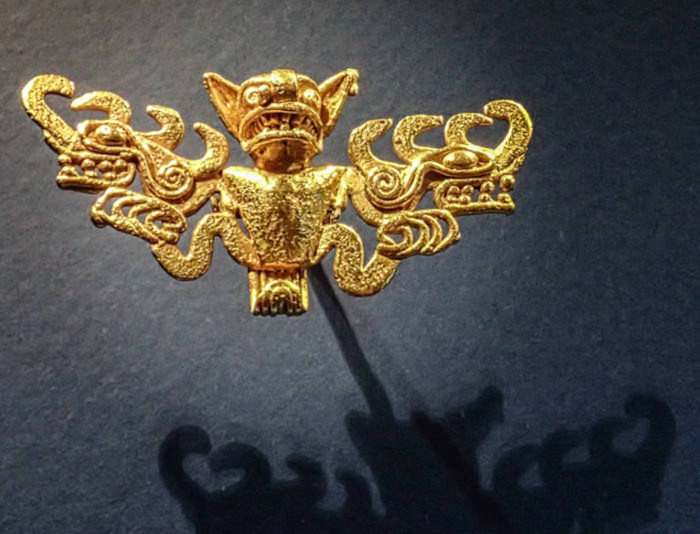
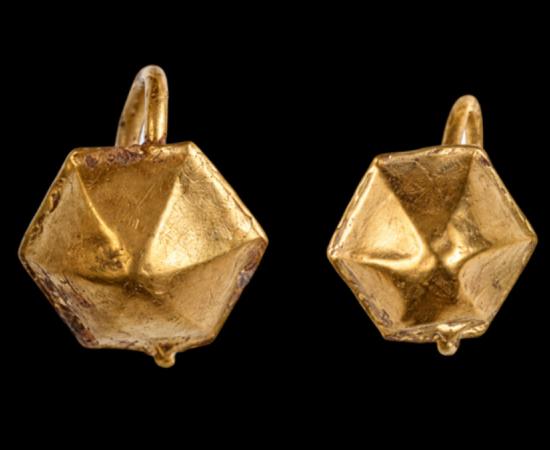
Gold Pendant, Conte Culture, Panama, 500–900 AD. (Mary Harrsch / CC BY 2.0)
Among these legendary treasures were five green stones that had long been suspected to be emeralds but had never undergone rigorous scientific testing. To determine their exact identity and provenance, a research team led by Dr Carlos Mayo Torné of the Technological University of Panama and the Fundación El Caño analyzed the stones using non-destructive (although somewhat invasive) analytical techniques. By employing portable X-ray fluorescence (pXRF), infrared spectroscopy (FTIR), and photoluminescence, they successfully mapped the chemical signatures of the gems.
Mapping the Ancient Gemstone Route
The results of the geochemical analysis were compared with 22 reference emeralds from known deposits in Ecuador and Colombia. The testing revealed that all five Panamanian stones possessed chemical signatures identical to emeralds mined in Colombia's famous Western Emerald Belt, home to the Muzo mines, and the Eastern Emerald Belt near Chivor. This represents the northernmost confirmed occurrence of precolonial Colombian emeralds in the Americas.
- The Bloody Legacy of Emeralds – The Gemstone of Lovers
- 8 Jars Of Colombian Emeralds, Gold, and Silver Unearthed Near Bogotá
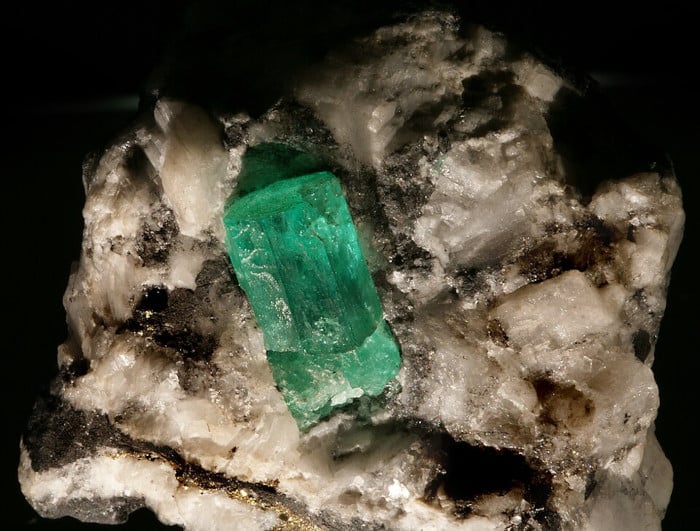
A stunning raw emerald crystal embedded in its white calcite and pyrite matrix from the famous Muzo Mine in Colombia. (Didier Descouens / CC BY-SA 3.0)
Rather than a direct commercial route, researchers believe the gems arrived in Panama through a "down-the-line" exchange network. Under this system, the precious stones were traded sequentially from one coastal or riverine community to another, gradually making their way north. This decentralized trade network allowed exotic luxury items to travel huge distances, acquiring immense symbolic value and prestige with every transaction.
Local Artisans and the Challenge of Emerald Craftsmanship
The technological assessment of the emeralds also revealed a fascinating story of local adaptation and craftsmanship. While some emeralds arrived in the Gran Coclé region as finished or partially worked pieces, others show clear signs of being modified by local Coclé artisans. Microscopic examination of the stones revealed traces of failed drilling attempts and surface damage.
Drilling emeralds is an incredibly delicate and risky task because the gemstone's natural internal fractures make it highly susceptible to cracking under pressure. Despite the damage caused during these ancient modifications, the Coclé elites did not discard the flawed gems. Instead, they repaired, reworked, and proudly incorporated them into their ceremonial regalia, including copper pendants, spider ornaments, and golden feline figures. This practice highlights the immense symbolic, political, and ritual power that emeralds held in ancient Coclé society.
The Sudden Disappearance of Pre-Columbian Luxury
One of the most intriguing aspects of the study is that emeralds, along with other exotic prestige goods like pyrite mirrors, suddenly vanished from the central Panamanian archaeological record around AD 1000. This abrupt disappearance coincides with a major shift in local funeral practices and the abandonment of elite ceremonial centers like El Caño. At roughly the same time, the elaborate elite burial traditions that defined the Gran Coclé region came to an end. This sudden cultural shift hints at major transformations in local power structures and long-distance trade relationships.
Archaeologists suggest that this transition reflects a decline in the political and economic influence of the Coclé chiefdoms over regional trade routes. Without the power to secure these highly valued imports, local rulers could no longer use them to forge political alliances or display their elite status, leading to a restructuring of pre-Columbian society. To understand how these networks functioned before their collapse, Dr Mayo Torné hopes to reconstruct the exact routes used to transport the emeralds. Future studies will combine spatial modeling with archaeological data from intermediate sites that may have functioned as interaction hubs linking the Colombian mines with Panamanian consumers.
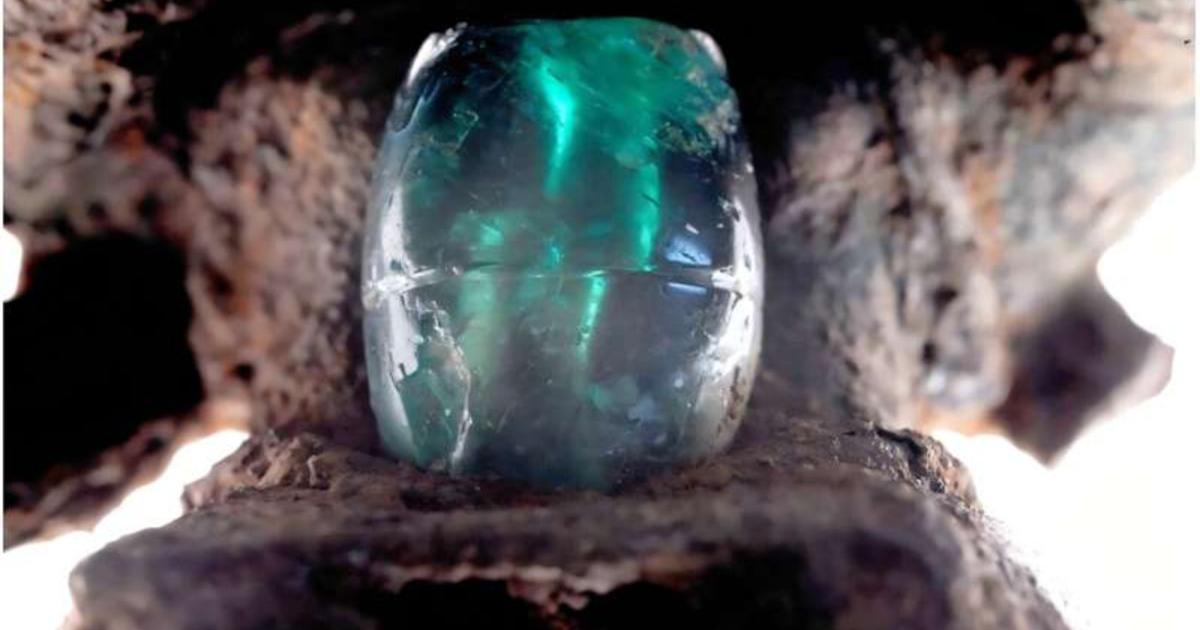
Top image: An emerald mounted on a copper pendant recovered from a Coclé burial. Source: C. Mayo Torné/Fundación El Caño
By Gary Manners
References
Archaeology Magazine. 2026. Colombian Emeralds Identified in Panama Burials. Archaeology Magazine. Available at: https://www.archaeology.org/news/13073-colombian-emeralds-identified-in-panama-burials
Mayo Torné, C., J. Mayo Torné, A. Hancock, A. Carbotte, and S. Redwood. 2026. Evidence of Emerald Long-Distance Exchange in the Isthmo-Colombian Area. Latin American Antiquity. Cambridge University Press. Available at: https://www.cambridge.org/core/journals/latin-american-antiquity/article/evidence-of-emerald-longdistance-exchange-in-the-isthmocolombian-area/1D438780D5871C510B358E7CD1177722
Oster, S. 2026. Green stones buried with Panama's ancient chiefs confirmed as Colombian emeralds. Phys.org. Available at: https://phys.org/news/2026-05-green-stones-panama-ancient-chiefs.html