
A cave complex in northwest China preserves evidence of artistic activity that may stretch from the Early Bronze Age to the era of Tibetan Buddhist expansion. In a new study published in npj Heritage Science, researchers identify anthropomorphic figures and geometric motifs at Tangbaletasi in Xinjiang’s Altai region, followed by later Tibetan-script inscriptions and a crossed vajra. The result is a picture of Chinese cave art as a layered record of changing communities rather than a single moment of painting. It also shows how advanced imaging can reveal details that ordinary photographs miss.
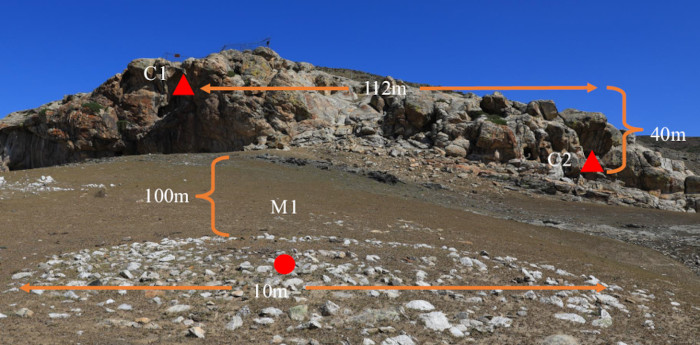
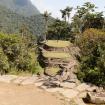
Geographic location and surrounding landscape of the Tangbaletasi Cave Paintings. (Huang et al/Nature)
A Cave Used Across Centuries
Tangbaletasi lies in the mountains of Fuyun County, about 70 kilometers from the county town. The site includes two painted areas, called C1 and C2, separated by roughly 112 meters horizontally and 40 meters in elevation, while a circular stone burial mound stands around 100 meters away. Its setting echoes the wider cultural landscape of Xinjiang, where sites such as the Kizil Caves, the earliest major Buddhist cave complex in China, preserve evidence of movement along routes linking Central and East Asia.
The team combined iconographic comparison, historical records, spatial analysis and hyperspectral imaging. The camera recorded 180 bands of light between 400 and 930 nanometers, allowing the researchers to separate pigment signals and identify two motifs invisible to the naked eye. Because the paintings have not been directly dated, the proposed chronology remains relative, based on overlaps, pigment differences and comparisons with better-known regional art. A separate Heritage Daily report likewise emphasizes the site’s long sequence of artistic activity.
- Kizil Caves, earliest Buddhist caves in China, hide rare treasures
- The Mogao Grottoes in China, the Legendary Home to a Thousand Buddhas and Hidden Library
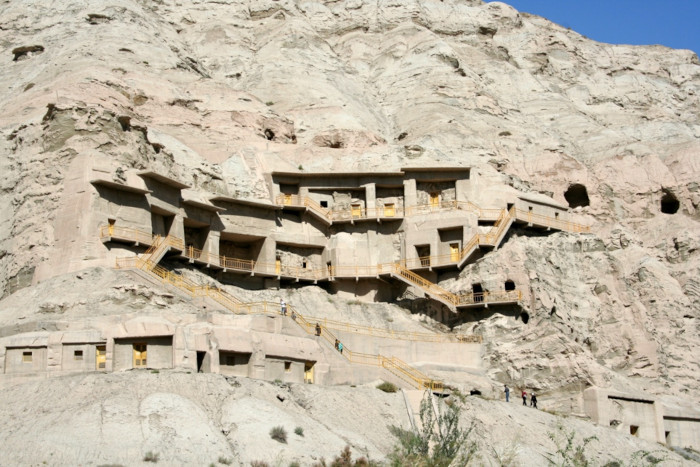
Kizil Thousand Buddha Caves in Xinjiang, China. (Rolfmueller / CC BY-SA 3.0)
Hidden Figures Beneath the Surface
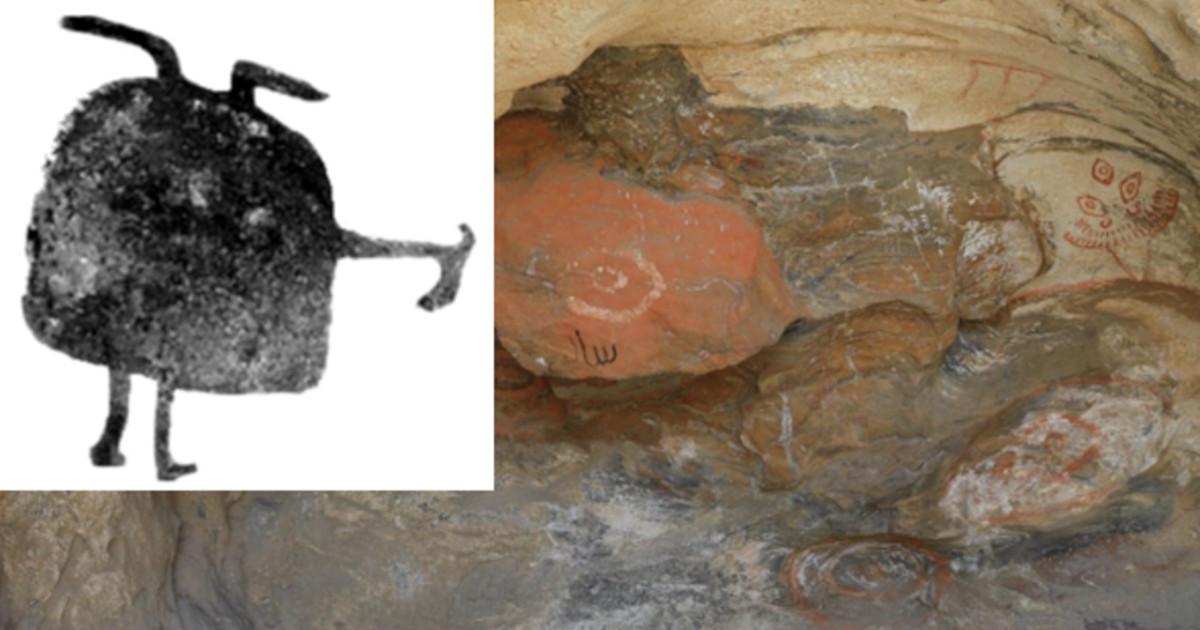
Cave C1 contains 19 identifiable figures and motifs, including a weathered, three-eyed face with a beard, an elongated chin and short rays around the top of its head. Another faint image has a bell-like shape that the researchers compare with anthropomorphic figures associated with the Chemurchek culture of the Early Bronze Age. C2 contains 49 visible compositions, including horned human-like forms, X-shaped signs, animals and three figures that appear to carry bows and arrows.
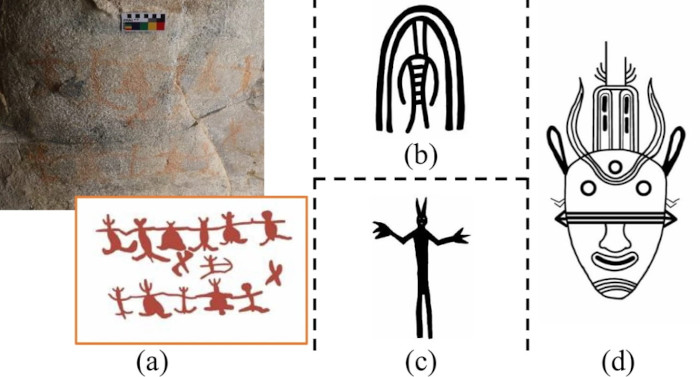
Horned anthropomorphic figures in panel C2 and comparative examples from Bronze Age cultures of the Altai region. (F. Huang et al./ NPJ Heritage Science)
The imaging also helped establish a sequence of painting. In one area, an older motif has broken or truncated outlines beneath a later figure, while the two images show different pigment signatures. The finding suggests that people returned to the cave and added new imagery without erasing everything that came before, a pattern also relevant to wider studies of ancient murals such as Brush strokes on very ancient murals may rewrite the history of art in China.
- Mystery of Ancient Buddhist Cave Temple Writing Solved
- 2000-Year-Old Chinese Rock Art May Owe Its Survival to Blood
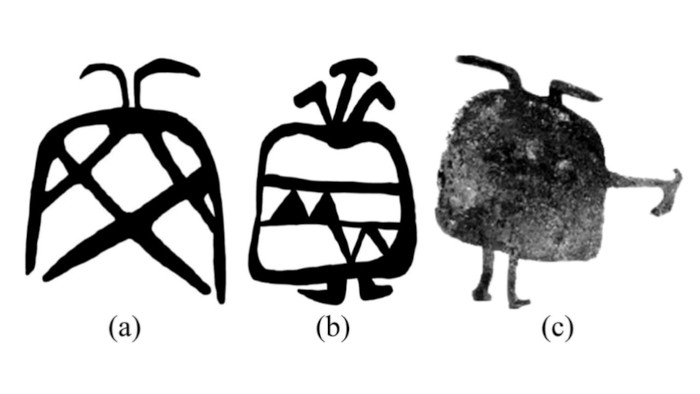
Bell-shaped anthropomorphic motifs associated with the Chemurchek Culture. (F. Huang et al., NPJ Heritage Science)
Bronze Age Faces and Later Buddhist Signs
The researchers compare the horned figures in C2 with imagery linked to the Samus, Karakol and Okunev cultures of the Altai and southern Siberia. One bell-shaped figure is instead compared with Chemurchek examples associated with the mid-third millennium BC. These parallels place much of the anthropomorphic imagery broadly within the Bronze Age, although the authors stress that resemblance alone cannot provide an exact date or prove direct cultural descent.
The later layer is more clearly tied to Tibetan Buddhism. In C1, three inscriptions use Tibetan script and one faint image, revealed through hyperspectral processing, is a crossed vajra, a symbol of indestructible wisdom in Tibetan Buddhist traditions. The researchers suggest these motifs may have appeared as early as the Yuan dynasty, when imperial support helped Tibetan Buddhism circulate across Inner Asia; later movement of the Torghut people may also have strengthened Buddhist connections in the Altai. The history of this visual world can be explored further through 10 Awe-Inspiring Facts about Ancient Tibet and the Mogao Grottoes in China.
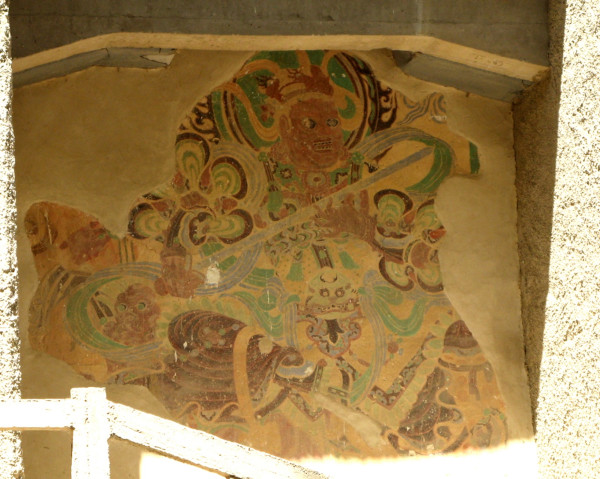
Buddhist mural at the Mogao Caves, Dunhuang. (G41rn8 / CC BY-SA 4.0)
A Cautious Chronology
The study does not claim that every image belongs to a single ritual system. The arrangement of figures, the nearby burial mound and the absence of ordinary domestic features suggest organized, non-domestic activity, but the precise meaning of the paintings remains open. The authors also note that direct scientific dating and systematic excavation are still needed. Tangbaletasi is therefore best understood as a repeatedly used place where older Chinese cave art remained visible while later communities added their own signs.
Top image: Frontal photographs of the Tangbaletasi Cave Paintings. Inset, sketch of Bell-shaped anthropomorphic motifs associated with the Chemurchek Culture. Source: F. Huang et al., NPJ Heritage Science
By Gary Manners
References
Archaeology Magazine. 2026. Ancient cave paintings in China trace Bronze Age art and later Tibetan Buddhist beliefs. Available at: https://archaeologymag.com/2026/10/cave-paintings-in-china-tibetan-buddhist-beliefs/
Heritage Daily. 2026. Ancient cave paintings reveal thousands of years of religious activity in China. Available at: https://www.heritagedaily.com/2026/10/ancient-cave-paintings-reveal-thousands-of-years-of-religious-activity-in-china/159543
Huang, F., Fu, Y., Zhou, G. et al. 2026. Chronology and function of Tangbaletasi cave paintings via hyperspectral and iconographic analyses. npj Heritage Science, Springer Nature. Available at: https://doi.org/10.1038/s40494-026-02433-7