
A team of prehistoric archaeologists from Tel Aviv University has proposed a new hypothesis to explain a long-standing mystery: Why did ancient humans bring very young children deep into underground cave painting sites, through dark and dangerous passages? Their answer: because in prehistoric societies, children were seen as mediators between the physical and spiritual worlds, and caves were sacred spaces with portals that allowed for contact with supernatural or other-dimensional beings.
“Next to many cave paintings, there is clear evidence of the presence of children as young as two years old,” the researchers explained in a press release. “So far, most hypotheses have focused on the educational aspect — learning the community’s traditions and customs. However, we believe that children also played a unique cultural role in these caves: Young children were credited with special qualities in the spiritual world, enabling them to communicate with entities from the beyond – which were believed to be accessible from the depths of the cave.”
This hypothesis and the research that developed it were carried out by Dr. Ella Assaf, Dr. Yafit Kedar, and Prof. Ran Barkai of the Jacob M. Alkow Department of Archaeology and Ancient Near Eastern Cultures at Tel Aviv University. Their paper was published in the journal Arts.
- A Whopping 25% of Prehistoric Rock Art Could Be Children’s Art, Study
- Unraveling the secrets of White Shaman Cave
Childhood in Prehistoric Times: A Unique Cultural Role
The cave art phenomonen remains one of the most fascinating aspects of prehistoric human life, and it remains a widely-studied subject that provokes much theorizing and speculation.
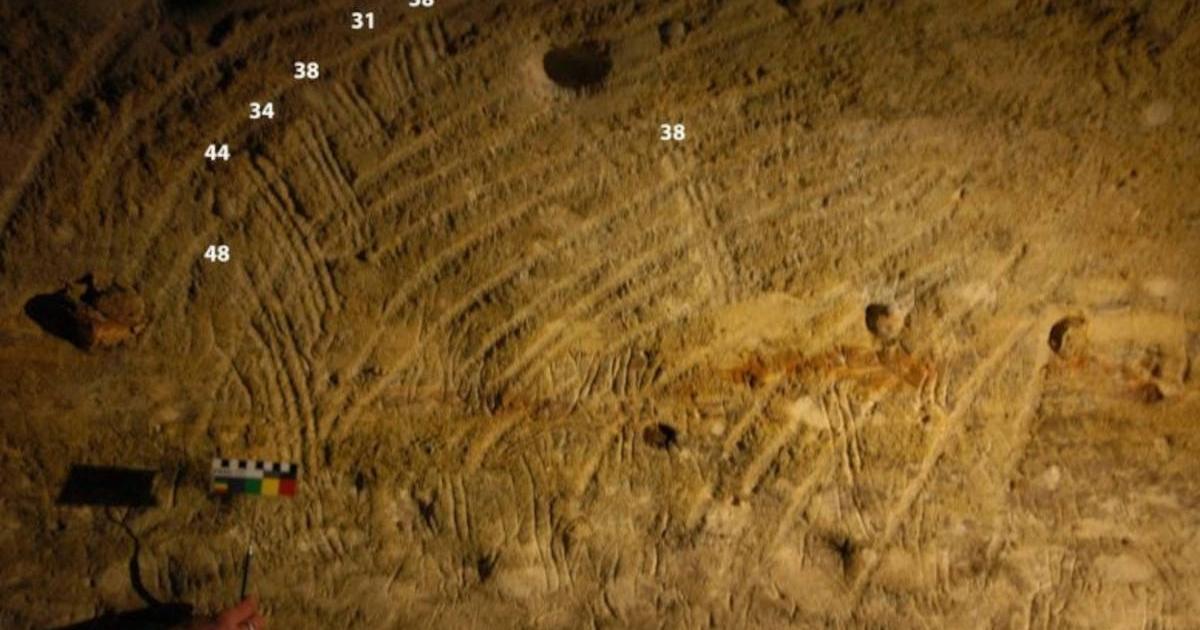
“To date, around 400 caves containing cave art have been discovered, mainly in France and Spain, with the artwork dated between 40,000 and 12,000 years ago,” Dr. Assaf said. “There is solid evidence of children’s participation in the artwork — handprints and finger paintings made by children aged two to twelve. In addition, footprints and handprints of children have been found in some caves, alongside those of adults. This naturally raises the question: Why were the children there? Why were very young children taken on exhausting and hazardous journeys deep into the dark, meandering caves with low oxygen levels — crawling through crevices, descending shafts, and climbing rocks to reach their destination?”
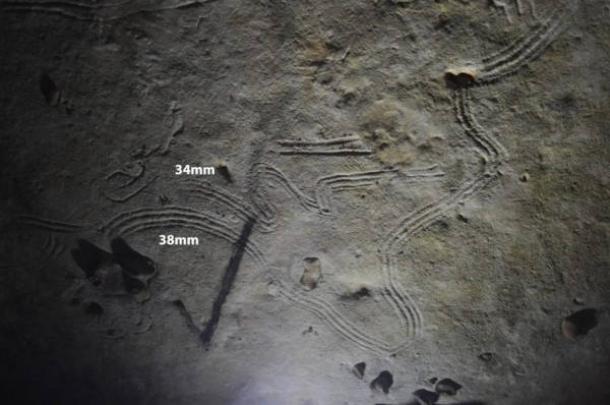
Children’s fluting examples from Saiga panel from Rouffignac cave. (Assaf, et.al/Arts).
The Tel Aviv University archaeologists note that despite the extensive research that has been done on cave art, few studies have focused on the presence of children. The prevailing hypothesis is that their participation served an educational purpose — passing down knowledge, traditions, and customs to the next generation. But the researchers involved in this new study are convinced that more was going on than just this.
“In fact, they [children] played an important, unique role of their own — direct communication with entities residing in the depths of the earth and otherworldly realms,” stated Dr. Kedar. “This study follows our previous works, in which we presented cave artworks as expressions of cosmological approaches, with emphasis on relationships between humans and various entities.”
The latest research has shed new light on childhood in prehistoric times, which makes it clear that children were active participants in the artistic and spiritual life of the community.
“Based on extensive studies about children in indigenous societies, along with new insights into rituals performed in caves with cave paintings, a new understanding is emerging regarding the role of children in the creation of cave art,” Dr. Assaf stated. “By integrating data from these research fields, we were able, for the first time, to propose a novel and original explanation for the inclusion of children in creating cave paintings.”
The world of childhood differs from that of adulthood, as children possess a special range of mental and cognitive traits as a result of their ongoing neurological development. Consequently, indigenous cultures worldwide, throughout history and prehistory, have viewed children as ‘active agents’ — mediators between this world and the entities inhabiting the natural world, the underworld, and the cosmos as a whole, the researchers say.
- The Theopetra Cave and the Oldest Human Construction in the World
- The Shaman’s Secret World: Living in Light and Darkness
In this way, children made a vital contribution to the survival of their communities, which were organized around the hunter-gatherers lifestyle. The people lived in nature and sought to maintain continuous, respectful relationships with various entities: animals and plants that served as food sources, stones used for toolmaking, ancestral spirits, and deities who needed to be honored, respected and appeased.
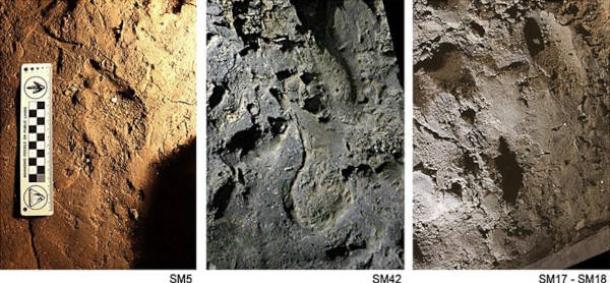
Children’s footprints from Basura Cave, 14,000 years ago. (Assaf, et.al/Arts).
Protecting and Preserving the Community
While the depths of caves might not seem like proper environments for children from our modern perspective, to the ancients things would have seemed very different. They would have seen it as far more dangerous not to take their children into caves, as that would mean cutting them (and their communities) off from access to beings whose actions had a dramatic effect on life in the normal, everyday four-dimensional world.
“Many of these societies regarded caves as gateways to the underworld – where, through shamanic rituals, they could communicate with cosmic entities and inhabitants of the underworld, to resolve existential problems,” Professor Barkai explained. “In this context, young children were perceived as liminal beings — belonging to both the realm they had left just recently (before birth) and the world they currently inhabit. Thus, small children were considered particularly suited to bridging the gap between the worlds and delivering messages to non-human entities.”
It is notable that children continued to accompany adult into caves in ancient times for tens of thousands of years, as the content of the cave art demonstrates. Prehistoric societies obviously felt like it was necessary to take children into those environments, as they were clearly convinced that contact with other dimensions was possible and that it produced tangible benefits on this side of the veil.
Top image: Children’s fluting examples from G4 panel from Rouffignac cave.
Source: Assaf, et.al/Arts.
By Nathan Falde