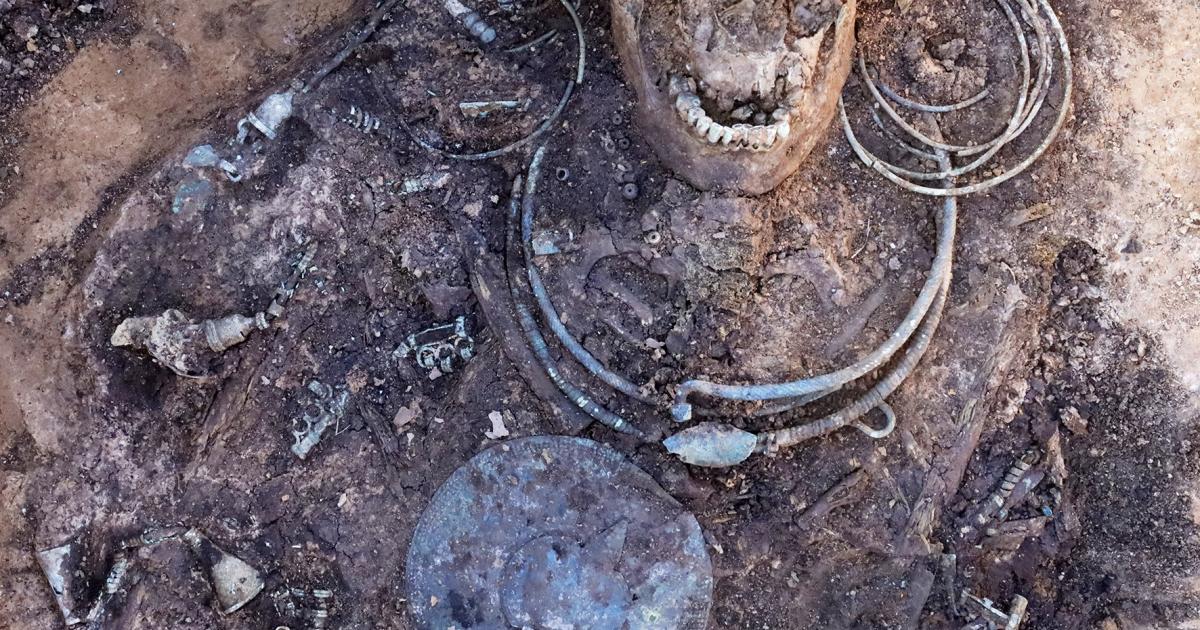

Along the high banks and wide bends of the Oka River in Russia's Nizhny Novgorod Region, archaeologists have revealed the burial practices of the region's early medieval people, the Murom. Excavations of the earliest Murom burials at the Zvyaginsky II cemetery, especially a rare high-status female grave with a ceremonial headdress, are reshaping the understanding of Murom culture through increased documentation of clothing, weaponry, and social status that offer new details about the origins and development of one of the Volga-Oka region's least understood early medieval communities. The newly identified early burials strengthen archaeological links between the Murom culture and the earlier Bezvodninsky-Akhmylovsky cultural tradition, evidenced at sites spread across the confluence of the Volga and Oka Rivers.
Excavation and Burial Evidence
Archaeologists from the Institute of Archaeology of the Russian Academy of Sciences and the Nizhny Novgorod Museum-Reserve investigated approximately 1,000 square meters of the oldest section of the Zvyaginsky II cemetery, documenting 43 burials. The sample included 37 inhumations, one cremation, and six horse burials, with two horses interred in a single grave pit. Researchers examined evidence of Murom cultural practices, using stratigraphic context and artifacts that date some graves to the late 6th and early 7th centuries AD, and revising the chronology of Murom settlement in the area. Previous excavations at the site had focused on understanding the decline of the Murom people; the work in the cemetery's oldest section allowed researchers to investigate the culture's emergence rather than its disappearance.
- A Tiny Silver Door to the Afterlife? Muroma Teenager's Grave Explored
- Medieval Rus Warrior Burials Discovered in Russia
Researchers found many personal ornaments, weapons, and belt fittings. One male grave contained a set of warrior equipment, while others preserved spearheads, darts, axes, and celts. Several distinctive belt assemblages were among the artifacts. The most typical were iron-fitted belts common among Volga-Finnic peoples and "eastern belts" — a style believed to have originated in Central Asia before spreading into the Kama region during the 7th and 8th centuries. One woman wore an eastern belt around the pelvis, paired with a rare tin-lead clasp bearing a "winged needle" design usually associated with military attributes.
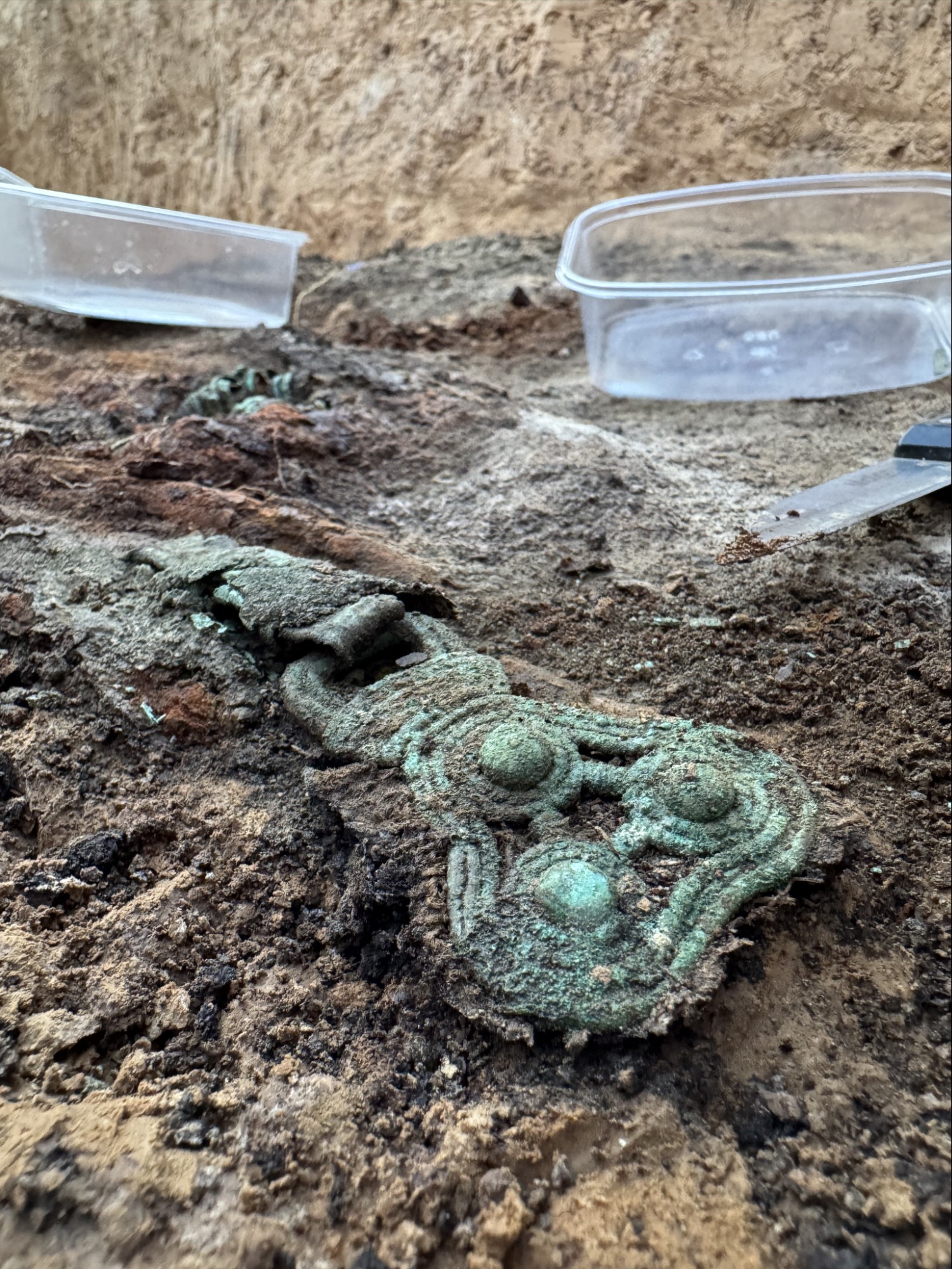
An intricately decorated bronze belt pendant remained in its original position after nearly 1,400 years, offering valuable evidence for Murom craftsmanship and elite dress. (Institute of Archaeology, Russian Academy of Sciences/Nizhny Novgorod Museum-Reserve)
Ceremonial Headdress and Shared Traditions
Excavation of a high-status female burial, marked by an elaborate ceremonial headdress, highlights its importance in Murom social hierarchy and connects it to similar finds across the Volga-Oka confluence, emphasizing shared cultural traditions.
The headdress was decorated with eight cross-shaped brooches: seven small brooches arranged in a halo-like pattern around the skull and a larger two-plate brooch positioned behind the head. The lack of fastening pins and the presence of tin-lead beads suggest these ornaments were sewn onto a cloth headdress. There was also evidence of leather cords secured with bronze rings, which were part of elite Murom headwear construction.
- The Kyivan Rus’ – When Vikings and Slavs Cooperated to Shape History
- Mongol-Era Christian Headdress Reveals A Complex Medieval Russia
Grave Goods Help in Dating Burials
Jewelry and grave goods from Zvyaginsky II, including boat-clasp torcs, syulgams, glass beads, and decorated breast ornaments, have been used to date many of the burials to the late 7th and early 8th centuries CE. However, several children's graves contained artifacts-such as a necklace of opaque red glass beads and distinctive syulgams-that suggest some burials may date to the late 6th or early 7th century. These findings indicate that Murom communities established themselves along the high banks of the Oka River earlier than previously recognized. The expansion of Murom culture across the Lower Oka basin appears to have involved both continuity and adaptation, with the population remaining established for nearly five centuries despite the river's role as a geographic boundary.
- New Study Finds Roots of Modern Russia in its Viking Style Past
- This Medieval Ring Traveled 1,300 Miles to Reach a Russian City — And Scientists Want to Know Why
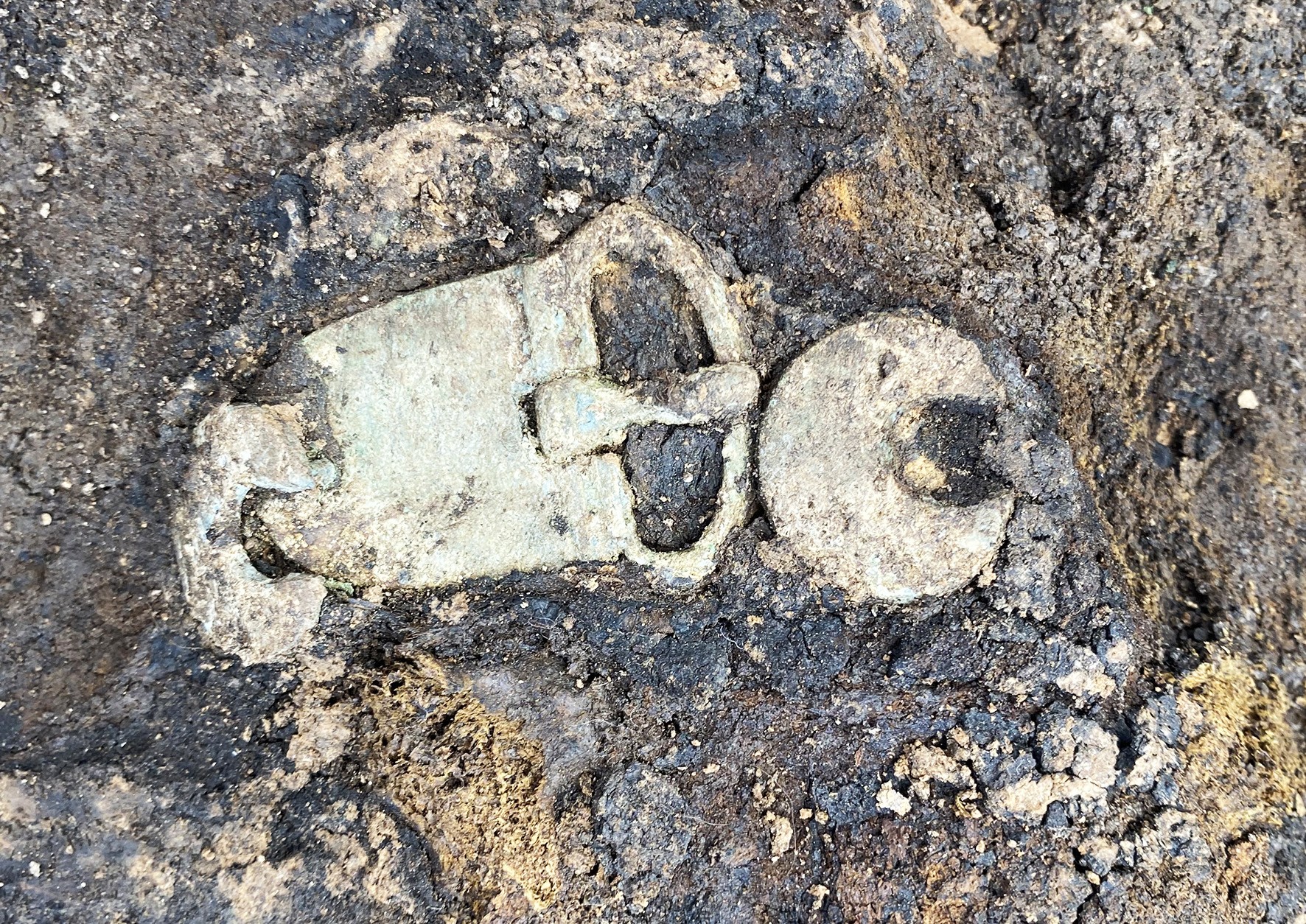
A bronze belt buckle discovered during excavations at Zvyaginsky II forms part of a broader assemblage of early medieval dress accessories that reveal the cultural connections of the Murom people. (Institute of Archaeology, Russian Academy of Sciences/Nizhny Novgorod Museum-Reserve)
Research Methods and Limitations
The Zvyaginsky II burial ground is now considered one of the most thoroughly studied Murom archaeological sites. Modern excavation techniques, including advanced digital recording and scientific analysis, have produced a more detailed reconstruction of burial practices, costume traditions, and social organization than was possible in earlier investigations. Researchers intend to increase the sample size to address limitations in preservation conditions and the lack of direct radiocarbon dates in previous investigations. Further research, including ancient DNA and isotope analysis, may help clarify population relationships and mobility patterns in the region. Chronological frameworks for early medieval populations like the Murom are subject to ongoing revision as new evidence emerges.
- Scythian Burial With Golden Headdress Found in Russia
- Vikings in Byzantium: The Varangians and their Fearless Conquests
Discoveries at Zvyaginsky II Increase Understanding of the Murom People
The discoveries at Zvyaginsky II reframe the understanding of the origins of the Murom people. They provide both an earlier chronology of the culture's emergence and exceptional examples of elite costume, weaponry, and belief, as seen in the woman's ceremonial headdress and accompanying grave goods. As excavation of the cemetery's oldest section continues, researchers will expand their analysis of Zvyaginsky II burials using advanced technological approaches to add detail to the story of one of the Volga-Oka region's most intriguing early medieval communities.
Top Image: The grave of a high-status Murom woman preserves an elaborate ceremonial headdress decorated with cross-shaped brooches, bronze rings, and beads, providing rare evidence for elite costume traditions during the emergence of Murom culture. Source: Institute of Archaeology, Russian Academy of Sciences/Nizhny Novgorod Museum-Reserve
By Ramsey Hardin
References
Altunas L . July 27, 2026. A Tiny Silver Door to the Afterlife? Richly Furnished Grave of a Teenage Girl Discovered at 1,300-Year-Old Muroma Cemetery. Arkeonews. Available at:https://arkeonews.net/a-tiny-silver-door-to-the-afterlife-richly-furnished-grave-of-a-teenage-girl-discovered-at-1300-year-old-muroma-cemetery/
Hassett, B. August 6, 2026. Early Murom Burials and Ceremonial Headdress Found at Zvyaginsky II. Science Report. Available at: https://science.report/discover/early-murom-burials-and-ceremonial-headdress-found-at-zvyaginsky-ii-78695/
Milligan, M. August 5, 2026. Ceremonial Headdress Among Murom Grave Discoveries. Heritage Daily. Available at:https://www.heritagedaily.com/2026/08/ceremonial-headdress-among-murom-grave-discoveries/158841
Radley, D. August 6, 2026. Earliest Murom Burials in Russia Reveal Rare Ceremonial Headdress and the Origins of a Forgotten Culture. Archaeology News Online Magazine. Available at:https://archaeologymag.com/2026/08/earliest-murom-burials-in-russia/
Zelentsova O., Shvetsova A., and Milovanov, S.August 5, 2026. Ceremonial Headdress Among Murom Grave Discoveries. Institute of Archaeology, Russian Academy of Sciences. Available at: https://archaeolog.ru/press/articles/drevneyshiy-mogilnik-muromy-issledovaniya-zvyaginskogo-2-go-mogilnika-v-2026-g