
A stone-paved workshop discovered at Çayönü Tepesi has brought to the fore raw malachite, partially manufactured artifacts, copper beads and other tinny copper products, thus exhibiting a privileged perspective on the Neolithic craft production system. Çayönü copper workshop covering the area of around 5 square meters in southeastern Turkey is dated to approximately 6900-6800 BC according to what was announced by Culture and Tourism Minister Mehmet Nuri Ersoy. The discovery presents not simply information about what and how people produced copper, but also where production took place.
- Copper Mining Boom Across Britain 3,600 Years Ago Found in New Study
- The Lost Iberian Civilization of Los Millares: Was Copper the Secret of its Success?

Stone paving marks the small production area uncovered in the settlement’s western sector. (Republic of Türkiye Ministry of Culture and Tourism)
A Purpose-Built Neolithic Workspace
During the 2026 excavation, the workshop was discovered at the western section of the settlement by a team of archaeologists supervised by Associate Professor Savaş Sarıaltun of Çanakkale Onsekiz Mart University. Six postholes were found around the paved area, with maybe more that existed, indicating that the workshop was probably covered with a light roofing structure. The layour of the structure is a part of the larger context of the Neolithic revolution in Anatolia when the first permanent settlements appeared and developed new architecture, food production and crafts.
18 pieces of malachite were sourced from the heart of the site, while approximately 24 to 25 pieces were discovered inside the workshop or in the surrounding area. Most importantly, the surrounding area has yielded around 42 pieces of malachite and copper, Anadolu Agency reported. Their concentration and range (from raw mineral to finished objects) indicate the site was a copper workshop rather than a chance scattering of discarded ornaments.
- 'They weren't burned by accident': 5,500-Year-Old Pyrenees Cave Camp Uncovered
- Neolithic Twin of Knossos: First 8,800-Year-Old Farming Houses Discovered in Turkey
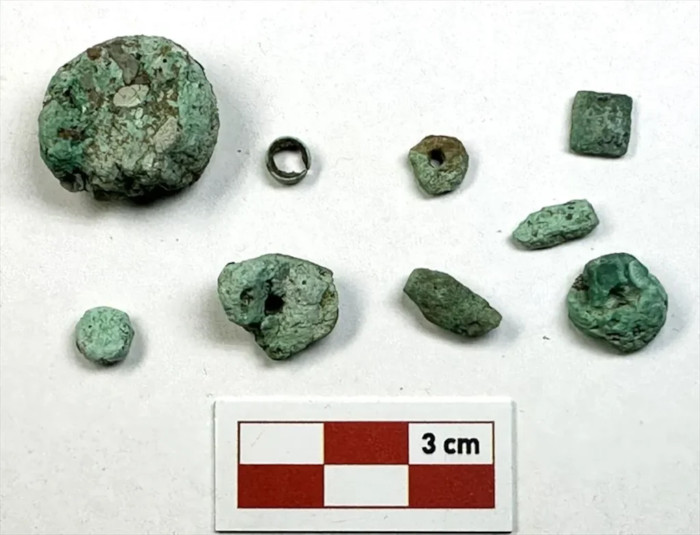
Worked and perforated malachite pieces lie beside a small copper bead and scale. (Republic of Türkiye Ministry of Culture and Tourism)
Copper Working Is Not Copper Smelting
Malachite is a green mineral that contains copper and could be worked into jewelry by prehistoric humans, by grinding, drilling and polishing, as evidenced by the find of a copper smelting site in the Pyrenees. The pure copper formed from native copper ore could be forged directly into tools without the need for smelting. The ancient North American copper mining and metallurgy industry illustrates the difference between these two processes. So the Çayönü assemblage is viewed as recording sophisticated material knowledge long before the mature technologies associated with the Copper Age.
As of now, there are no reports of a furnace, crucible or any other indicatives of the smelting process. A study conducted in 2025 has raised the need for distinguishing between cold working, heat treatment process and the chemical reduction of ore. In order to find out the exact processes for obtaining and shaping copper, scientific investigations need to be carried out.
Two Millennia of Technical Knowledge
According to Ersoy, copper and malachite use in Çayönü goes back at least 9100 BC.
“The new discovery reveals that the mining tradition here continued for approximately 2,000 years and that specialized production activities were carried out in designated working areas,” he said, as quoted by Anadolu Agency.
This emerging data provides confirmation for previous assertions regarding the importance of Çayönü, Nevalı Çori, and Göbekli Tepe in terms of great Neolithic inventions.
An initial study of metallurgy at Çayönü revealed the presence of hundreds of already finished and unfinished malachite beads plus copper beads and tools retrieved from previous excavations. The continuing practice of radiocarbon dating together with archaeometric studies should help establish the timeline of this new workshop and determine if the items produced there were beaten or made through heating, or used some other technology. However, the most important aspect of this workshop is its location; thanks to the organized workplace, we witness actions occurring during one of the earliest encounters with metal. By contrast with any single artifact, the restricted setting enables archaeologists to connect raw materials with the products and the process that crafters have made in one chain of decisions.
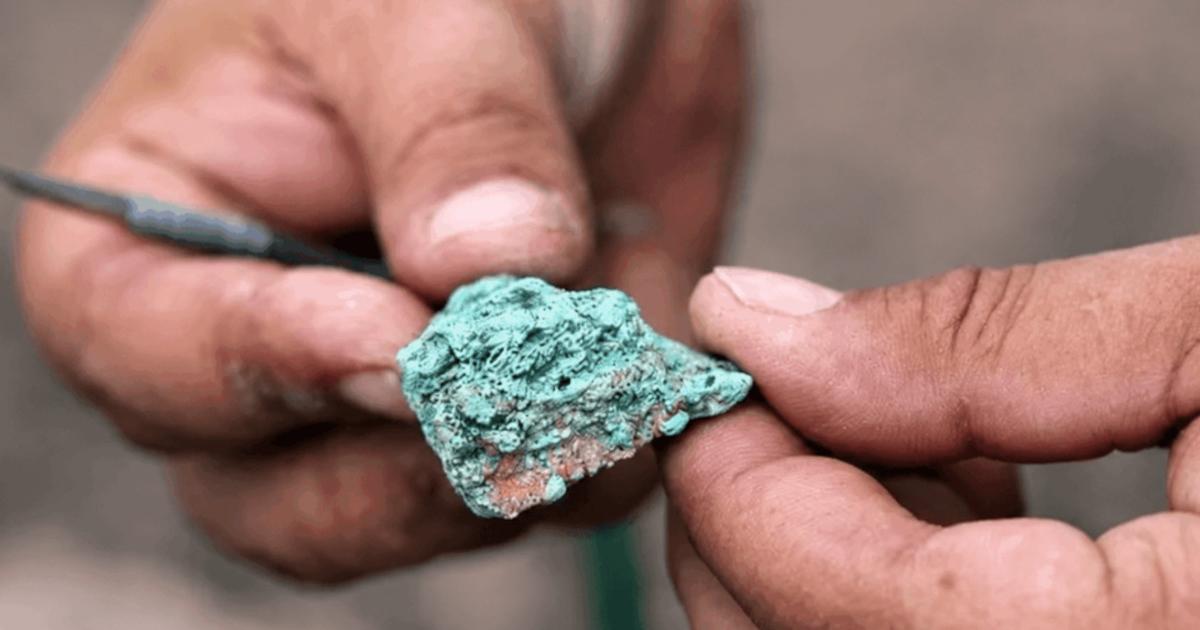
Top image: An excavator examines a malachite fragment from the 9,000-year-old Çayönü copper workshop. Source: Republic of Türkiye Ministry of Culture and Tourism
By Gary Manners
References
Altuntaş, L. 2026. 9,000-Year-Old Malachite and Copper Workshop Discovered at Çayönü Tepesi. Available at: https://www.anatolianarchaeology.net/9000-year-old-malachite-and-copper-workshop-discovered-at-cayonu-tepesi/
Candan, F. N. and Çanakcı, B. 2026. 9,000-year-old mining workshop found in Türkiye. Available at: https://www.aa.com.tr/en/turkiye/9-000-year-old-mining-workshop-found-in-turkiye/4043827
Ersoy, M. N. 2026. Çayönü Tepesi’nde insanlık tarihinin en erken üretim teknolojilerine ışık tutan önemli bir keşfi daha gün yüzüne çıkardık. Available at: https://x.com/MehmetNuriErsoy/status/2094681965999927360
Muşkara, Ü., Karayünlü Bozbaş, S., Telli, M. B. and Konak, A. 2025. Early copper production by the last hunter-gatherers. Journal of Archaeological Science: Reports, 62, 105051. Available at: https://doi.org/10.1016/j.jasrep.2025.105051
Özdoğan, M. and Özdoğan, A. 1999. Archaeological Evidence on the Early Metallurgy at Çayönü Tepesi. In A. Hauptmann, E. Pernicka, T. Rehren and Ü. Yalçın (eds ), The Beginnings of Metallurgy, Der Anschnitt, Beiheft 9, pp. 13–22. Bochum: Deutsches Bergbau-Museum. Available at: https://www.academia.edu/32222879/Archaeological_Evidence_on_the_Early_Metallurgy_at_C_ayo_nu_Tepesi_pdf