
Scientists have successfully dated a massive wooden marker post from ancient Cahokia, determining it was felled around 1124 AD - precisely during the peak of this remarkable North American city's political and economic influence. The discovery provides unprecedented insight into the timeline of monumental construction and the vast reach of Cahokia's material networks during the height of the Mississippian culture. Using advanced tree-ring radiocarbon dating and strontium isotope analysis, researchers determined that the bald cypress post was transported at least 110 miles (180 kilometers) to the Mitchell site, located 6 miles (10 km) north of the main Cahokia precinct.
The Mitchell Log, as it is known, represents the largest marker post ever discovered in the Cahokia region. Today only a 12 ft (3.5-meter) basal remnant weighing approximately one metric ton survives, but the original pole likely stood 60 foot (18 meters) tall and weighed between four and five metric tons, according to research published in PLOS One. Dr. Nicholas Kessler and his colleagues employed cutting-edge techniques to establish that the tree was approximately 194 years old when it was felled. The post was discovered in 1961 in the central plaza of the Mitchell site, abandoned in a ramp of the 13 feet (4 meter) deep post pit after it had apparently broken off during an extraction process.
- Cahokia: The Rise and Fall of an Indigenous Empire
- Ancient Cahokia of North America Reveals 900-Year-Old Treasures
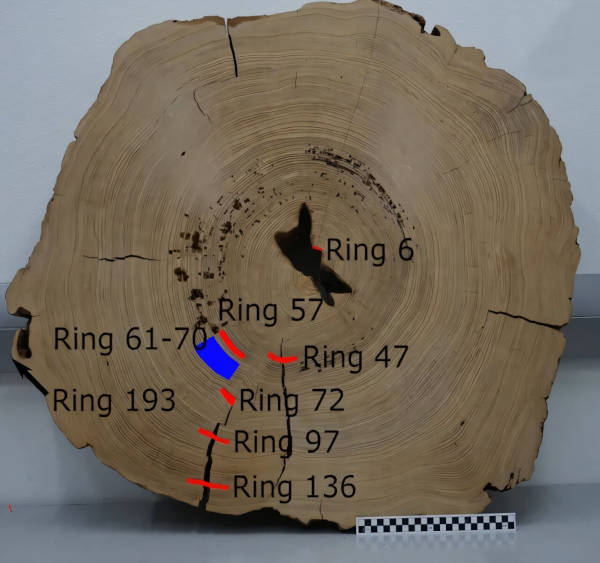
Archaeological remains of the Mitchell Log showing the massive wooden marker post. (Kessler et al/PLoS ONE)
Cahokia's Spectacular Rise as North America's First City
Cahokia emerged around 1050 AD as the largest city north of Mesoamerica, with a population estimated at 20,000 or more - greater than contemporary medieval London and Paris at its peak around 1100 AD. The city consisted of three contiguous precincts sprawled across the central portions of the northern American Bottom, a historically named expanse of Mississippi River floodplain, as reported by Phys.org. The largest of the 120 mounds, Monks Mound, was the largest earthen construction in the Western Hemisphere, standing as a testament to the engineering capabilities of this ancient civilization.
"Cahokia was extremely influential in the history of North America and was a singular and spectacular phenomenon as the first city north of what is now Mexico," explains Dr. Kessler.
The city grew rapidly in the late 11th century, with immigrants forming as much as a third of the population, before reaching its height in the mid-12th century when Cahokian goods, people, and ideas reached from the Gulf Coast up into the Great Plains. Cahokia's new political, social, and religious landscapes transformed the midcontinent and changed the historical trajectory of the Midwest and Southeast regions.
Sacred Poles and Ceremonial Significance
Marker posts were central to Cahokian religious and ceremonial life, serving as both powerful monuments and sacred objects in their own right. These large wooden monuments were hewn from tree trunks and set vertically in the ground near prominent buildings, atop pyramidal mounds, or in community courtyards, squares, and plazas. For many Indigenous peoples in the Americas, poles themselves were powerful and sacred, and for some, the poles were considered persons or ancestors in their own right, according to Dr. Kessler's research.
"In the precontact Cahokian world, poles were often placed in special places where they acted as axis mundis, physically connecting the upper, middle, and under worlds and helping mediate those powers and people's relationships with them," explains Dr. Kessler. Poles could be central to ceremonies or festivals, some of which included dancing, providing offerings to the poles, climbing the poles, or even attaching oneself to the pole to perform various acrobatic feats. In the Greater Cahokian region, such large posts did not appear until the beginning of the Cahokian urban Lohmann (1050-1100 AD) and Stirling (1100-1200 AD) phases, disappearing thereafter along with Cahokia's urban phenomenon.
- The Moundbuilders: North America's Little-known Native Architects
- Mystery enshrouds ancient Native Americans who built burial mounds
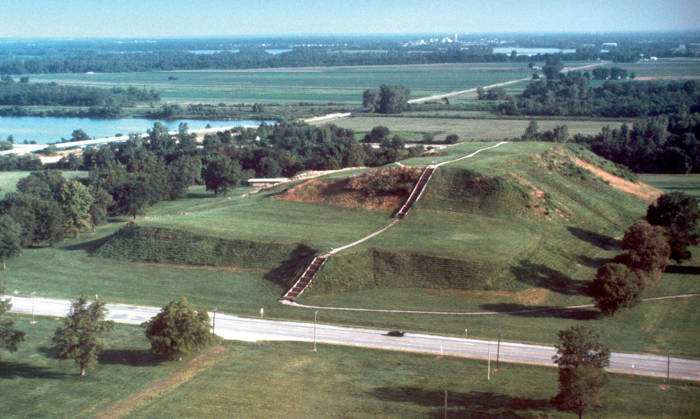
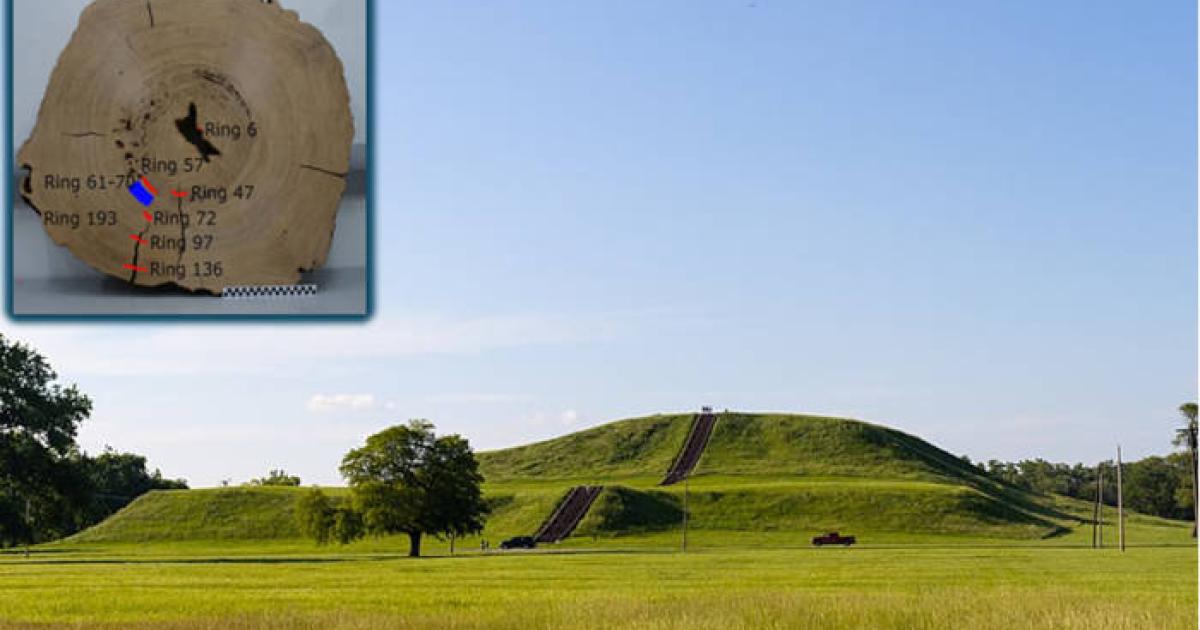
Monks Mound at Cahokia Mounds State Historic Site, the largest pre-Columbian earthwork in the Americas. (Public Domain)
Long-Distance Trade Networks and Cahokia's Decline
The non-local source of the Mitchell Log situates marker posts within regional material networks of similar scale involving shell, minerals, and figurines. Strontium isotope analysis revealed the bald cypress likely originated in southern Missouri, northern Arkansas, western Tennessee, or southern Illinois—with the nearest source at least 180 kilometers away. The bald cypress does not grow naturally in the Greater Cahokian area, making it an imported exotic material that would have required significant logistical capability to transport. Researchers suggest the most likely method would have been floating or rafting the logs upriver in the sloughs and backwaters of the Mississippi River.
The timing of the Mitchell Log procurement corresponds precisely with when earthen and wooden monumental construction had reached its peak, when the regional agricultural system was most highly integrated, and when exotic materials are most evident in and around Cahokia. If the Mitchell Log marker post stood for one or two human generations before natural decay began rotting the base, it would have broken in the ground between approximately 1150 and 1175 AD. This timeframe corresponds remarkably with indirect dating of nearby ceremonial buildings that were abandoned, and when the entire Mitchell site underwent major changes. By 1200 AD, significant regional depopulation and political, religious, and organizational shifts had been completed, and no more oversized marker posts were being emplaced in the Greater Cahokia region, marking the end of an era for North America's first indigenous urban center.
Top image: View of Cahokia's Monk Mound with inset the Mitchell Log. Source: Wikipedia, Inset: Kessler et al/PLoS ONE
By Gary Manners
References
Kessler, N.V., Benson, E.M., Pauketat, T.R., Kirk, J.D., Therrell, M.D. 2025. Age and origin of a Cahokian wooden monument at the Mitchell site, Illinois, USA. PLOS One. Available at: https://journals.plos.org/plosone/article?id=10.1371/journal.pone.0333783
Oster, S.,2025. Giant wooden marker post dates Cahokia's political and economic peak. Phys.org. Available at: https://phys.org/news/2025-10-giant-wooden-marker-dates-cahokia.html