
Before the great standing stones of Stonehenge rose on Salisbury Plain or the pyramids of Egypt appeared along the Nile, Neolithic communities along the coast of Brittany built long earthen monuments unique in prehistoric Europe. Now, archaeologists are using electrical resistivity surveys and other non-invasive geophysical techniques to peer inside these mysterious 6,000-year-old mounds without disturbing them. The efficient imaging technology is revealing revealing large, buried stone anomalies likely representing megalithic features hidden at their cores. The discoveries suggest these monuments are more complex than simple burial mounds. For the mound builders, preserving possible anthropomorphic standing stones may have served as symbols of ritual, ancestry, and social identity in one of Europe's earliest monumental landscapes.
Technology Has Uncovered Stone Shapes Inside Massive Earth Barrows
Electrical surveys at a French Neolithic cemetery have uncovered strange stone shapes concealed inside massive earth barrows. One shape, carved into a human-like silhouette, has puzzled archaeologists for decades. Deep in a forested plateau in Brittany, France, a set of unusual Neolithic monuments hid in plain sight for thousands of years. Long, cigar-shaped mounds of packed earth and silt, some stretching nearly the length of a football field, rise among the pines of Trédion. Now, a team of French researchers has used an effective, non-invasive technique called electrical resistivity mapping, which sends a small current through the ground to detect buried objects, allowing them to look beneath the surface without digging. This method reveals hidden structures by measuring how easily electricity flows through different materials, helping to uncover what lies beneath.
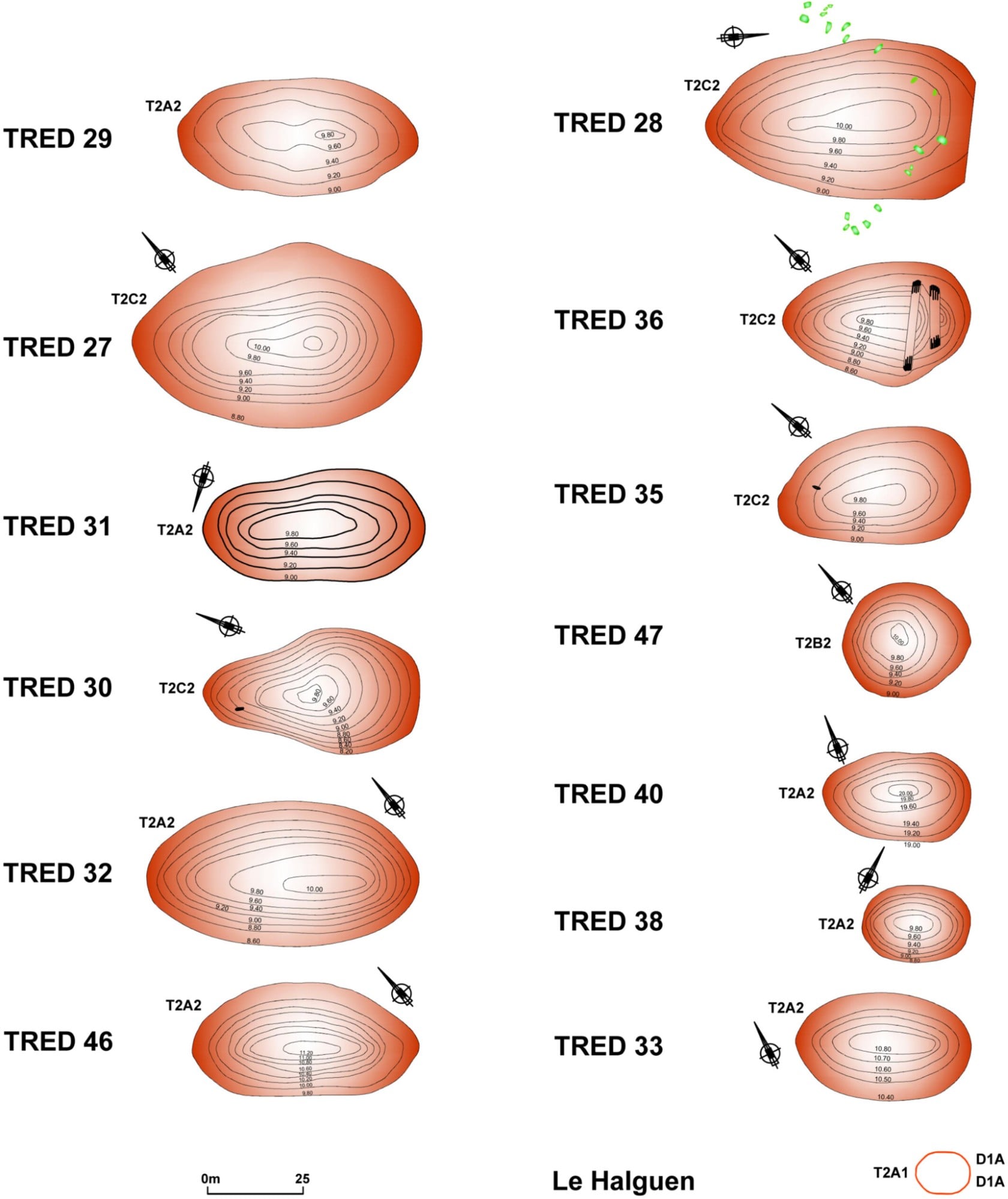
Topographic models of the elongated Neolithic barrows in the Le Halguen sector of the Coëby cemetery, Brittany, illustrating the size and morphology of individual monuments as determined by geophysical survey. (Philippe Gouézin&Vivien Mathé/Archaeological Prospection)
The Coëby Barrows Are Mysterious Prehistoric Monuments
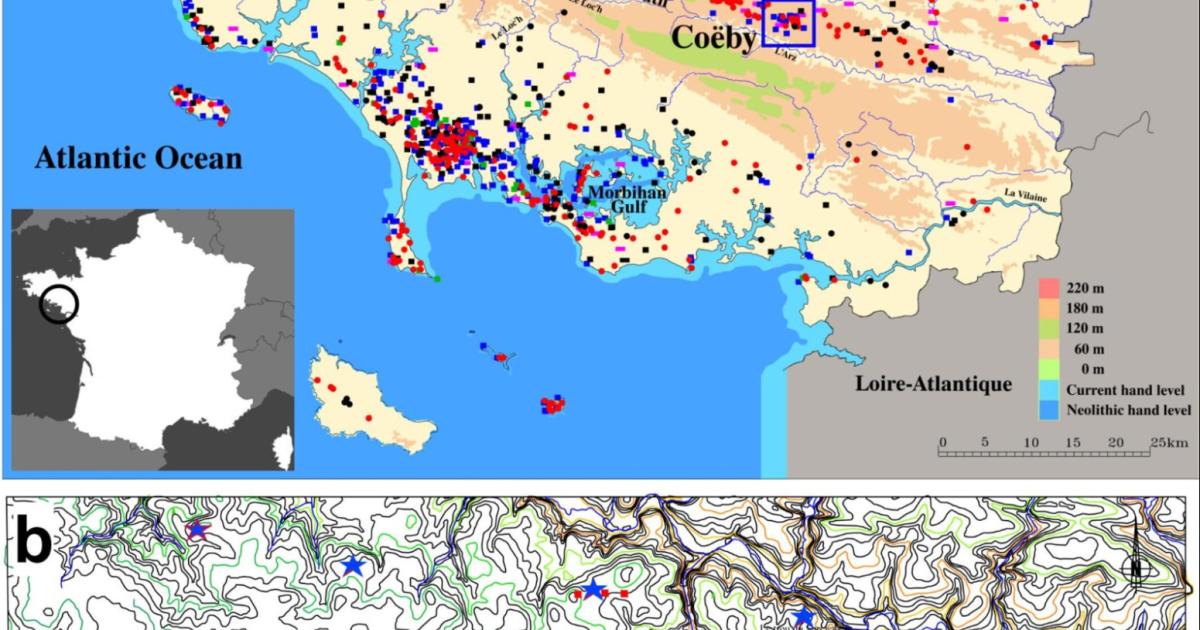
The Coëby Neolithic cemetery was discovered in 1986 in the commune of Trédion, located in the midst of the Landes de Lanvaux granite massif, about 30 kilometers from France’s Atlantic coast. It’s part of a region so rich in prehistoric monuments that Trédion alone contains 95 documented archaeological sites — dolmens, passage graves, standing stones, and the long, low mounds known as barrows. Unlike stone cairns, the Coëby barrows are built of earth and silt, giving them a soft, long shape that researchers compare to giant cigars or teardrops. They usually measure 50 to 80 meters long, 25 to 40 meters wide, and stand up to 1.8 meters tall. Their unusual construction has long raised questions about their purpose due to such great effort being used to construct what appears to be an earthen monument.
- Massive 7,000-Year-Old Wall Found Underwater Off French Coast
- 6,300-Year-Old Settlement Was Home to Earliest Megalithic Builders
More questions emerged in the 1990s, when test excavations at one of the barrows, known as TRED36, uncovered two roughly carved standing stones with distinctly human forms, hidden deep inside the mound rather than displayed on its surface. Archaeologists also found evidence that the earth filling these barrows had been carried in and deposited basket by basket. Further, the builders had placed a peripheral ditch around the structure. Archaeologists Philippe Gouézin and Vivien Mathé, whose new study appears in the journal Archaeological Prospection, now focused on a nagging question: were the standing stones in TRED36 a single oddity, or were similar hidden monuments tucked inside the many other unexcavated barrows scattered across the site?
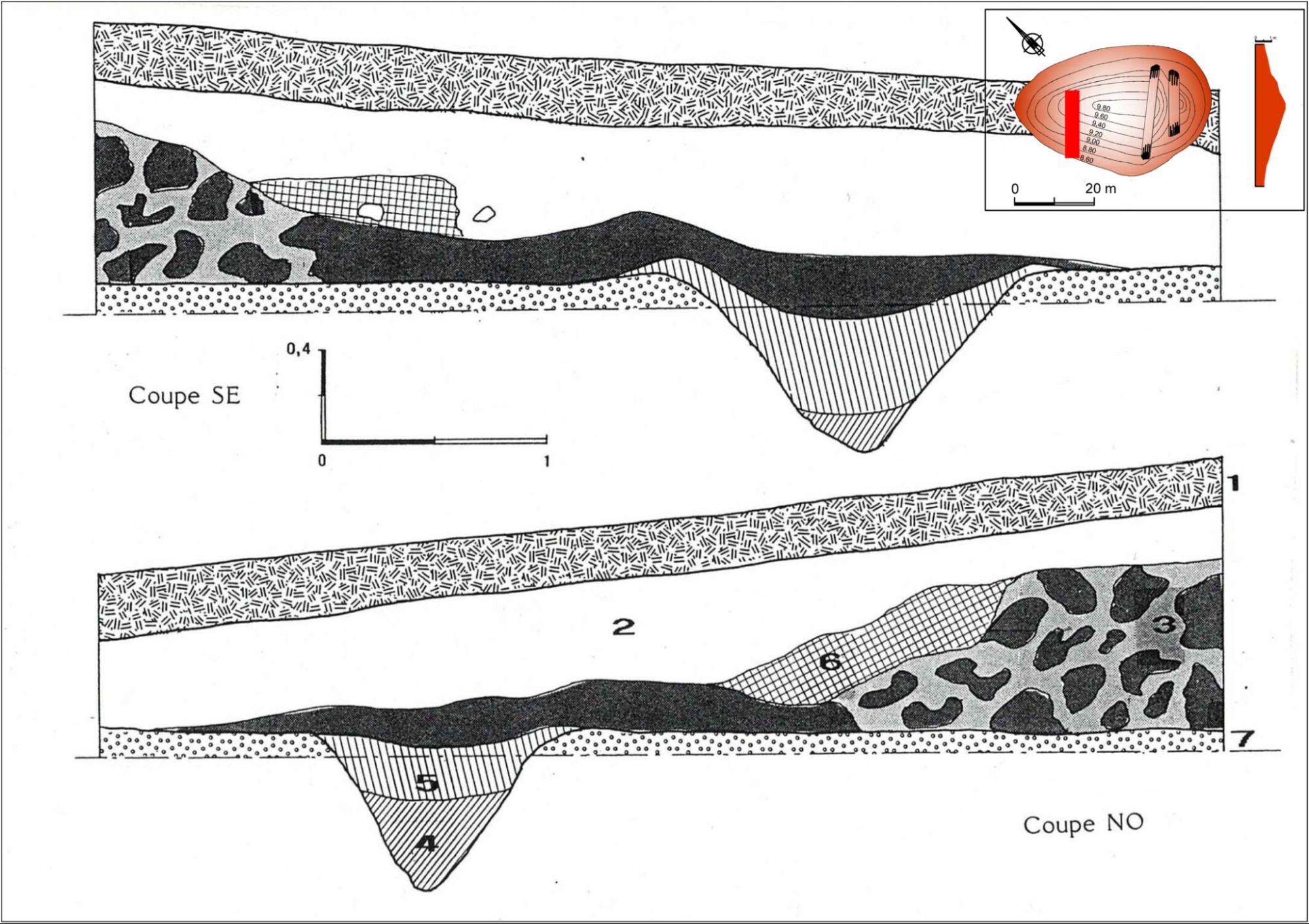
Excavation profiles of the TRED 36 long barrow illustrating the internal structure of the monument and the position of buried stone features associated with anthropomorphic standing stones. (Philippe Gouézin & Vivien Mathé/Archaeological Prospection)
Electrical Resistivity Surveying Replaces Excavations
Rather than excavate more of these fragile, centuries-old monuments, the team turned to geophysics. Electrical resistivity surveying sends a small current through the ground and measures ease of flow. Wet, compacted soil conducts electricity easily, but buried stone resists it strongly. The technicians mapped out the differences across a survey grid, revealing shapes hidden meters below the surface. The grid map let archaeologists “see” through the earth. At both monuments, the survey detected long zones of high resistance — an indication of buried stone — running along the center of each mound, exactly where buried stone features would be expected. an object meant to be protected. At TRED30, several distinct high-resistance areas clustered together, indicating groups of stone blocks placed at different depths below the surface. At TRED31, the pattern was even more pronounced: two areas near the mound’s center. Researchers noted that the larger of the two areas likely represented several stone features grouped.
- Excavations Near Stonehenge Reveal Early Bronze Age Barrow Cemetery
- 39 Prehistoric Megaliths At ‘The French Stonehenge’ Destroyed by Developers
The scans also captured the effects of time and modern land use on these ancient structures. A forest access road built after the 1980s survey had cut directly through one of the mounds, and roughly 20% of TRED30’s original footprint appears to have been eroded in recent years—a reminder of quiet, incremental destruction. According to the study, Coëby’s barrows resemble a category of monument known as Passy-type barrows — a tradition of long, standing-stone-topped earthen mounds first identified in the Yonne region of north-central France and known from Normandy down toward Burgundy. These similarities suggest that Brittany's Neolithic builders shared cultural practices with other regions of Europe, indicating part of a broader Middle Neolithic architectural tradition of monumentalizing the dead during the Middle Neolithic period, roughly the middle of the 5th millennium BC.
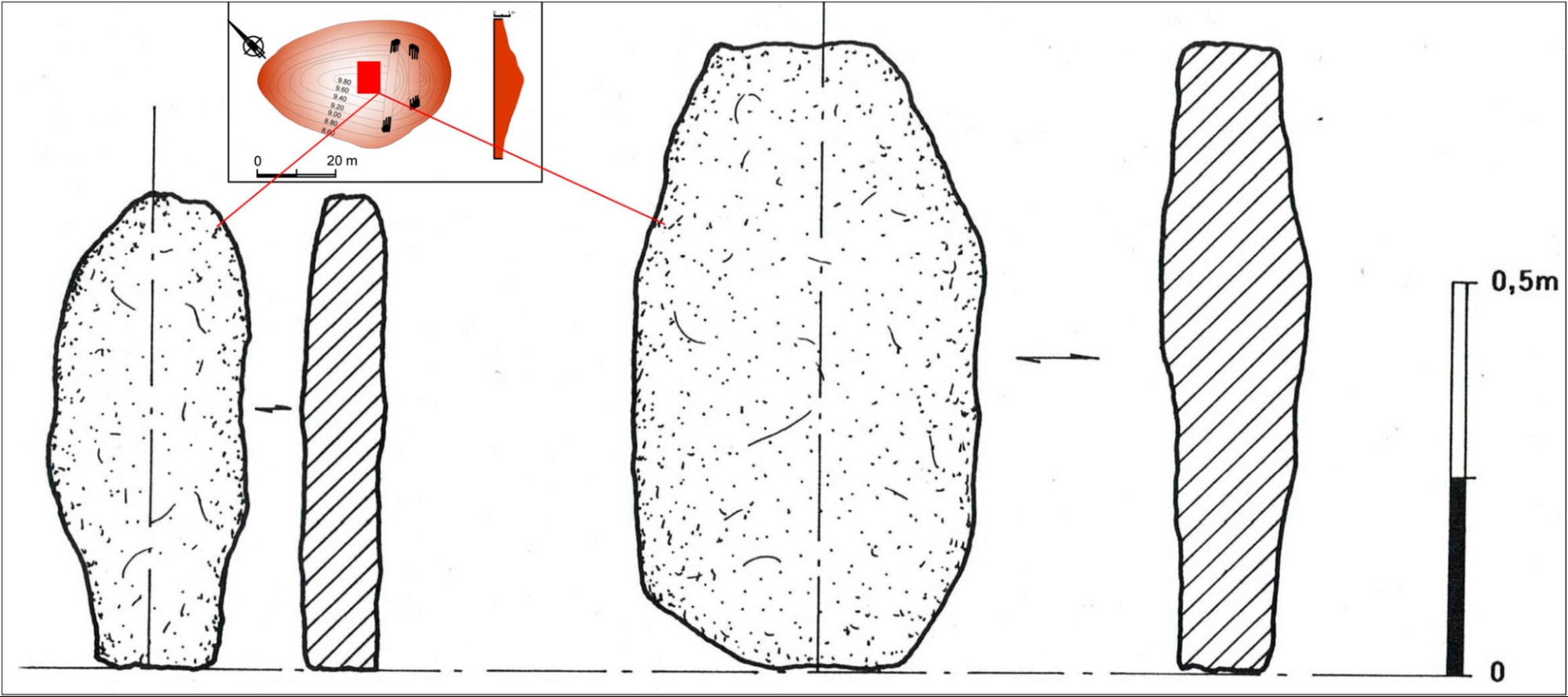
Illustrations of the anthropomorphic standing stones excavated from the TRED 36 barrow at Coëby, Brittany. The human-shaped monoliths provide rare evidence that some Neolithic earthen mounds enclosed carved standing stones within their structures. (Philippe Gouézin & Vivien Mathé/Archaeological Prospection)
The Mystery Is Still Buried
That connection suggests these mounds of dirt aren’t a local oddity, but part of a wider Neolithic tradition found across parts of prehistoric France of monumentalizing the dead. Standing stones, whether placed within a mound or atop it, may have played a symbolic role that archaeologists do not yet fully understand. The scans have helped researchers to develop a plan for the next phase of investigation. Using a more advanced 3D imaging technique called electrical resistivity tomography for future work at the site is one possibility, and a more thorough excavation is another. A method that has seen major advances in tumulus research over the past 15 years. For now, the Coëby cemetery continues to keep its secrets underground.
Top Image: Figure showing the location of the Coëby Neolithic cemetery within Brittany and the surrounding distribution of megalithic monuments, including dolmens, standing stones, passage graves, long barrows, and cairns. Source:(Gouézin & Mathé/Archaeological Prospection)
By Ramsey Hardin
References
Altuntaş, L. August 2, 2026. Giants of Brittany: Ground-Penetrating Scans Reveal Hidden Stone “Bodies” Inside 6,000-Year-Old Earthen Mounds. Arkeonews. Available at:https://arkeonews.net/buried-giants-of-brittany-ground-penetrating-scans-reveal-hidden-stone-bodies-inside-6000-year-old-earthen-mounds/
Arnold, P. August 1, 2026. Brittany Burial Mounds May Hide Human-Shaped Stones as Coëby Cemetery Mystery Deepens. Phys, Org Available at:https://phys.org/news/2026-07-brittany-burial-mounds-human-stones.html
Gouézin, P., and V. Mathé. July 19, 2026. Atypical Long Barrows in the Coëby Neolithic Cemetery (Trédion, Morbihan, France)? The Contribution of Electrical Surveys. Archaeological Prospection. Wiley. Online Library. Available at: https://doi.org/10.1002/arp.70060
Carvajal, G. August 2, 2026. Archaeologists Detect Stones That May Have Human Shapes Beneath the Enormous Neolithic Mounds of Coëby in Brittany. Labrujulaverde. Available at:https://www.labrujulaverde.com/en/2026/08/archaeologists-detect-stones-that-may-have-human-shapes-beneath-the-en, G.ormous-neolithic-mounds-of-coeby-in-brittany/
Radley, D. August 2, 2026. Brittany Neolithic Mounds May Hide Human-Shaped Stones at the Mysterious Coëby Cemetery. Archaeology News Online Magazine. Available at:https://archaeologymag.com/2026/08/neolithic-human-shaped-stones-coeby-cemetery/