
Fact Check verdict: Unverified. Bosch painted a real piece of music on a sinner's buttocks in Hell.
A post on X had passed 1.2 million impressions by October 27, 2026. It says Hieronymus Bosch painted sheet music on a sinner's bare backside in Hell, and that 500 years later someone transcribed and performed it. The painted detail is real, but is the tune now being shared the song Bosch painted, or a modern guess at what his brushstrokes mean?
According to the Prado, the Hell panel of Bosch's triptych is sometimes called the musical Hell, and news reports from February 2014 confirm that a student transcribed and recorded the notes painted on a sinner's buttocks there. Whether those marks were meant as a real piece of music is another matter. The one musicologist whose view could be found says they were not, and the student herself had doubts.
What the evidence says
The painting is The Garden of Earthly Delights, a triptych in the Museo Nacional del Prado in Madrid. Pilar Silva Maroto's catalog entry for the Prado says the right panel is "on occasions referred to as the musical Hell owing to the significant presence of instruments used to torture sinners who have devoted their time to secular music."
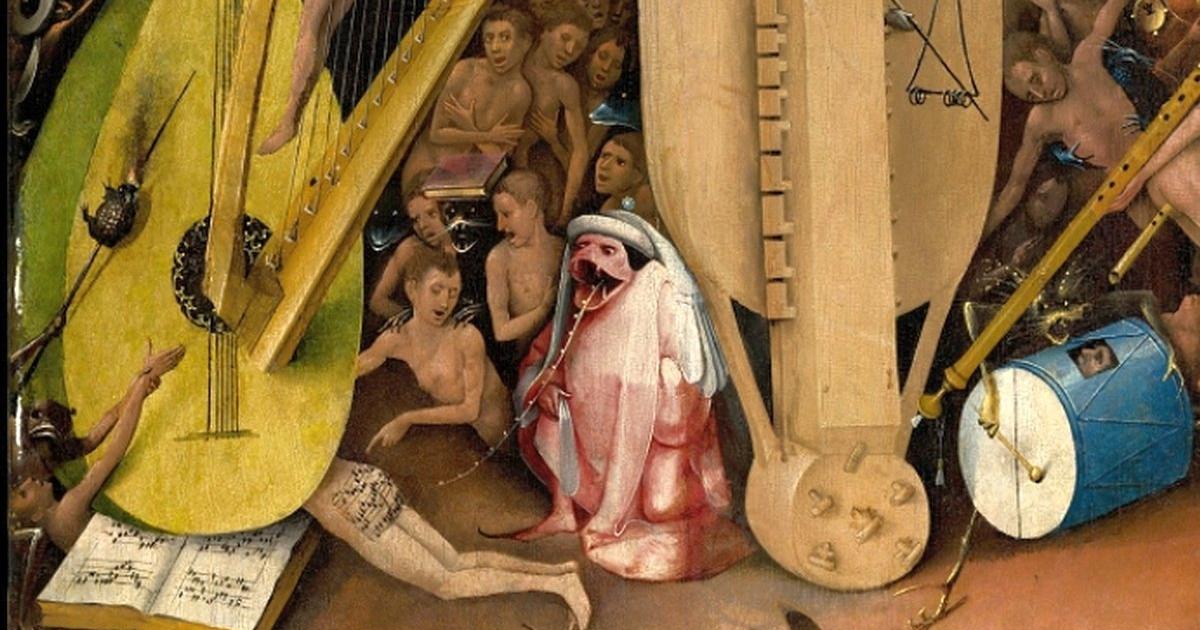
Among those instruments are a giant lute and a harp. A man lies pinned beneath the lute with a short staff of notes painted across his buttocks, beside an open music book. The Hieronymus Bosch Website hosted at alchemywebsite.com describes a choir of souls "led by a demon choirmaster" who "appear to be singing the music written on the bottom of a man crushed under the barbiton."
The date in the viral post holds up reasonably well. The Prado calls the dating "the subject of considerable debate" but concludes on stylistic grounds that the triptych "must have been painted in the 1490s and not after 1505." It also cites Antonio de Beatis, who recorded the work in the Nassau palace of Coudenberg in Brussels on July 30, 1517.
The modern life of the score began on Tumblr. The Guardian reported on February 13, 2014, that a self-described "huge nerd" called Amelia had found what she called "[a] 600-years-old butt song from Hell" while looking at a copy of the triptych with a friend. She wrote, "I decided to transcribe it into modern notation," explaining that she was "assuming the second line of the staff is C, as is common for chants of this era."
An Associated Press story by Kristi Eaton, carried by The Washington Times on February 23, 2014, named her as Amelia Hamrick, 20, an honors college student and sophomore at Oklahoma Christian University. The school said she is believed to be the first person to transcribe and play the song, according to the AP. The Guardian also reported that someone else wrote comic lyrics and a choral arrangement, and "each post had received thousands of notes and reposts."
The alternative view
The strongest case against a real song comes from Joscelyn Godwin, described on the Hieronymus Bosch Website as a musicologist and a colleague of the site's author, who asked him to assess the notation. His reply, published on that page and quoted here from it, begins: "I believe it is made-up notation with no musical identity." He then lists his reasons, which turn on how music was written down in Bosch's day.
Godwin's first objection is that "The C-clef is on a space," when, as he puts it, "Clefs are always on lines" and never between them. That bears directly on the 2014 version, which depended on reading the second line of the staff as C. His second point is that "The notes are not identifiable mensural types" for the period. He adds that the painter "seems to have used a single brush-stroke for each note, sometimes with a tail and sometimes without," so that "the rhythm, if any, makes no sense."
Godwin goes on to note that "There are two voices on each stave," while late 15th century notation, with rare exceptions for keyboard music, "uses one voice per stave" instead. Judging, as he says, by simply comparing notes in vertical alignment, he finds that "there is no sense to the harmony of the two voices" either. He also tests whether plainsong was meant and concludes that "the melody is very uncharacteristic of plainsong, because it has too many repeated notes and triadic patterns."
His conclusion is that the painter was simply signaling music "and not reproducing a real piece." The site's author sums up the reply as showing that the score "is only made to look like music but has no real musical structure." Hamrick reached a similar view in 2014, telling the AP, "I think Bosch may have just been slapping notes up there to make it look like music. I played through it several times and it's not a very good Gregorian chant."
The case for a real tune rests on the fact that the marks sit on a staff with a clef and can be sung once someone decides where C falls. Hamrick told the AP, "People have written about the music on the guy's butt before, but nobody ever bothered to transcribe it, apparently." Her version shows the notes can be made singable, though only by choosing a reading the painting itself does not settle.
Painters in Bosch's wake could depict real music when they chose to. The same website points to the Concert in an Egg, a painting by a later follower of Bosch in the Musée des Beaux-Arts in Lille. There, it says, the music seen close up "is obviously actual playable music." No source consulted for this check offers comparable evidence that the score in the Hell panel encodes a specific, recoverable melody.
Where this leaves it
The painted notes exist, and their setting is clear, since the Prado places them in a Hell where secular music is punished, and the Guardian notes that the instruments "are often interpreted as symbols of pleasure, lust or the notoriously naughty habits" of traveling minstrels. A sinner with a score on his buttocks fits that moral scheme whether or not anyone was meant to sing it.
What remains unproven is the step from paint to performance. The 2014 recording is one student's transcription built on an assumption about the clef, and the only expert assessment found for this check says the notation breaks the conventions of its own period on several counts. That evidence is indicative rather than conclusive, because it rests on a single musicologist's reply relayed through one website.
So the claim that Bosch painted a real piece of music remains less a discovery than an act of interpretation. Anyone can play the notes, as Hamrick did, though what listeners hear in any recording of it is a modern reading of brushstrokes that may never have been meant as a tune.
How we checked this
Read in full for this check: the Prado's catalog entry, the Hieronymus Bosch Website page with Joscelyn Godwin's reply, the Guardian's report of February 13, 2014, and an archived copy of the AP story in The Washington Times. The viral X post was used only for its claim about the song, and its impression count was read on October 27, 2026.
No interviews were conducted, earlier Ancient Origins coverage was not used as a source, and every quote was checked against a saved copy on October 27, 2026. Godwin's views are quoted secondhand from the website that published his reply. The image license was checked on its Wikimedia Commons file page.
Related on Ancient Origins
- Band Posters of the Renaissance: How Medieval Music Fans Showed off Their Taste
- Hurdy Gurdy Man: Rock Star of the Medieval Music Scene
- 3,000-year-old Hurrian Hymn Indicates Ancient Connections Across Continents
- The ancient song recreated from 3,400-year-old cuneiform tablets
- The Book Once Read in Some Early Churches: A Vision of Hell the Bible Left Out
How we label claims: see How we check evidence.
More in this series: Göbekli Tepe, the Sphinx and Atlantis: what the evidence says.
Detail of the Hell panel of Hieronymus Bosch's The Garden of Earthly Delights (Museo Nacional del Prado, 1490s), with the staff of notes painted on a sinner's buttocks beneath a giant lute. Hieronymus Bosch, via Wikimedia Commons. Public domain
By Aris Manus
Claim by claim
- Unverified: Bosch painted a real piece of music on a sinner's buttocks in Hell. Reason: the musicologist Joscelyn Godwin calls it made-up notation, with a clef on a space and notes that are not identifiable mensural types.
- Established: Bosch painted a staff of notes on a sinner's buttocks in the Hell panel of The Garden of Earthly Delights. Reason: the detail is visible in photographs of the panel and was described by the Guardian and the Associated Press in 2014.
- Established: A student transcribed and recorded a version, reported in February 2014. Reason: the Guardian and the AP both reported it, and the AP names her as Amelia Hamrick of Oklahoma Christian University.
- Unverified: The 2014 tune is the melody Bosch wrote. Reason: the transcription assumed the second line of the staff is C, and Hamrick told the AP it was not a very good Gregorian chant.
- Established: The Hell panel is closely tied to music. Reason: the Prado says it is sometimes called the musical Hell for its instruments of torture.
- Established: The painting is roughly 500 years old. Reason: the Prado dates it to the 1490s, though it notes the dating is debated.
Sources
- Silva Maroto, Pilar (2016). Jheronimus Bosch. The Garden of Earthly Delights Triptych. Catalog entry, Museo Nacional del Prado.
- The music in Bosch's Garden of Earthly Delights. Hieronymus Bosch Website, alchemywebsite.com, with a reply by the musicologist Joscelyn Godwin.
- Michaels, Sean (2014). Report on the blogger who recorded sheet music from Hieronymus Bosch's triptych. The Guardian, February 13, 2014.
- Eaton, Kristi (2014). Associated Press report on Amelia Hamrick's transcription. The Washington Times, February 23, 2014. Archived copy.