
Strange Grooves in Two Ancient Mouths
The remains of Maros-LBB-1a were recovered from Leang Bulu Bettue site located in South Sulawesi and belonged to an adult around 35 of age. A second, male adult specimen, known as CPL-R2a was buried at a cave called Leang Cappalombo 1, about 7,600-6,300 years ago. Both humans were born before the advent of agriculture, during an era when the island had a culture known to produce ancient cave paintings.

The historical distribution of betel chewing, with Leang Bulu Bettue and Leang Cappalombo 1 marked in the South Sulawesi inset. (Adam Brumm / Natural Earth / CC BY 4.0)
The specimens show rounded groove abrasion on their teeth unlike that of ordinary wear and tear, and typical of holding hard, spherical objects 10 to 20mm across in size. Due to the scarcity of ancient skeletal remains in Sulawesi, the sample size is small but the similarity in the traced damage appeared between samples which were recovered more than 10,000 years apart shows a persistent type of behavior.
- 4,000-year-old Teeth Reveal the Earliest Human High
- The Legacy of Ancient Trippers Stripped from Teeth
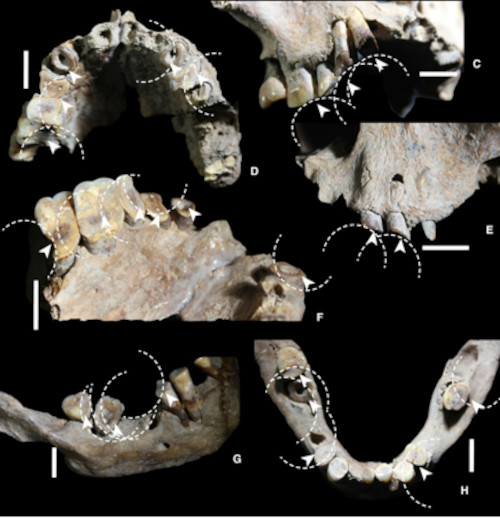
The rounded grooves in teeth from the two Sulawesi foragers are marked by arrows and dashed circles. (M. Vlok / CC BY 4.0)
From Suspicion to Chemical Evidence
The researchers suspected betel nuts use, as the grooves matched the size and shape of wild areca seeds. To prove that whole nuts could work without the assistance of slaked lime (which is commonly used in today’s betel quids), they soaked three types of areca seed in a liquid similar to saliva and applied the solution to frog eggs engineered to contained human neural receptors. The intact nuts released sufficient amounts of arecoline, which is the primary neuroactive alkaloid, to activate the muscarinic receptors thereby producing various effects.
A technique called liquid chromatography–mass spectrometry then detected arecoline in dental tissue from both individuals. Their teeth lacked the dark staining associated with chewing a prepared quid, and compounds produced in larger quantities when lime is added were absent. These findings indicated a method of simply sucking the seed. The approach extends work showing how archaeology can identify drug-taking in prehistory even when plant remains have vanished.
- Tiny Ice Age Art from Indonesia Confirms Humanity’s Creative Drive
- Hints of Ancient Symbolic Culture are Revealed in Indonesian Ice Age Art and Jewelry
A Painkiller That Made the Pain Worse
The question arises why individuals would elect to continue a practice that results in destruction of their teeth. Arecoline is known for its analgesic properties, and both samples had poor teeth condition. Therefore, it can be speculated that chewing the seeds might have alleviated the pain caused by dental problems while also acting as a stimulant. According to the Griffith University report, Adam Brumm, the lead author of the study, explained that the long years of chewing may eventually result in the exposure of the pulp chamber, cause infection and create “a cycle of continued habitual use”.
Evidence of that cycle appears especially obvious in the case of the teeth of CPL-R2a, which were worn right to the root in some areas and the exposed pulp must have cause severe pain. The evidence does not indicate precisely the reasons for first starting betel nut use - whether it was relief, stimulation, ritual or some social norm.
Sofia Samper Carro, an independent archaeologist not affiliated with the study informed ABC Science that these samples “predate any published evidence by thousands of years.”
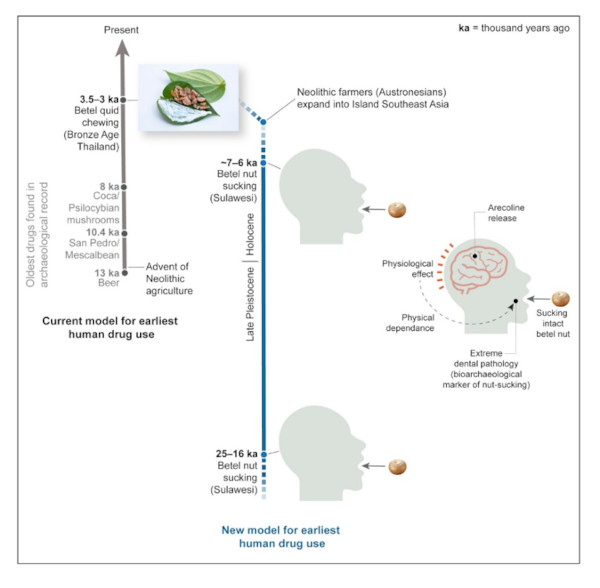
The proposed Sulawesi chronology places betel-nut sucking well before established evidence for beer and several other psychoactive substances. (A. Brumm / CC BY-SA 4.0)
Drug Traditions Before Farming
Before this discovery, prominent evidence for sustained psychoactive consumption included 13,000-year-old beer production at Raqefet Cave in Israel, and much later residues from coca, mescalbean and other plants elsewhere. The Sulawesi finds suggest that detailed knowledge of useful and mind-altering plants belonged to mobile hunter-foragers, not only to later farming societies. They also give new depth to the long history of medicinal and ritual plant drugs, while stopping short of proving that these two people represent the world’s first drug users.
The modern preparation of betel quid is made up of components such as areca nut, betel leaf, and slaked lime, thus increasing the chances of its main active constituents being absorbed and yielding greater effect. The new study proposes that this complex practice may have evolved from the simpler Ice Age habit of sucking intact nuts. If the interpretation is correct, betel nut use carried both attraction and harm long before villages, fields or written medicine appeared.
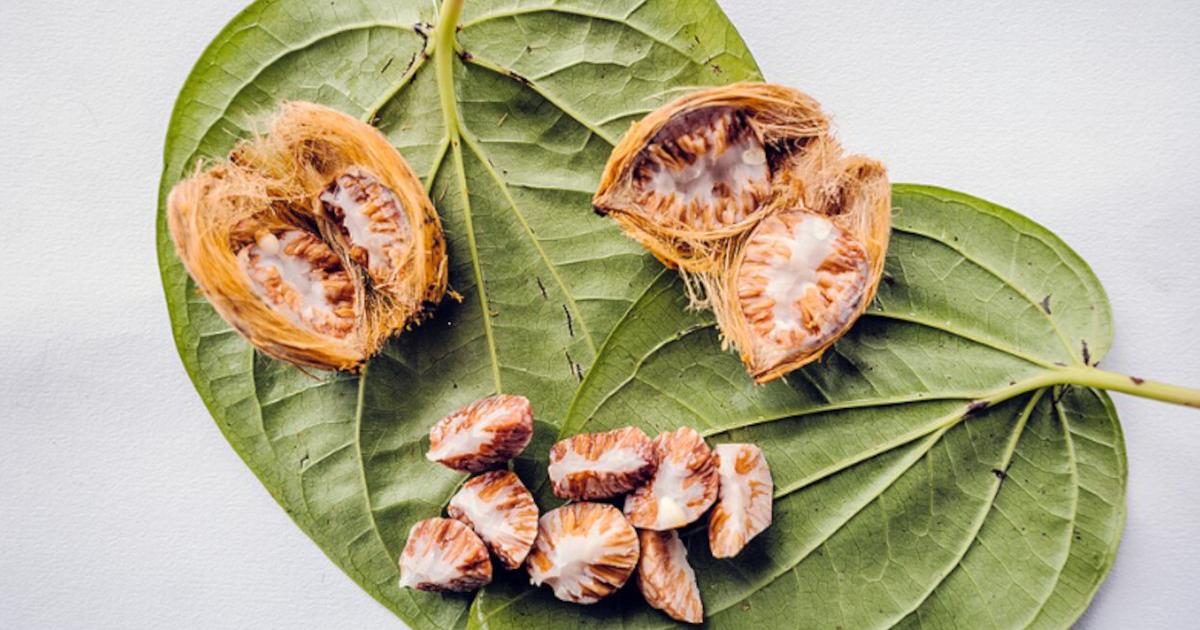
Top image: Betel nuts on a leaf. Source: Wann Majaw/CC0
By Gary Manners
References
Brumm, A., et al. 9 September 2026. Betel nut sucking is the earliest recorded evidence for the habitual use of a neuroactive plant drug. Science Advances. AAAS. Available at: https://www.science.org/doi/10.1126/sciadv.aei1901
Brumm, A., Matheson, C. D., Fakhri, Vlok, M. and Papke, R. L. 9 September 2026. Ancient teeth reveal the Ice Age origins of the world’s 4th most common addictive drug. Available at: https://theconversation.com/ancient-teeth-reveal-the-ice-age-origins-of-the-worlds-4th-most-common-addictive-drug-285790
Griffith University. 9 September 2026. Ice Age origins of one of humanity’s oldest drug habits discovered. Available at: https://phys.org/news/2026-09-ice-age-humanity-oldest-drug.html
Phiddian, E. 10 September 2026. Traces of betel nut in 25,000-year-old teeth earliest-known evidence of human drug use. Available at: https://www.abc.net.au/news/science/2026-09-10/earliest-evidence-of-human-drug-use-discovered-in-indonesia/107130656