



On the surface, an event portrayed in the Bayeux Tapestry seems innocuous, but it may have a much more serious political implication than its size would suggest, as argued by Professor Michael Lewis from the British Museum. Lewis believes that Ælfgyva is Emma of Normandy, and that the naked man underneath her may indicate an affair which could undermine William the Conqueror’s claim to the throne. The proposed Bayeux Tapestry scandal turns an already mysterious vignette into a possible attack on the very legitimacy of the Norman Conquest.

Scene 15 of the Bayeux Tapestry shows Ælfgyva, a cleric and a nude man in the lower border. (Université de Caen Normandie, CNRS, ENSICAEN/Fabrique de patrimoines en Normandie/Public Domain)
A Tiny Scene with a Dangerous Message
The scene occurs approximately 15 meters (49 ft) into the embroidery. A clergyman is seen extending his hand to a woman wearing a veil in a section with the Latin inscription Ubi unus clericus et Ælfgyva meaning “where a certain clergyman and Ælfgyva.” A nude male figure appearing in the lower margin takes a pose similar to that of the cleric thus creating a visual link between the two which has been interpreted as a sign of lust or sexual misconduct. The ambiguous scene has led to a number of identifications of Ælfgyva because Ælfgifu, its Old English form, was a common name.
In the original HistoryExtra podcast discussion, Lewis and Oxford historian Dr Emily Winkler examine whether the figure could be Emma. Lewis told the program that the sexual allusion “undermines her legitimacy and therefore the legitimacy of the Norman Conquest,” quotes a Daily Mail report. If contemporary viewers recognized the reference, the Bayeux Tapestry scandal may have worked as a compact piece of dynastic propaganda.
- Nearly 1,000 Years Old, the Bayeux Tapestry is An Epic Tale and Medieval Masterpiece
- A Red Dawn Rises - The Battle of Hastings, 1066
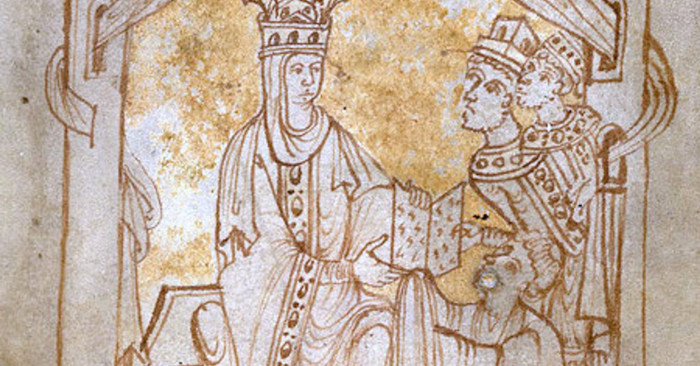
Emma of Normandy receives the Encomium Emmae Reginae, with Harthacnut and Edward behind her. (The British Library/Public Domain)
Emma of Normandy and the English Crown
Emma wedded Æthelred II in the year 1002 and took the English name Ælfgifu, which provides her candidacy for the name of the inscription. Following Æthelred’s death she married Cnut, with her offspring including Edward the Confessor whose death without heirs led to the war for England in 1066. Since Emma was also the great-aunt of William, her Norman ancestry became a major element of family relations that supported his claim.
The later allegation named Ælfwine, the bishop of Winchester, but the evidence of the allegation comes from oral tradition at a later date rather than any hard evidence. According to Lewis's reading, the tapestry employs this rumor to purposefully tarnish the image of Emma and thus question William's legitimacy to rule. In light of this interpretation, the scandal from the Bayeux Tapestry is not something irrelevant but rather a systematic part of the struggle for power.
- Odo of Bayeux: Sharing the Spoils Under William the Conqueror
- The Harrying of the North, by William the Conqueror
Why the Identification Is Still Uncertain
The Emma Theory is not a new thing. In his 1991 study, “The Identity of Aelfgyva in the Bayeux Tapestry,” Eric F. Freeman demonstrated her candidacy. There are other hypotheses where Ælfgyva is presented as an abbess, or member of the family of Harold Godwinson, or Ælfgifu of Northampton, or Eadgifu of Leominster. Each of the candidates is able to explain part of the scene, but none resolves its inscription, gestures and border imagery beyond doubt.
Historian Natasha Hodgson argues against the theory in The Conversation, pointing out that the stories of Emma and the bishop came much later than her death and the making of the tapestry. This gap weakens the chances of claims that the panel depicts a known scandal of the 11th century, even if they made older hearsays survive in writing. Therefore, the most reasonable conclusion is that Lewis has raised a more daring possibility, rather than solved the mystery.
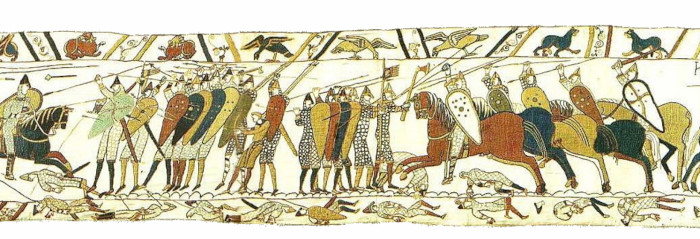
Norman cavalry and English infantry clash during the Battle of Hastings. (Public Domain)
A Medieval Mystery Returns to England
In 2026, the Bayeux tapestry returned to England for the first time in almost 1000 years. The official Bayeux Museum describes the work as nearly 70 meters (230 feet) of wool embroidery on linen, telling the events around William’s victory at the Battle of Hastings. It is one of the most important cultural artifacts in the world.
Whether the Bayeux Tapestry scandal names Emma or another Ælfgyva, its unresolved ambiguity shows why this medieval artwork still provokes argument almost a millennium later.
The tapestry will be on display at the British Museum from September 10, 2026 to July 11, 2027.
Top image: Scene 15 of the Bayeux Tapestry shows Ælfgyva, a cleric and a nude man in the lower border. Source: Université de Caen Normandie, CNRS, ENSICAEN/Fabrique de patrimoines en Normandie/Public Domain
By Gary Manners
References
Bayeux Museum. 2026. Discover the Bayeux Tapestry. Available at: https://www.bayeuxmuseum.com/en/the-bayeux-tapestry/discover-the-bayeux-tapestry/
British Museum. 2026. The Bayeux Tapestry. Available at: https://www.britishmuseum.org/exhibitions/bayeux-tapestry
Freeman, E. F. 1991. The Identity of Aelfgyva in the Bayeux Tapestry. Annales de Normandie, 41(2 ), pp. 117–134. Available at: https://www.persee.fr/doc/annor_0003-4134_1991_num_41_2_1886
HistoryExtra. 2026. Is there a royal sex scandal hidden in plain sight in the Bayeux tapestry? Available at: https://podcasts.apple.com/de/podcast/is-there-a-royal-sex-scandal-hidden-in-plain-sight/id256580326?i=1000786481726
Hodgson, N. R. 2026. What three female figures in the Bayeux tapestry reveal about medieval women. Available at: https://theconversation.com/what-three-female-figures-in-the-bayeux-tapestry-reveal-about-medieval-women-289344
Jarman, C. 2025. Emma of Normandy: not just a two-time queen consort of England. Available at: https://www.historyextra.com/period/anglo-saxon/emma-normandy-queen-life-marriages-children-death-buried/
Leatham, X. 2026. The sex scandal hidden in the Bayeux Tapestry: Scene depicting a naked man and a mysterious woman might have been a subtle nod to an affair, expert claims. Available at: https://www.dailymail.com/sciencetech/article-16095175/sex-scandal-Bayeux-Tapestry-mysterious-affair.html






















