

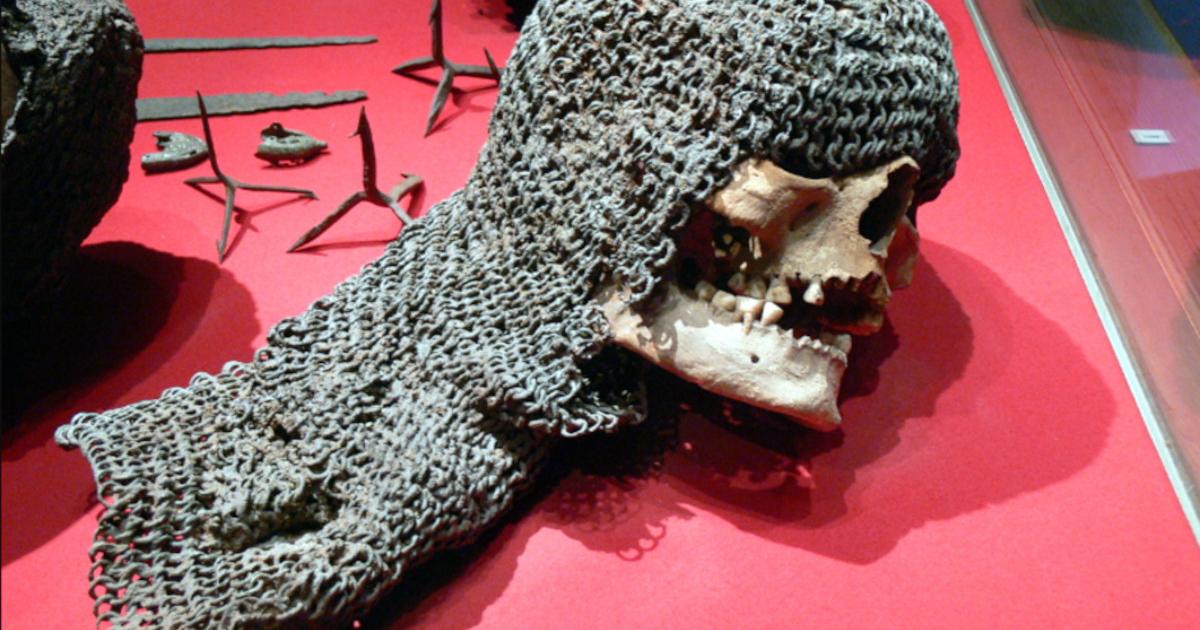

A spiked war club may have delivered the final blow to some of the men killed in the Battle of Visby in 1361. A new forensic and experimental study, presented at the 25th European Paleopathology Association meeting in Berlin matched the weapon’s distinctive injuries to square-shaped holes found in skulls from the battle’s mass graves.
The result adds a grim detail to one of medieval Europe’s most remarkable archaeological records and may preserve evidence of coordinated attacks.
A Mass Grave Preserves a Medieval Battle
Danish soldiers invaded Gotland in July, 1361 culminating in the Battle of Visby. The bodies of about 1,800 soldiers are thought to have been buried in the mass grave at Korsbetningen, many still in armor. This find has provided a wealth of physical evidence regarding the realities of medieval warfare.
The grave was first excavated early in the 20th century, and has provided an insight into how swords, axes, spears, and other weapons were used during that time. It has also shown how effective they were, based on the evidence found on bones and armor from the Battle of Visby. Using structured light scanning and microphotogrammetry of seven crania, Patrick Randolph Quinney and colleagues reconstructed penetrating trauma to study the fracture patterns surrounding the injury sites. This has provided more information regarding the nature of injuries sustained from sword cuts, axe wounds, and other weapons commonly used during the medieval period.
- The Harrowing Remains of the Battle of Visby’s Medieval Massacre
- Axe-Wounded Visby Warrior Brought to Life Over 600 Years Later
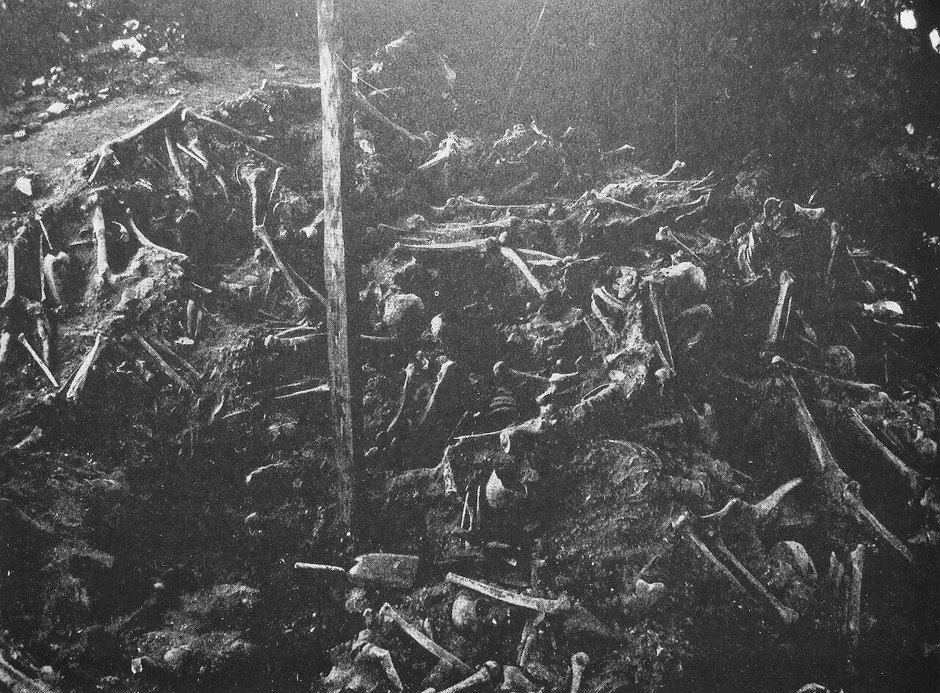
Early excavation of the Battle of Visby mass graves in 1905. (Public Domain)
Testing Crossbows, Axes and Clubs
The square lesions had previously been attributed to several possibilities, including a crossbow, a spiked axe and a spiked club. To test them, the researchers made authentic reproductions and struck animal-bone targets covered with ballistic gelatin and replica armor. Motion capture and four-dimensional telemetry recorded the movements and impact mechanics, while forensic fractography helped compare the experimental damage with the archaeological wounds.
Only the spiked club reproduced the square defects closely enough to support the match. The official study abstract therefore describes the club as the likely cause, while carefully qualifying the conclusion as a possibility rather than a certainty. Because the research has been presented at a conference and has not yet appeared in a peer-reviewed journal, the findings should be regarded as a strong working interpretation rather than the final word.
- Skeletons Show Horrific Injuries from The Battle of Towton
- Battered Remains of Medieval Knight Who Died in England’s Bloodiest Battle
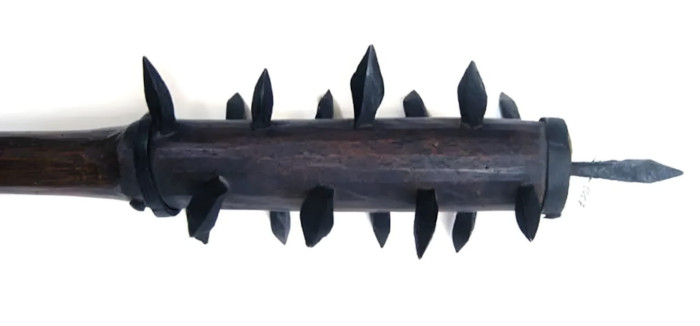
Spiked club in the Livrustkammaren/Swedish History Museum collection. (Kalmö, Ulf, Livrustkammaren/SHM, CC BY 4.0)
A Possible Coup de Grâce
Perhaps the most disturbing finding is the order in which the injuries occurred. Some of the skulls exhibit multiple weapon types, and at least one sequence places an axe wound before a strike that resulted in the square-shaped opening. The authors propose that multiple attackers may have rendered a victim incapacitated prior to another assailant delivering the final blow, or coup de grâce, using a club.
That interpretation also complicates older descriptions of the Gotland defenders as an untrained peasant force overwhelmed by professional soldiers. The Visby warrior brought to life through facial reconstruction demonstrates the violence recorded in a single skull, while the comparison with the battlefield remains from Towton and Stirling suggests that similar penetrating injuries may be identifiable elsewhere.
An Important Step Forward
The study’s real significance lies in its method as much as in the weapon it identifies. Using three-dimensional modelling of bones along with fracture analysis, recreating weapons and utilizing motion capture, they have illustrated how experimental archaeology can test alternative claims regarding injuries sustained during battles in the Middle Ages.
The significance of the Battle of Visby mass graves is enhanced due to the speed at which the soldiers were buried, as well as the inclusion of many of the soldiers' personal effects. Other battlefield discoveries, such as the medieval mass grave found in England, show how burial context can preserve evidence long after historical documents cease to exist.
As further research examines the bodies, armor and ancient DNA, the battlefield may reveal not only what weapons were used, but also how those weapons were used at close range.
Top image: Battle of Visby skull in chainmail, recovered from a mass grave on Gotland. Source: Wolfgang Sauber/CC BY-SA 3.0
By Gary Manners
References
Cowie, A. 2022. Axe-Wounded Visby Warrior Brought to Life Over 600 Years Later. Available at: /news-history-archaeology/visby-warrior-0017482
Miller, M. 2019. Battered Remains of Medieval Knight Who Died in England’s Bloodiest Battle. Available at: /news-history-archaeology/battered-remains-medieval-knight-who-died-bloodiest-battle-england-020428
Radley, D. 2026. Spiked club delivered the final blow in the 1361 Battle of Visby, study finds. Available at: https://archaeologymag.com/2026/08/spiked-club-in-the-1361-battle-of-visby/
Randolph-Quinney, P. 2026. Visby 1361 battle trauma: Forensic analysis & experimental verification of spiked war club penetration mechanics. Available at: https://cfp.dainst.org/25th-european-ppa-meeting/talk/XAXJMT/
Wu Mingren. 2023. The Harrowing Remains of the Battle of Visby’s Medieval Massacre. Available at: The Harrowing Remains of the Battle of Visby's Medieval Massacre | Ancient Origins






















