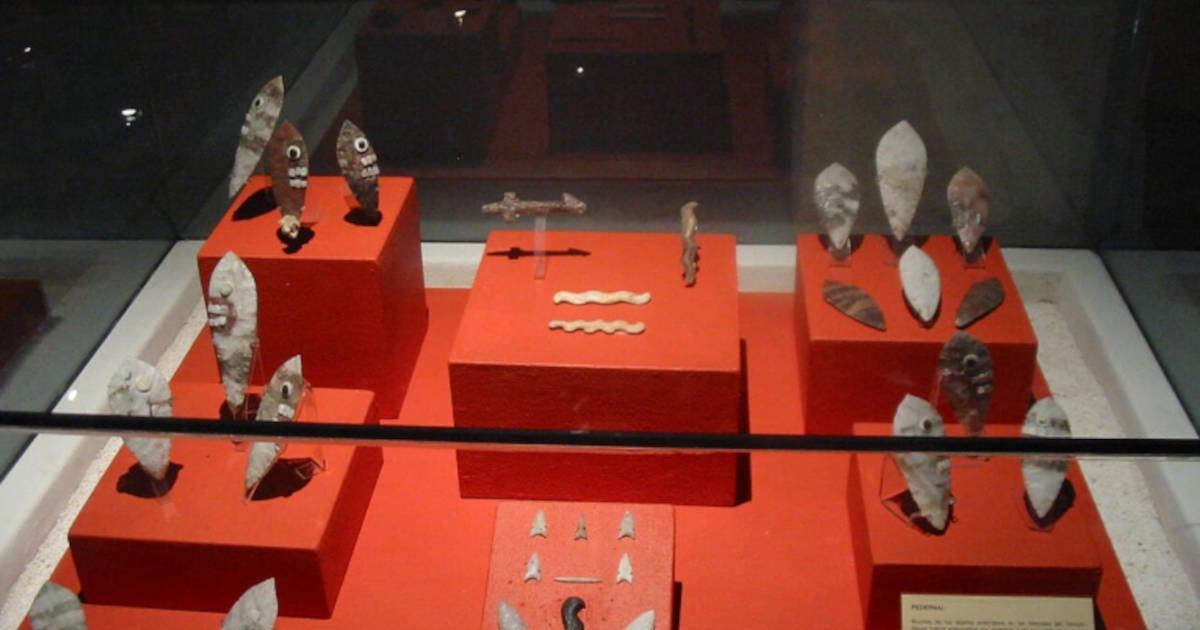

Under the volcanic heart of pre-Columbian Mesoamerica, obsidian glittered like frozen flame—black, knife-edged, and imbued with religious meaning. To the Mexica, people commonly referred to as the Aztecs, this volcanic glass represented a religious channel, a political currency, and a mirror of empire.
A fascinating new study, the largest ever of its kind, published in the Proceedings of the Natural Academy of Sciences, examined 788 artifacts from the sacred center of the Temple Mayor in Tenochtitlan, showing the movement of the beautiful stone, displaying a rich web of obsidian trade, ritual, and imperial control. The study reveals how this one material contributed to the rise of Mexica Empire, its religion, and its extensive reach far beyond its borders.
- Over 500 Pre-Hispanic Obsidian Mine Shafts Uncovered in Central Mexico
- Paleolithic weapons factory was a rich source of obsidian tools from 1.4 million years ago
Obsidian: The Stone of the God
Obsidian's beauty wasn't just in its deadly sharpness but in its shiny, otherworldly sheen. Mexica (Aztec) craftsmen turned it into blades, ear spools, sacrificial knives, and the shining inlaid eyes of gods. Even a ceremonial scepter, the ehecatopilli, was devoted to Ehecatl-Quetzalcoatl, the god of the wind, its green glow mirroring the breath of divine passage.
Almost 90% of the artifacts studied were from Sierra de Pachuca, a source famous for its uncommon green and golden color. Not only was it lovely—it was also symbolic. It reminded the empire of Tollan, the mythic city of the Toltecs, who were seen by the Mexica as precursors to their own culture. The empire created a mythic identity and established its divine legitimacy through the use of this material.
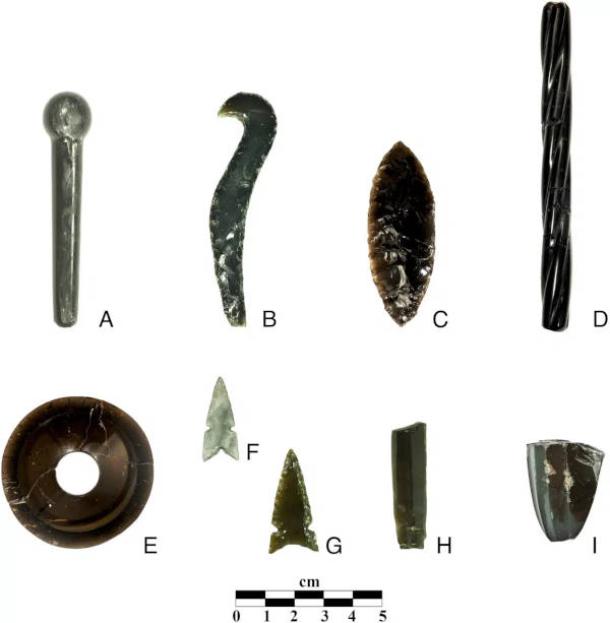
Examples of some of the ritual and non-ritual obsidian artifacts that were analyzed during this study. (Mirsa Islas/CC BY-SA 4.0).
"Although the Mexicas preferred green obsidian, the high diversity of obsidian types, mainly in the form of non-ritual artifacts, suggests that obsidian tools from multiple sources reached the capital of the Empire through market instead of direct acquisition in the outcrop. By studying where this material came from, we can explore the movement of goods across Mesoamerica,” said lead author Diego Matadamas-Gomora, a Ph.D. candidate in Tulane's Department of Anthropology, in a press release.
Empire in a Blade
Using non-destructive portable X-ray fluorescence (pXRF), scientists from Tulane University and Mexico's National Institute of Anthropology and History (INAH) created maps of the chemical signatures of each item. What they found was a history of control, expansion, and adaptation.
There were at least eight different obsidian sources discovered that were distinct from one another—some well beyond Mexica territorial limits. These included Ucareo from within Purépecha territory, an enemy culture that was never conquered by the Mexica. The enemy’s obsidian nevertheless still entered into the imperial city, showing a sophistication in the economy that relied on more than just conquest. It was trade, diplomacy, and maybe tribute that supplied the city with obsidian.
Temple artifacts were unquestionably state property. Ornaments given as temple offerings, small arms, and inlays were nearly all made from the renowned Pachuca obsidian. But in city fill used in construction—thin deposits of the detritus of everyday life—scientists discovered tools fashioned from less attractive, more heterogeneous obsidian. These probably were offered for sale in the local markets and circulated freely among the population, reports Science.
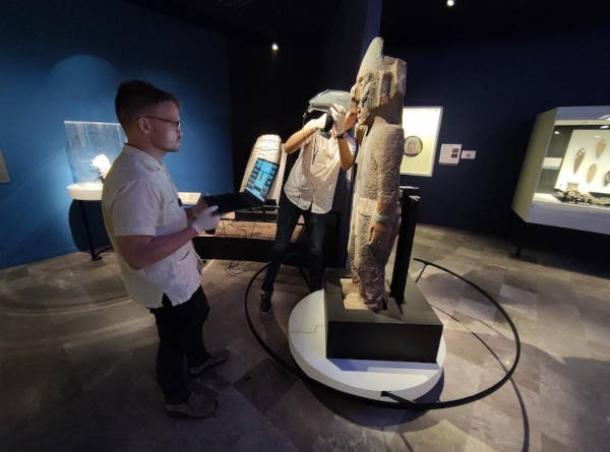
Tulane researchers Diego Matadamas-Gomora and Jason Nesbitt (left) analyzed obsidian artifacts to track how the use of the volcanic glass shifted over time across ancient Mesoamerica and shaped life in its capital, Tenochtitlan. (Leonardo López Luján/Tulane University)
Sacred Standardization
It was in c.1375 AD that Tenochtitlan was founded. But it was not until later than 1430 AD, once the Aztecs had centralized authority and extended their empire, that the employment of obsidian was radically changed. In the early phase, ritual and utilitarian objects drew upon multiple sources of obsidian.
With mounting imperial control, ritual employment became forcefully standardized, with virtually only Pachuca obsidian being used. Centralization of religious authority was responsible for this change, as the material culture followed in its wake.
Common tools were still made from obsidian sourced from many locations, though, which meant that Mexica citizens enjoyed more access to obsidian through urban markets. The state may have monopolized ritual symbolism, but most citizens still used obsidian in kitchens, workshops, and street stalls, and would get it from wherever they could find it.
- Mayan Child Sacrifices with ‘Divine’ Obsidian and Jade Discovered in Guatemala
- Rapa Nui Obsidian Discovery: Did the Islanders sail to America?
Trade Networks Cut in Stone
That obsidian was imported from distant or hostile states testifies to something more significant: an immense economic apparatus, one that stretched beyond war frontiers. Obsidian was not only an instrument of art and violence, but of politics and statecraft. In the politically fragmented environment of Mesoamerica, where coalitions were fleeting, the ability to import obsidian from hostile states says much about the impressive organizational capabilities of the Mexica.
And so every shard speaks more than one tale. A blade may recall a battlefield, a market stall, or the hand of a high priest. An earring may speak of courtly fashion, or foreign tribute. Obsidian is no longer an object, but a repository, one inscribed with the politics, religion, and ambition of a civilization that once thought of itself as the center of the world.
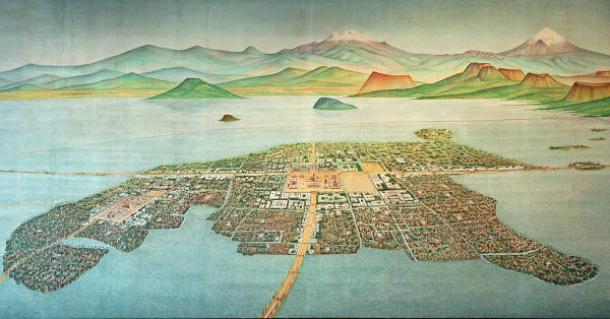
Painting of Tenochtitlan and Lake Texcoco as they would have looked in 1519. (Gary Todd/CC0).
The Empire Reflected in Glass
This research, conducted by Tulane's Diego Matadamas-Gomora and Jason Nesbitt, sheds light not only on trade routes or the use of resources. It also brings the material rhetoric of empire to life.
Obsidian helped the Mexica to exercise power, inscribe belief, and tie themselves to mythic sources. Obsidian enabled them to join the divine and the terrestrial. And through obsidian, we are now able to trace how the beating heart of a lost empire once pulsed—sharpened, sacred, and shining green in the sun.
Top image: Obsidian objects and artifacts in the museum of the Templo Mayor of Tenochtitlan, including blades used for sacrificial purposes.
Source: Thelmadatter/Public Domain.
By Sahir Pandey
References
Matadamas-Gomora, D., et al. 2025. Compositional analysis of obsidian artifacts from the Templo Mayor of Tenochtitlan, capital of the Mexica (Aztec) Empire. Proc. Natl. Acad. Sci. U.S.A. 122 (20). Available at: https://doi.org/10.1073/pnas.2500095122.
Ortega, R.P. 2025. Aztec Empire sought obsidian from far and wide to make ritual jewelry and basic tools. Available at: https://www.science.org/content/article/aztec-empire-sought-obsidian-far-and-wide-make-ritual-jewelry-and-basic-tools.