
Archaeologists excavating a 17th-century settlement in Germany would usually expect to uncover the ordinary waste found in an early modern period latrine. Instead, they found a remarkable concentration of skulls belonging to crested domestic geese - an unusual breed rarely identified in most archaeological contexts. Because the remains of the geese appear to have been discarded or deposited, the find raises certain questions about animal husbandry and household practices during the early modern period. What first appeared to be an ordinary cesspit has ironically become one of the site’s most intriguing discoveries.
- From Pagan Roots to Protestant Reforms: A Religious History of Germany
- Bones found in Magnificent Amphipolis Tomb belong to Five People, Ministry Announced
An Unexpected Find Beneath the Settlement
Once the samples from the excavation had been brought back to the lab, researchers were able to notice that each goose's skull displayed distinctive openings and cranial defects, unlike ordinary butchery marks or post-burial damage. Detailed macroscopic analysis ruled out weathering, animal gnawing, and disease as potential causes. Instead, the defects closely matched those documented in modern crested domestic birds, leading archaeologists to identify the remains as crested geese. Although discarded among the usual kitchen refuse, the goose skulls immediately attracted significant scientific attention because these finds offered rare evidence of keeping prestige poultry such as geese in 17th-century Germany.
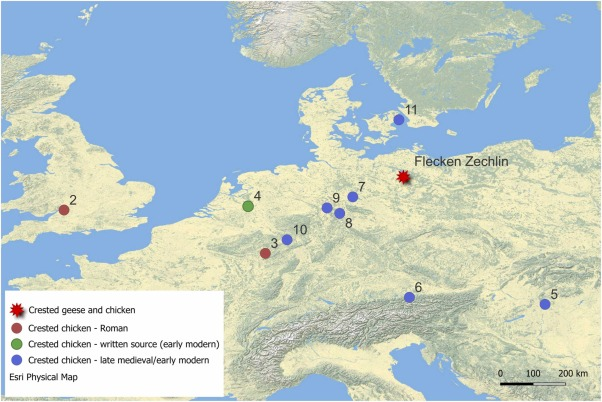
Distribution map of archaeological evidence for crested geese and crested chickens in Europe. (Groot, Maaike and Marcus Wandelt/International Journal of Paleopathology)
A Rare Breed from the Early Modern Period
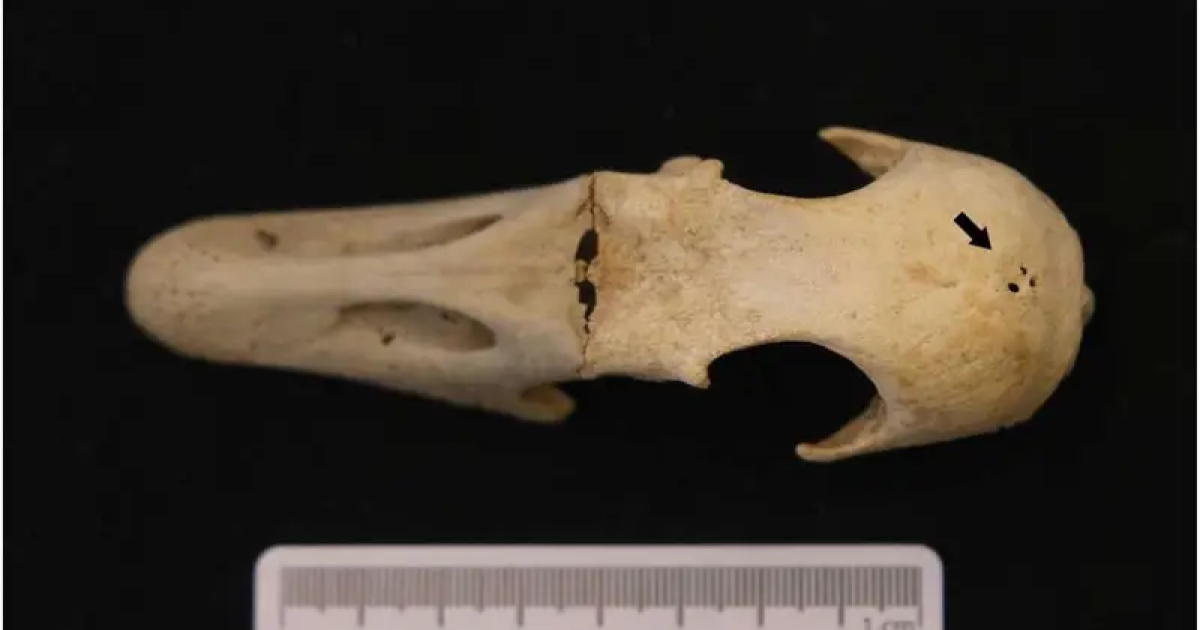
These goose skulls immediately stood out due to each one possessing a unique opening in the skull, associated with the crest trait. This is a rare genetic mutation found in certain domestic goose breeds. Found on living crested geese, this bony defect supports a tuft of feathers that ultimately forms a crested variety rather than an ordinary domestic goose. Their identifying features are significant since archaeological evidence for crested geese is very rare, making these goose skull remains the earliest documented examples of this particular breed of fowl in Europe. This invaluable discovery demonstrates the practice of selective breeding for visible or ornamental traits and also suggests that some households actually valued poultry not only for feathers, eggs, and meat, but also for their unusual appearance and social prestige.
- Demons in Your Toilet? Guardians of the Sewers and How They Protected Ancient Latrines
- Discovery of Genetic Mutation That Separates Humans and Neanderthals | Ancient Origins
Interpreting the Skull Deposit
When it comes to why the latrine contained multiple goose skulls rather than the usual assortment of discarded animal bones, a simple explanation could represent ordinaryhousehold refuse. Nevertheless, archaeologists remain very cautious about unusual archaeological contexts across Europe. While it has been noted that animal skulls have occasionally been interpreted as symbolic deposits associated with certain household customs, foundation rituals, and protective beliefs, at present there is no evidence that the Flecken Zechlin goose skulls served such a purpose. Meanwhile, the researchers directly emphasize that zooarchaeological analysis and comparison with similar sites are still needed to determine whether the deposit of these goose skulls reflects ordinary food disposal, selective butchery practices, or an as-yet unexplained aspect of early-modern domestic life.
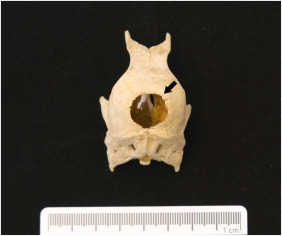
Cranium of Goose 1 showing cranial defect associated with the crest mutation. (Maaike Groot and Marcus Wandelt, International Journal of Paleopathology)
Everyday Life in 17th-century Germany
Although quite modest in appearance, the discovery of these goose skulls offers valuable insight into everyday life in 17th-century Germany. Latrines, wells, and refuse pits preserve organic materials that rarely survive elsewhere, allowing these archaeologists to reconstruct diet, household economies, agricultural practices, and livestock management. Rather than focusing solely on castles, churches, or elite residences, discoveries such as this one reveal how ordinary families interacted with their domestic animals and went about their daily lives.
- 1000-Year-Old Sarcophagus Discovered Beneath One of Germany’s Oldest Churches – Who’s Inside?
- Decade of DNA Analysis Reveals Astonishing Truths About Our Past

Domestic Goose (Anser anser domesticus). (JJ Harrison/CC BY-SA 3.0.)
Unlocking the Secrets of Europe’s Earliest Crested Geese
Researchers still plan to conduct additional analyses to better understand the ancestry, place, and breeding history of the development of these domestic goose populations. Comparative anatomical studies, ancient DNA analysis, and isotopic research may end up revealing whether these birds belonged to a local breeding tradition in this part of Germany or simply represented animals introduced through regional trade networks. Future discoveries from similar archaeological sites may also be critical to determine how widespread crested geese were across the breadth of 17th-century Europe.
Top Image: Cranium of Goose 2. Source: Wandelt & Whitefield/ International Journal of Paleopathology
By Ramsey Hardin
References
Groot, M. & Wandelt, M. 2026. “Cranial Defects in Remains of 17th-Century Geese from Brandenburg, Germany.” International Journal of Paleopathology 54 (2026): 9–13. https://doi.org/10.1016/j.ijpp.2026.06.001
National Library of Medicine. “Cranial Defects in Remains of 17th-Century Geese from Brandenburg, Germany.” PubMed. Published June 10, 2026. Accessed June 24, 2026.
Oster, Sandee. “Lavatory Shaft Reveals the Cost of 17th-Century Vanity in Germany.” Phys.org. June 23, 2026. https://phys.org/news/2026-06-lavatory-shaft-reveals-17thcentury-vanity.html
Radley, D. “17th-Century Lavatory Shaft Yields Earliest Archaeological Evidence of Crested Geese in Germany.” Archaeology News Online. June 24, 2026. Accessed June 24, 2026. https://archaeologymag.com/2026/06/first-evidence-of-crested-geese-in-germany/