
Kimi Antonelli is the new Formula 1 World Champion, and the record books had to be rewritten to make room for him. According to Formula 1's official report, the Mercedes driver started fourth at the Mexico City Grand Prix on November 1, 2026 and finished third, which was enough to claim the crown. The FIA described him as the youngest World Champion in the history of the sport.
The numbers behind that claim are precise, and the team spelled them out. Mercedes stated that he took the title "at just 20 years and 68 days old, surpassing Sebastian Vettel who was 23 years and 134 days old in 2010." Motorsport.com reported the same figures, and for a modern sport built on long junior careers, that is a very early peak, and the age gap to the previous record is more than three years.
Nearly 2,000 years ago, though, a 20-year-old star in a racing chariot would have raised few eyebrows. The best evidence comes from inscriptions that Roman charioteers, or their friends, paid to have carved. Those texts record wins, prize money and ages at death with the care of a modern statistics sheet, and some of them point to careers that may have begun in the early teens.
A Teenager in the Blue Colors
The clearest case is a man named Crescens, whose epitaph survives in Rome and is catalogued as CIL VI 10050. In the translation by classicist Barbara F. McManus for the VRoma project, the stone opens with "Crescens, charioteer of the Blue faction, a Moor from Mauretania by birth, 22 years old." It then lists a career that would fit neatly on a modern driver's profile page.
According to the inscription, Crescens "won a race for the first time with a four-horse chariot in the consulship of Lucius Vipsanius Messalla (115 CE)," driving the horses Circius, Acceptor, Delicatus and Cotynus. Between that year and 124 CE, the text says, "he burst from the starting-gate 686 times." He won 47 races, came second 130 times and third 111 times, and "brought home winnings of 1,558,346 sesterces."
The famous starting age comes from simple arithmetic, because if Crescens died at 22 in 124 CE and won his first race in 115 CE, he was about 13 when that victory came. That figure is a reasonable inference from the dates on the stone, although the inscription itself never states his age at his debut. McManus put it more cautiously in her notes, writing that "Crescens was very young when he began racing and was probably still something of an apprentice when he died."
Her notes add two further cautions about the details. The stone's wording on his first win "may indicate the number of races Crescens had driven before winning one, or it may indicate which of the races held on that day Crescens won." She also observes that the inscription "implies (but does not directly state) that Crescens died in this race," meaning the race of August 1, 124 CE. The evidence for a boy who raced and died young is strong, though some of the details remain open.
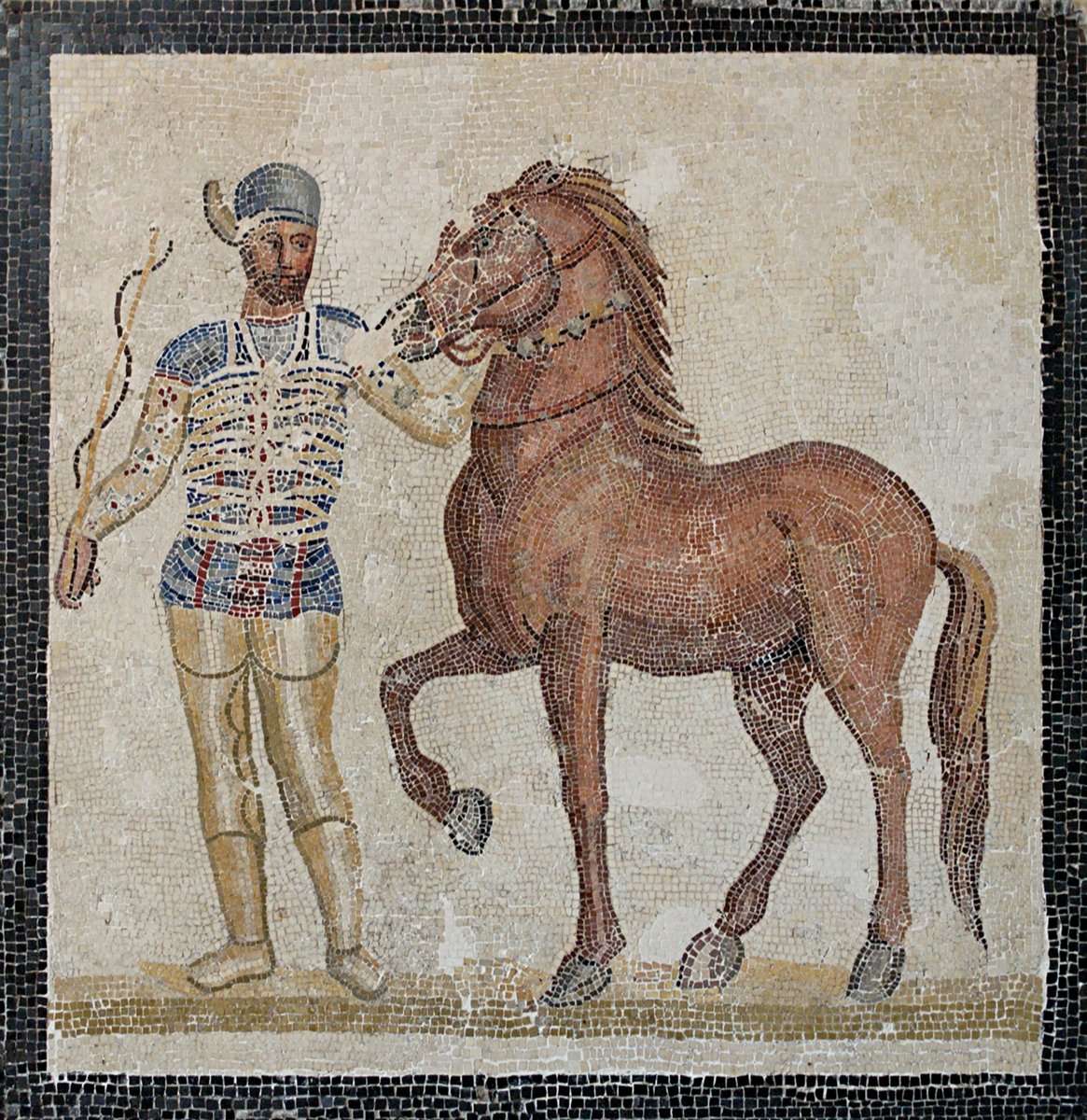
A charioteer of the Blue faction, the team Crescens drove for, in a Roman mosaic of the early 3rd century AD now in the Museo Nazionale Romano, Palazzo Massimo, Rome. Image: Jastrow, public domain (Wikimedia Commons).
Scorpus and the Poet Who Mourned Him
Crescens was a rising name, while Scorpus was one of the best known athletes in Rome. The great inscription of the charioteer Diocles, CIL VI 10048, mentions in passing "Flavius Scorpus, winner 2048 times," a total that Diocles himself never matched. Scorpus raced in the late first century AD, and his death moved the poet Martial to write two epigrams about him, which survive as numbers 50 and 53 in Book 10.
In the 1920 Loeb translation by Walter C. A. Ker, the first of these laments: "Robbed, Scorpus, of thy first youth, art thou fallen, and so soon dost yoke Death's dusky steeds!" The second is written as if Scorpus were speaking from the grave. "That Scorpus am I, the glory of the clamorous Circus, thy applause, O Rome, and thy short-lived darling," it begins.
The poem then gives his age in the poet's roundabout way. "Me, snatched away in my ninth three years' span, jealous Lachesis, counting my victories, deemed old in years." Nine spans of three years places his death in his 27th year, so he was 26 or younger, and Martial's joke is that the Fate Lachesis counted his wins and assumed he must be an old man. With more than 2,000 victories to his name, the mistake is easy to understand.
How does a man win more than 2,000 races before 27? Martial does not explain. The arithmetic of so many races in so short a life suggests that Scorpus, like Crescens, began driving very young. That reading remains an inference, however, since no surviving source gives his starting age.
The Long Career of Diocles
For contrast, the most famous Roman charioteer of all had an unusually long career. According to the sourcebook Spectacles in the Roman World by Siobhán McElduff, Diocles "raced from the age of 18" over a career of 24 years, recorded on a monument of 146 CE. His inscription states that he "started 4,257 races, won 1,462," and he retired alive, which was rare. AO has covered the career and earnings of Gaius Appuleius Diocles in more detail, for readers who want the full story.
Diocles is the exception that shows the rule, and other epitaphs collected by McElduff tell a darker story. "Fuscus, charioteer for the Greens, lived 24 years," one reads, while another records a driver who lived to 29, and a third mourns Mollicus Tatianus, who "lived 20 years, 8 months, 7 days." None of these men lived to see 30.
The danger was real, and the stakes went beyond broken bones, since McElduff notes that charioteers "started their careers as slaves and could be sold to another faction" by their owners, and many, she adds, died as slaves without ever gaining their freedom. Rivals also turned to the supernatural, as a curse tablet aimed at a chariot racer shows.
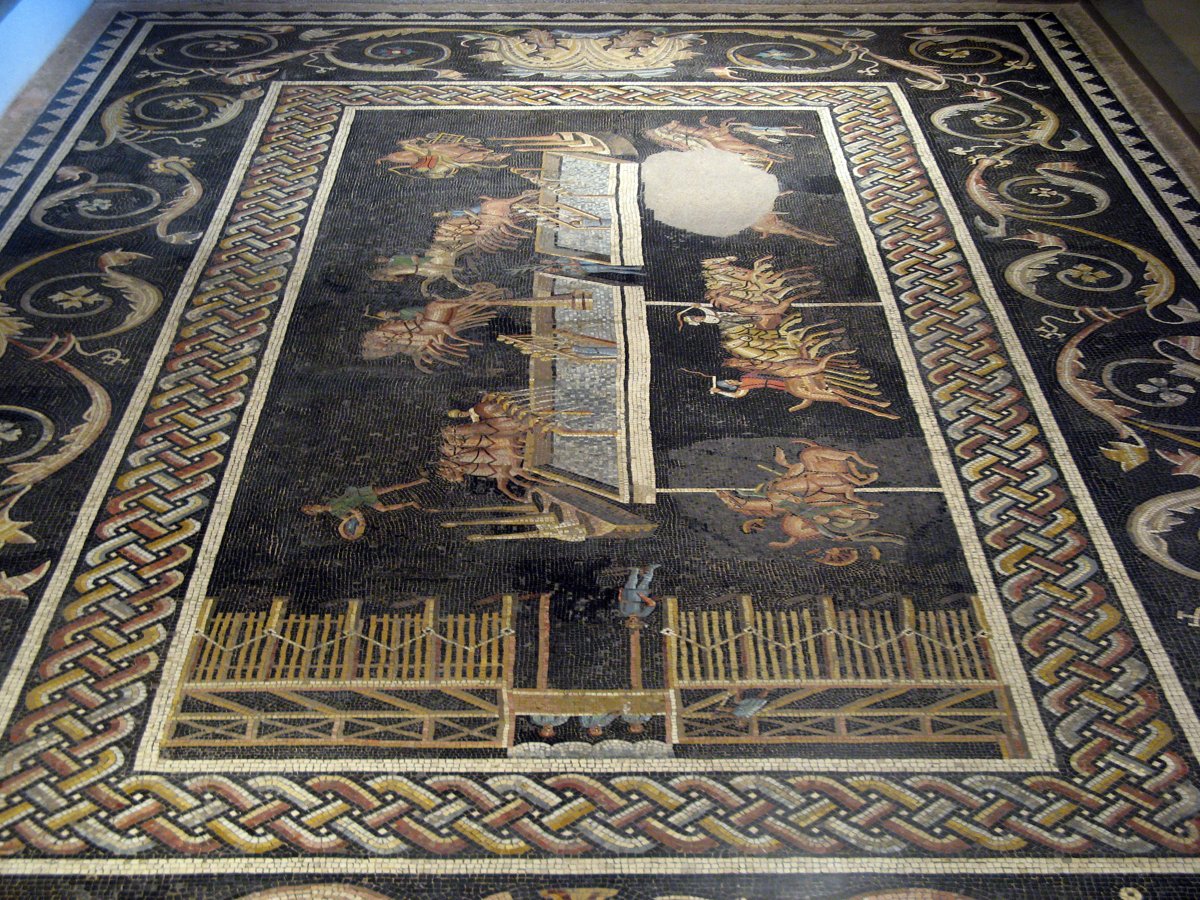
Detail of a 2nd century AD mosaic of a chariot race in a Roman circus, found at Ainay in Lyon and now in Lugdunum Musée et Théâtres romains. Image: Mark Landon, CC BY 4.0 (Wikimedia Commons).
A Bronze Boy From the Sea
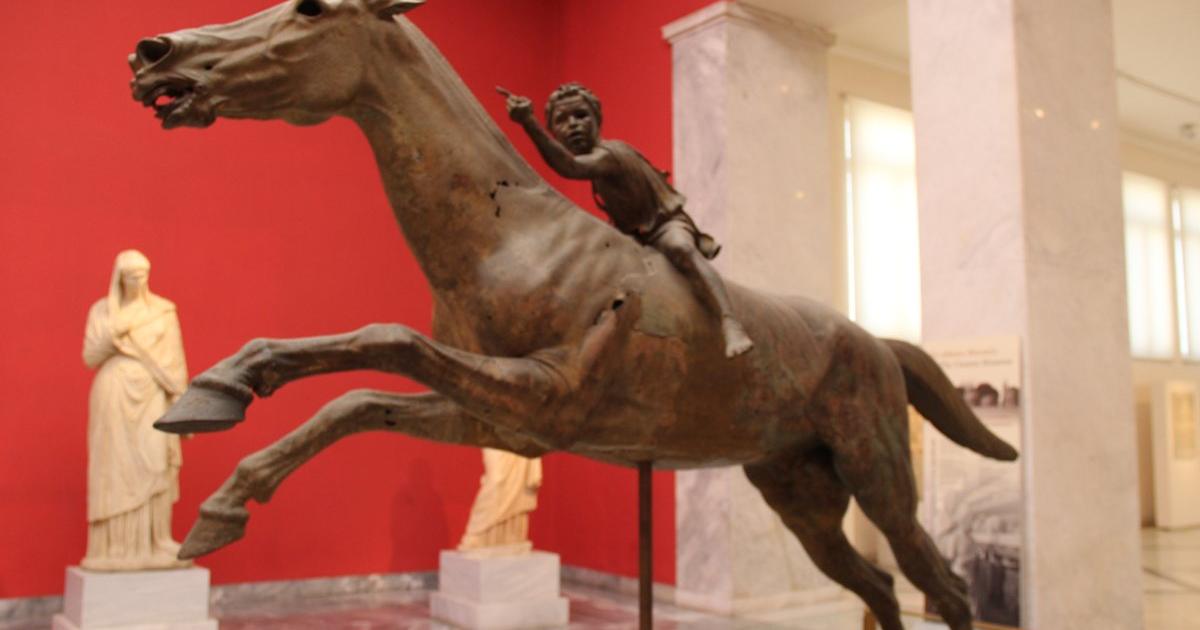
The Greek world offers a different kind of evidence, cast in bronze. The Jockey of Artemision, now in the National Archaeological Museum in Athens, shows a small rider clinging to a galloping horse, and the Hellenic Ministry of Culture dates the group to the Hellenistic period, "ca. 140 B.C.," and describes the rider as "very young." His exact age cannot be known from the statue, and the museum does not attempt to give one.
The museum explains that the group came up in pieces from a shipwreck off Cape Artemision in northern Euboea, at a depth of over 45 meters. "Later (1928) the front part of the horse with its small jockey was found. It took nine years (1937) for the remaining part of the horse to be found accidentally near Oreoi," the museum writes. The Ministry suggests the group was "probably dedicated at an important sanctuary" before it ended up on the ship that carried it into the sea.
In Greek horse races, glory went to the owner of the horse. Pausanias, writing in the second century AD, records that the Spartan princess Kyniska was the first woman to breed horses and win at Olympia, and that her monument there showed a chariot, a charioteer and a statue of Kyniska herself. AO has told how Cynisca won at the ancient Olympic Games. The riders and drivers took the physical risks, while the owners who paid for the horses took the credit and the monuments.
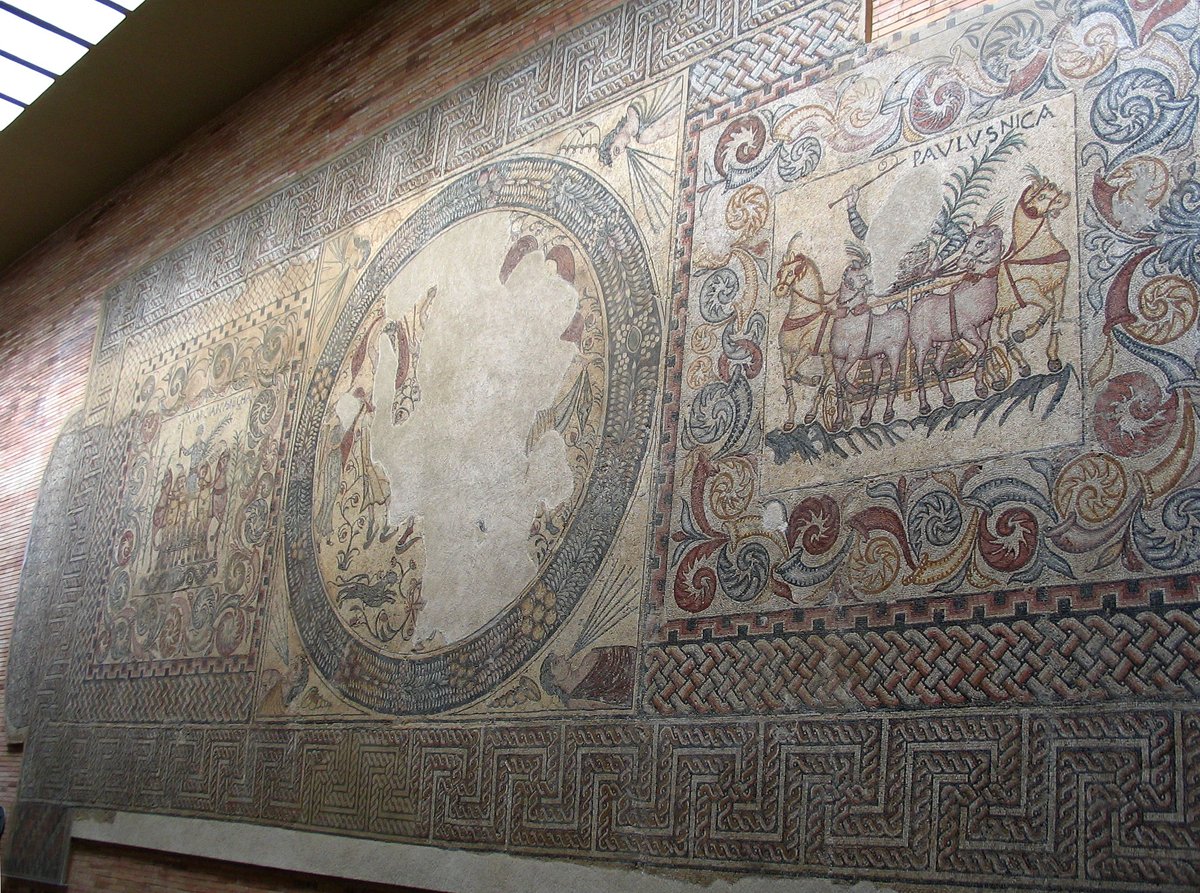
A 4th century AD mosaic from Mérida, Spain, showing victorious charioteers named Marcianus and Paulus holding palm branches. Museo Nacional de Arte Romano. Image: Mark Landon, CC0 (Wikimedia Commons).
Antonelli's title is a genuine record for Formula 1, but set beside the tombstones of Rome, a champion of 20 would have looked ordinary in the Circus Maximus. Crescens had been racing for years by that age, Scorpus had his thousands of wins before 27, and several of their colleagues died in their early twenties. The evidence for exact starting ages remains less certain than the evidence for how young, and how exposed, these racers were.
The bronze Jockey of Artemision, dated by the National Archaeological Museum in Athens to around 140 BC. Image: Gary Todd, CC0 (Wikimedia Commons).
By Aris Manus
Sources
- Formula 1. 2026. Kimi Antonelli crowned youngest F1 champion as Max Verstappen wins eventful Mexico City Grand Prix. Formula1.com, November 1, 2026. Available at: https://www.formula1.com/en/latest/article/antonelli-crowned-youngest-e…
- FIA. 2026. F1: Antonelli crowned F1's youngest World Champion as Verstappen wins in Mexico City. FIA.com, November 2, 2026. Available at: https://www.fia.com/news/f1-antonelli-crowned-f1s-youngest-world-champi…
- Mercedes AMG Petronas F1 Team. 2026. Race report: Kimi Antonelli becomes youngest ever World Champion with Mexico podium. Available at: https://www.mercedesamgf1.com/reports/race-report-kimi-antonelli-become…
- Motorsport.com. 2026. Kimi Antonelli becomes youngest world champion in F1 history. Available at: https://www.motorsport.com/f1/news/kimi-antonelli-becomes-youngest-worl…
- McManus, B. F. Crescens Inscription (CIL VI 10050), translation and notes. VRoma Project. Available at: http://vroma.org/vromans/bmcmanus/crescens_trans.html
- McElduff, S. Famous Charioteers, in Spectacles in the Roman World: A Sourcebook. BCcampus Pressbooks. Available at: https://pressbooks.bccampus.ca/spectaclesintheromanworldsourcebook/chap…
- Martial. 1920. Epigrams, Vol. II. Translated by W. C. A. Ker. Loeb Classical Library. London: Heinemann. Available at: https://archive.org/details/epigramswitheng02mart
- Hellenic Ministry of Culture and Sports. Jockey of Artemision. Odysseus portal. Available at: http://odysseus.culture.gr/h/4/eh430.jsp?obj_id=6221
- National Archaeological Museum, Athens. When the sea turns into a vast watery grave. Available at: https://www.namuseum.gr/en/monthly_artefact/when-the-sea-turns-into-a-v…
- Pausanias. 1918. Description of Greece. Translated by W. H. S. Jones. Loeb Classical Library. Via ToposText.