

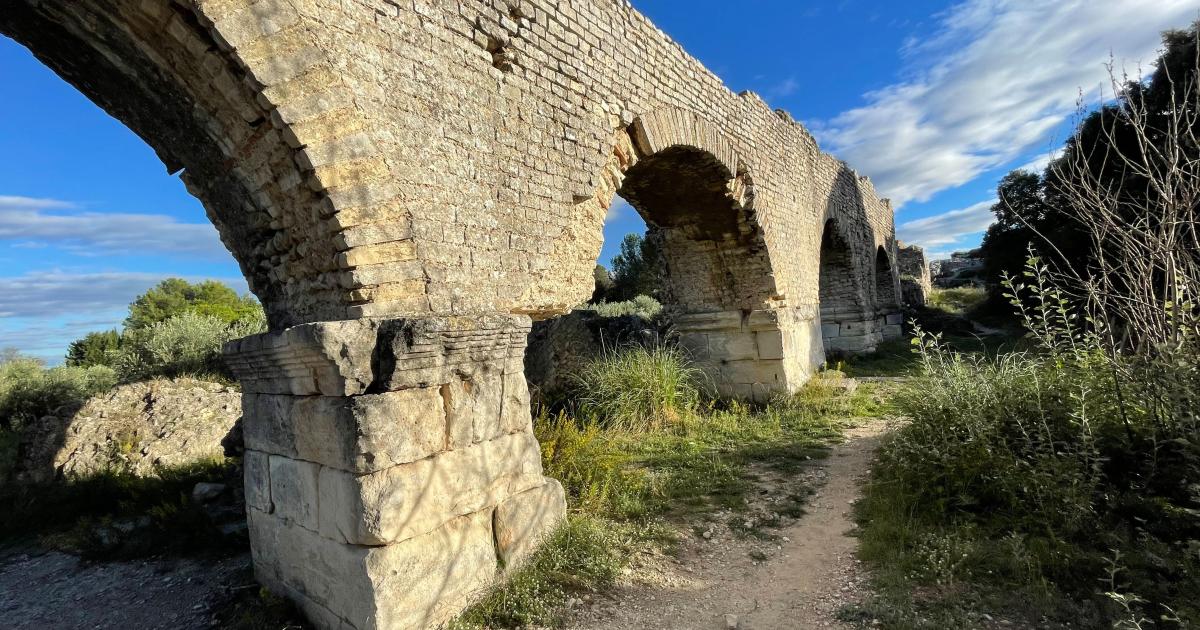

Under the quaint Provençal village of Arles, the skeleton of a lost empire in stone, lime, and lead has been unboxed through geological archaeology. Researchers and scientists working on the project have deciphered the history of this vast and efficient hydraulic network of the Roman waterworks that formerly served Arles. The telling material? Carbonate: mineral-rich limescale that built up inside Roman aqueducts, basins, and even pipes over centuries.
Their research, published in Geoarchaeology, brings isotopic analysis together with archaeological excavation to recreate the dynamic life of one of the ancient world's most sophisticated water networks.
"This study clearly shows how a Roman aqueduct worked over several centuries and was transformed at different times by the Romans, efficiently maintained and modified, and hence this is one of the clearest examples of a sustainable water management system from antiquity," said Dr. Gül Sürmelihindi from the JGU Institute of Geosciences, who conducted the study.
He was assisted by scientists and researchers from Johannes Gutenberg University Mainz (JGU), the University of Oxford, and the University of Innsbruck.
Aqueducts in Motion: A Feat of Ancient Engineering
The tale starts sometime during 3 BC, with Roman engineers constructing the initial aqueduct from the southern slope of the Alpilles hills to feed Arles. Nearly a century later, they laid an additional line on the northern face of the same hills.
Instead of decommissioning the south channel, it was shrewdly diverted to supply the Barbegal mills, a colossal industrial flour mill complex fueled by 16 water wheels, widely quoted as the greatest aggregation of mechanical energy in the ancient world.
- Roman Empire’s Eastern-most Aqueduct Found Half Finished in Armenia
- How Did Roman Aqueducts Work? (Video)
"Unlike in previous studies in which we mostly dealt with a single aqueduct, here we investigated the complex water supply of ancient Arles, consisting of several aqueducts, a basin, and connected water structures in the city," added Professor Cees Passchier from the Institute of Geosciences at Mainz University, in a press release.
This redirection was no minor improvement. It involved redirecting water flows over grade changes and welding new supply into current structures, particularly the main cistern, which functioned as a settling tank before the water flowed into the city through an arcade bridge. The makeshift entry point for the second aqueduct, above the original cistern intake, is an obvious architectural indicator that it is a second addition.

The Roman baths in Arles. In the foreground, concrete blocks from the collapsed ceiling can be seen, in which researchers found carbonates from an older aqueduct. (Cees Passchier/Geoarchaeology, 2025)
A Ceiling Made of Time: Baths of Constantine
Perhaps most unexpectedly, though, it did not originate in a pipe or a channel, but on the roof of the Baths of Constantine. Scientists found pieces of ancient carbonate trapped in fallen ceiling tiles; remnants that, through isotopic "fingerprinting," matched the northern aqueduct. That implies an event of recycling: in the 4th century AD, the aqueduct was flushed and its deposits reused as aggregate in building.
This not only determined which aqueduct fed the baths—it also attested that the water system continued in operation well into late antiquity, perhaps as long as the 5th century, before the arrival of Franks and Burgundians disturbed Roman existence in the area.
"These limescale deposits are a sort of record," added Dr. Gül. "They can't be carbon-dated due to contamination with clays, so we date them using stable oxygen and carbon isotopes to synchronize different deposits in structures, similar to tree rings, but in lime."
The Rhône's Secret Siphon
Yet another of the much-discussed puzzles was large pipes made of lead discovered in the Rhône River in the 19th century. Were they an outgoing wastes system? Or did they supply water to the city?

Carbonate sample from the roof of the Roman baths in Arles. (Cees Passchier/Geoarchaeology, 2025)
The carbonate responded once more. Isotopic correlations between deposits in the Rhône pipes and deposits in the northern and southern aqueducts verify that they were components of an inverted siphon system—transporting water over the river to the Trinquetaille quarter of Arles, reports LBV Magazine.
- Why Was Roman Concrete So Durable? Scientists Say It Could Heal Itself
- The Wonders of Ancient Engineering: 15 Most Amazing Ancient Aqueducts
Greater than a piece of engineering, the Arles aqueduct system shows us something rarer: Roman infrastructure that was dynamic. It wasn't a one-and-done affair. It changed to new demands. Its components were recycled, rechanneled, and serviced for more than 400 years.

Unlock the ‘Mad, Bad, and Deadly: Power in the Hands of Infamous Roman Emperors’ Interview with Robbert Fabri available on the Ancient Origins Shop.
"It's a fantastic demonstration of sustainable water management in the ancient world," Sürmelihindi said. "The Romans didn't build once and forget. They optimized, reorganized, and reused materials—such as limescale, which now allows us to trace over their work."
Top image: Bridge of the Roman aqueduct in Arles Source: Cees Passchier/Geoarchaeology, 2025
By Sahir
References
Carvajal, G. 2025. Mystery of the Roman Lead Pipes Found in the Rhône Solved: They Supplied Water to the Baths of Constantine. Available at: https://www.labrujulaverde.com/en/2025/07/mystery-of-the-roman-lead-pipes-found-in-the-rhone-solved-they-supplied-water-to-the-baths-of-constantine/.
Sürmelihindi, G., et al. 2025. The Roman Water Management of Arles as Read in Aqueduct Carbonate Archives. Available at: https://doi.org/10.1002/gea.70020.






















