
A new study of 2,316 burials from China’s Central Plain suggests that ancient inequality became durable thousands of years before the first states appeared. Published in Science Advances, the research argues that differences in wealth and opportunity were not simply the result of more intensive farming or larger populations. Instead, social networks, portable wealth and conflict gradually gave some people greater access to labor, resources and ritual power.
A Six-millennia Record
Led by Dongdong Li, Suwei Guo and Xiaoyan Chen, the study brings together previously published archaeological evidence from 24 sites. The burials span almost 6,000 years, from 7000 to 1500 BC, covering the Central Plain’s transition from small communities to early state societies. That unusually long sequence allows the researchers to compare periods that are usually studied separately.
The researchers compared grave construction and burial goods with evidence from human bones, animal remains and chemical traces in ancient tissues. These data offered clues about health, diet and subsistence, while the labor invested in graves and objects provided a measure of relational wealth: the support and obligations a person could command through their connections. In other words, a richly equipped grave was treated as evidence of social investment, not as a complete inventory of personal possessions.
- How Oxen Plowed the Way for Social Inequality
- World’s Oldest Matrilineal Society Unearthed in China’s Neolithic
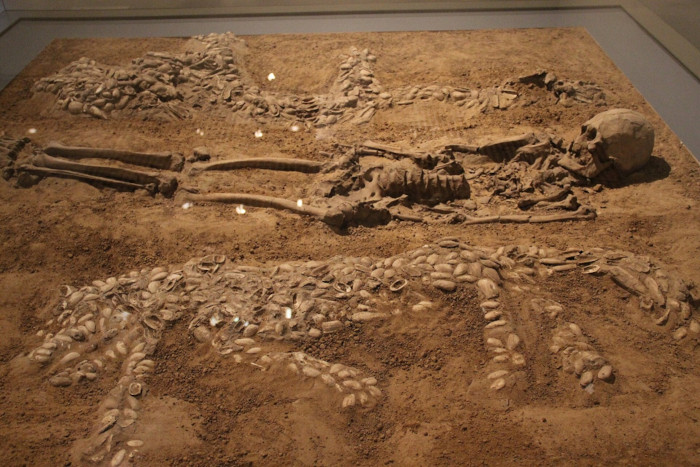
Neolithic burial with dragon and tiger in shells, Yangshao culture, Puyang, Henan, China. (Gary Todd/CC0)
Networks Mattered More Than Farming Alone
The pattern was not a smooth climb. Inequality changed sharply at different points, and the study found no simple relationship with agricultural intensification or population size. Instead, people occupied different positions in networks that connected them to workers, food, scarce goods and objects with symbolic value.
That finding revises a familiar story about the origins of class divisions. Earlier research on ox-drawn plows and inequality emphasized how labor-saving technology could separate land and wealth from human work, while the present study points to a wider process in which social relationships determined who could mobilize resources. It also helps place rising inequality in early farming societies within a much longer and less predictable history.
As subsistence practices changed, wealth that could be stored, moved or claimed became increasingly important. The researchers argue that growing control over such portable assets, together with escalating violence, reorganized social networks and concentrated ritual authority, political influence, military power and technological knowledge. Those developments could make an advantage repeatable across generations instead of leaving it as a temporary difference between neighbors.
- Systematic Human Bone Modification Found in Neolithic China
- An Ancient Chinese City and the Evolution of Urbanization
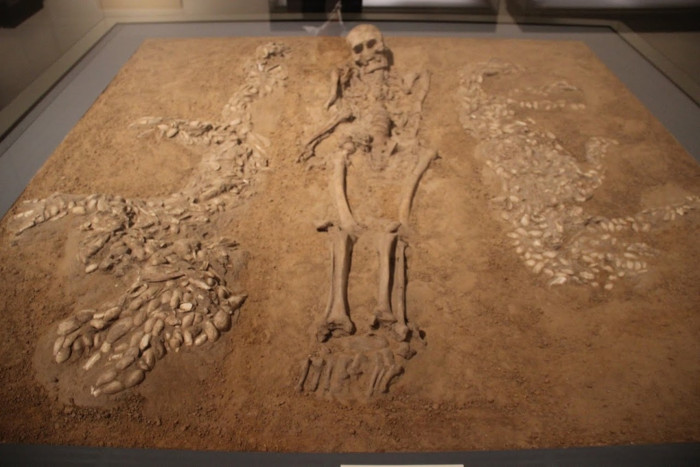
Human burial surrounded by shell mosaics from Xishuipo, Henan, associated with the Yangshao culture. (Prof. Gary Lee Todd/CC BY-SA 4.0)
States Formalized Older Divisions
The study does not claim that every grave directly reveals a person’s wealth, or that burial goods represent the entire material economy. Mortuary evidence is especially useful for showing social investment and status, but it can miss perishable goods and forms of wealth that were not displayed in death. The authors therefore describe their results as relative measures of relational wealth rather than precise estimates of total assets.
Even with that caution, the long sequence offers a striking conclusion about ancient inequality. When early states finally emerged, they did not create all social differences from nothing; they made existing advantages more durable by formalizing control over resources, violence and access. That distinction matters because it shifts attention from the sudden birth of hierarchy to the gradual hardening of earlier advantages. As the authors write in the Science Advances study, early states “stabilized rather than created these pre-existing disparities by institutionalizing control over resources, violence, and network-based access.”
That conclusion places relationships at the center of China’s early social history. It also leaves room for different paths: the low inequality documented at the Neolithic Fujia community in Ancient Origins’ report on a matrilineal society shows that agriculture and settled life did not produce one inevitable social outcome. The history of ancient inequality was shaped by choices and pressures within communities, not by a single technological switch.
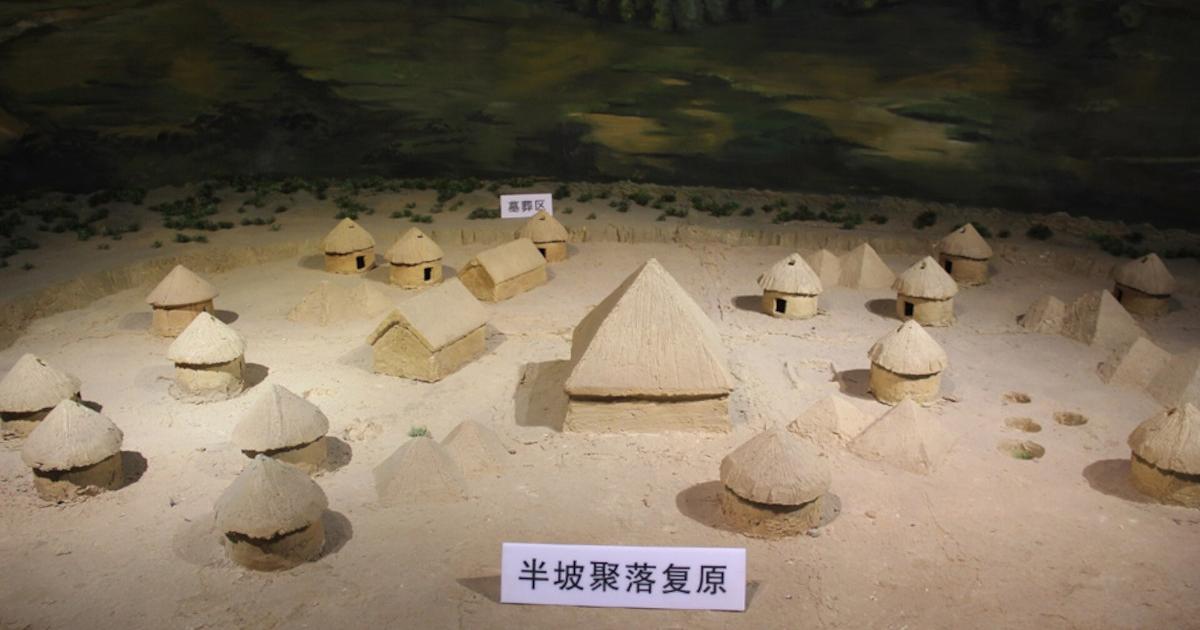
Top image: Yangshao Village Diorama, illustrating an early Neolithic settlement in Henan, China. Source: Gary Todd / CC0
References
Cowie, A. 2019. How Oxen Plowed the Way for Social Inequality. Available at: /news-history-archaeology/social-inequality-0012627
EurekAlert! 2026. Burial data in ancient China reveal inequality’s deep roots before the rise of states. Available at: https://www.eurekalert.org/news-releases/1147547
Geroy, A. 2024. An Ancient Chinese City and the Evolution of Urbanization. Available at: /ancient-places-asia/anyang-ancient-city-china-0020196
Li, D., Guo, S. & Chen, X. 2026. How inequality became durable before states: Evidence from 6,000 years in the Central Plain of China. Science Advances. Available at: https://doi.org/10.1126/sciadv.ady6737
Radley, D. 2026. Inequality in ancient China became durable long before the first states, burials show. Available at: https://archaeologymag.com/2026/10/inequality-in-ancient-china-before-first-states/