

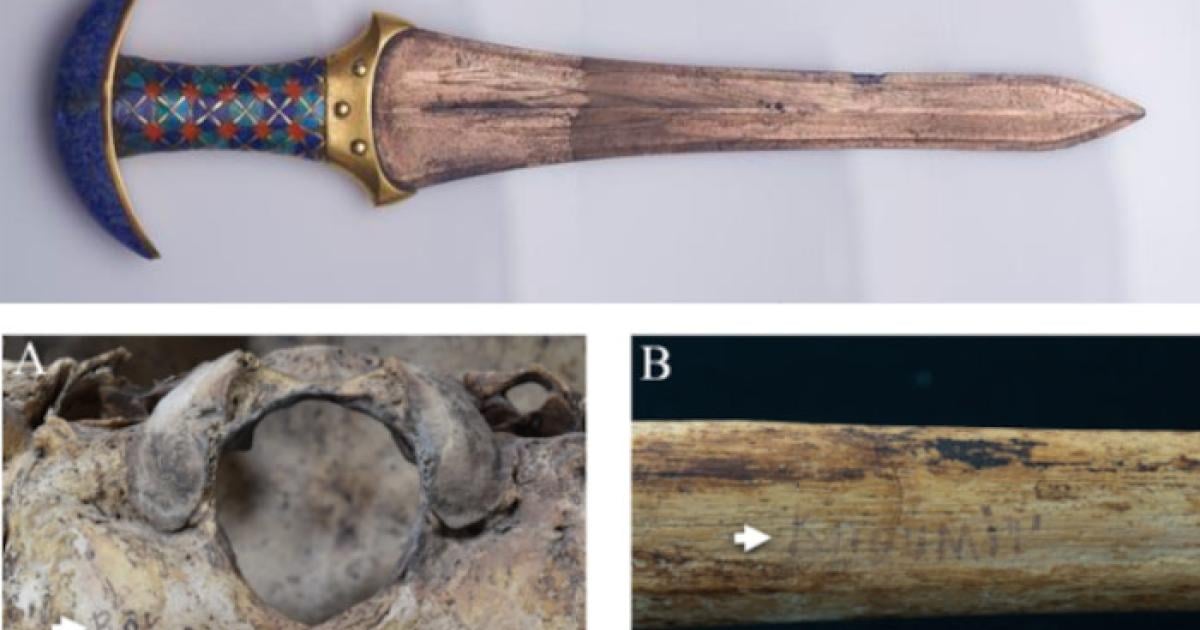

For over a century, scientists have debated the purpose of weapons found in the burial chambers of ancient Egyptian royal women. Were these items merely ceremonial, or did the princesses actually wield them? A bioarchaeological reassessment of five royal mummies from the Middle Kingdom has definitively shown that some ancient Egyptian princesses born 4,000 years ago were, in fact, highly skilled archers.
The study, recently published in the journal Frontiers in Environmental Archaeology, focuses on six royal individuals discovered in the 1890s at Dahshur, a significant necropolis complex known for its pyramids and shaft tombs. The mummies, which had been lost for years, were rediscovered in the Egyptian Museum in Cairo during a curation project in 2020.
- Warrior Women: Despite what Gamers Might Believe, the Ancients Knew Better
- Thutmose III, the Famed Warrior King of Ancient Egypt
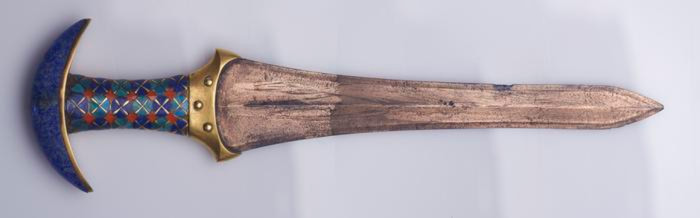
The dagger buried with Princess Ita. Photograph by Sameh Abdel Mohsen, Egyptian Museum photographer. (Sameh Abdel Mohsen/Frontiers)
The Royal Sisters of Dahshur
Among the rediscovered remains were four sisters, all daughters of the pharaoh Amenemhat II, who ruled during the 12th Dynasty. The sisters - Princess Ita, Princess Khenmet, Princess Itaweret, and an anonymous woman provisionally identified as Princess Sathathormeryt - were buried in matching underground chambers. Surprisingly, they were interred with items traditionally associated with men, such as bows and arrows. Princess Ita's coffin even contained an exquisite dagger. Similar regalia accompanied the other two royals evaluated in the study: Princess Noub-Hotep and King Hor.
Although the soft tissue of the mummies had turned to powder and their skulls were lost in the early 1900s, the remaining bones were remarkably well-preserved. This allowed researchers to conduct a thorough osteological analysis, estimating the individuals' age at death, height, and sex, while also uncovering evidence of illnesses and physical trauma.
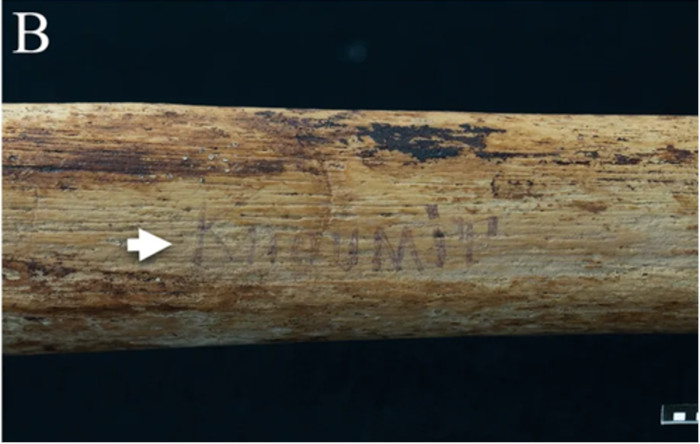
Original nineteenth century handwritten identifications preserved on bone. B) KnOUMiT written on the lateral aspect of Khenmit right tibia. (Hashesh et al/ Frontiers in Environmental Archaeology)
Pronounced Muscle Attachments Reveal Active Lives
The analysis revealed that these royal women led highly active lives. Dr. Zeinab Hashesh of Beni-Suef University, the lead author of the study, noted that "Members of the royal family, especially the women, were active participants in skilled, physically demanding activities such as archery and hunting." This conclusion is strongly supported by the robust muscle attachments on the princesses' bones, which correspond directly to the weapons discovered in their tombs.
For instance, Princess Ita, a young woman aged between 28 and 34, exhibited strong upper-body muscle attachments, suggesting she habitually used weapons like maces or daggers. Princess Itaweret, aged between 20 and 34, survived broken ribs and foot fractures, and her skeleton clearly indicates she was a skilled archer. The researchers found pronounced development in the upper limbs of these individuals, correlating to repetitive, high-intensity actions such as pulling a bowstring or stabilizing a weapon.
These findings provide compelling evidence that the weapons buried with the women were not merely symbolic gifts but practical tools they actively used throughout their lives.
Injuries, Infections, and Royal Vulnerability
While their royal status afforded them privileges, it did not shield them from the harsh realities of life in ancient Egypt. The study uncovered evidence of various injuries, such as Princess Itaweret's broken ribs, likely caused by a blow or a fall. "These injuries were most likely caused by accidents, falls, hard blows, or other impacts linked to an active lifestyle, whether through hunting, military training, or other demanding activities," Dr. Hashesh explained. Remarkably, the injuries healed well, suggesting the princesses had access to advanced medical care for their time.
However, the researchers also found evidence of persistent infections and possible nutritional deficiencies among the royals. Furthermore, the sisters shared rare spinal abnormalities, indicating that their parents and wider family were closely related, a common practice among Egyptian royalty to maintain the purity of the bloodline.
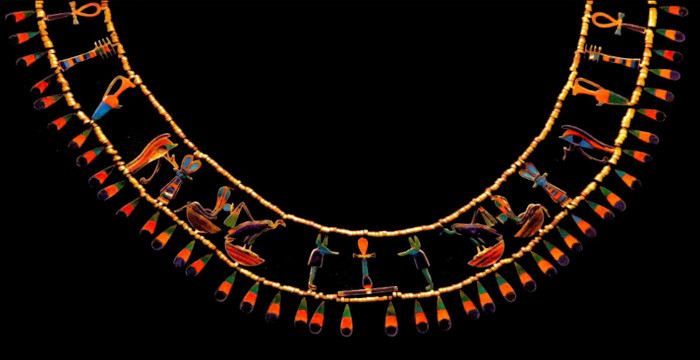
Jewelry of Khenmet,12th Dynasty. (Hans Ollermann/CC BY-SA 2.0)
Reconstructing Ancient Lives
The recent bioarchaeological reassessment of these royal mummies highlights the importance of re-evaluating historical collections using modern scientific techniques. While the loss of the princesses' skulls limits some analyses, the researchers hope to conduct further studies, such as stable isotope analysis, to shed more light on their diets and potential nutritional deficiencies.
Ultimately, the goal is to move beyond simply identifying the Dahshur royals and to reconstruct their full life stories, including their health, familial relationships, and even their political roles. As Dr. Hashesh eloquently stated, "While archaeologists have long focused on preserving these treasures, the people themselves were often forgotten. Our study seeks to change that."
Top image: Top; The dagger buried with Princess Ita. Photograph by Sameh Abdel Mohsen, Egyptian Museum photographer. Bottom; Original nineteenth century handwritten identifications preserved on bones, (A) Roi Hor written in black beside the foramen magnum of king Hor skull, (B) KnOUMiT written on the lateral aspect of Khenmit right tibia. Also, on old labels and wrapping materials, (C) princess: noub hotep / Dachour 1894, Source: Hashesh et al/ Frontiers in Environmental Archaeology
By Gary Manners
References
Frontiers. 2026. Ancient Egyptian princesses born 4,000 years ago were skilled archers, new study shows. Available at: https://www.frontiersin.org/news/2026/07/17/ancient-egyptian-princesses-4-000-years-ago-skilled-archers-frontiers-environmental-archaeology
Hashesh, Z. et al. 2026. A multidisciplinary bioarchaeological reassessment of the royal skeletal remains from the Dahshur excavations (1894–1895 ). Frontiers in Environmental Archaeology. Available at: https://www.frontiersin.org/journals/environmental-archaeology/articles/10.3389/fearc.2026.1844402/full






















