A distinctive painted pottery tradition from a Saudi Arabian oasis may represent one of the earliest examples of ancient branding yet identified in ceramic production. New research places its beginnings at Qurayyah Oasis around 3,600 years ago, where potters developed a recognizable two-color style that later travelled hundreds of kilometres across the ancient Near East.
The study, published in PLOS ONE, does not suggest that Bronze Age merchants used trademarks in the modern legal sense. Instead, the researchers argue that consistent materials, techniques, designs, place of origin and wide circulation combined to create a product identity that consumers could recognize.
A Recognizable Product from Qurayyah
Qurayyah Painted Ware, formerly called “Midianite Pottery,” was made at a walled oasis in what is now northwestern Saudi Arabia. The new analysis traced its beginnings to local kilns and identified a sequence of seven production groups, QPW 1 to QPW 7, continuing for more than a millennium. Excavations at the large walled river oasis have been carried out by the Qurayyah Joint Archaeological Project since 2014, giving researchers a stratified local context for the pottery.
The earliest painted vessels appeared around 3,600 years ago, while a later form known as QPW 4 emerged about four centuries afterward. According to the Austrian Academy of Sciences, QPW 4 featured black-and-red geometric decoration, stylized animals and human figures, and became the most clearly recognizable export form. Its repeated visual language helped distinguish Qurayyah products from other pottery circulating in the region.
- 4,400-Year-Old Bronze Age Town Shows That Arabia Was Slow to Urbanize
- Clear Evidence of 4000-Year-Old Trading Post Unearthed Near Abu Dhabi
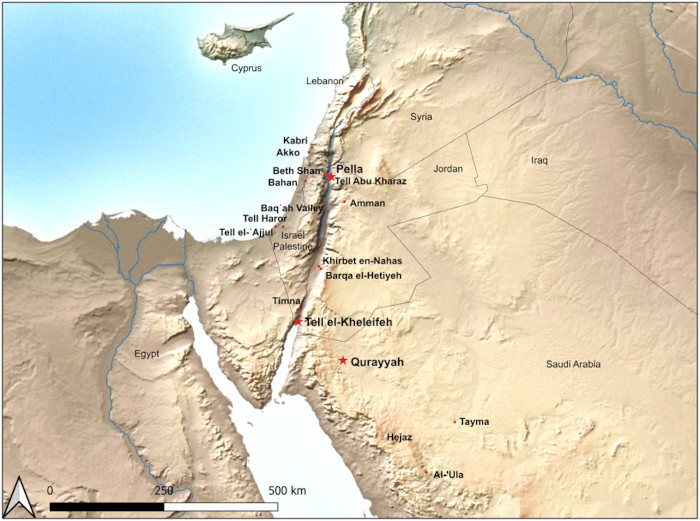
Regional map showing Qurayyah and connected sites in the southern Levant and Arabia. (Luciani et al., PLOS ONE/CC BY 4.0)
How the “Brand” was Made
To test whether the pottery represented ancient branding, the international team combined several kinds of evidence. Researchers examined vessel forms and manufacturing traces, studied thin sections of the ceramic under a polarizing microscope, and used neutron activation analysis to compare chemical fingerprints. The PLOS ONE paper analyzed dozens of stratified fragments from a Qurayyah kiln, then compared the results with material from sites including Tell el-Kheleifeh and Pella in Jordan.
This approach places the oasis within a wider pattern of exchange. Related evidence of interconnected communities appears in Ancient Origins’ reports on Saudi Arabia’s Bronze Age town of al-Natah, Mustatils and Saudi Arabia’s prehistoric monuments, and an ancient trading post near Abu Dhabi. The broader Arabian trade picture also included Dilmun’s role as a Bronze Age trading hub and long-distance exchange with Egypt, the Levant and neighbouring oasis settlements.
- Ritual Platform Discovered in Saudi Arabia, with Egyptian Artifacts
- The Vagaries of Trade in Ancient Egypt
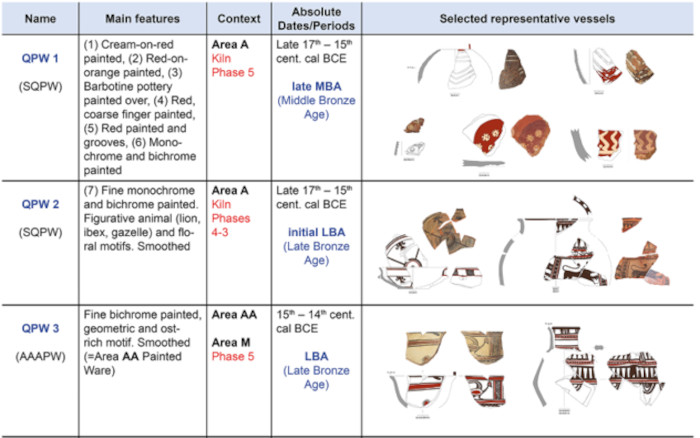
The QPW 1–7 sequence (partially shown) shows how Qurayyah’s painted ceramic tradition developed through successive periods. (Luciani et al., PLOS ONE Figure 2, CC BY 4.0)
Branding Without Labels or Packaging
The researchers’ interpretation is significant because it shifts attention away from stamps, written marks or labels. At Qurayyah, the pottery itself carried the identity: its recipes, colours, shapes and imagery remained sufficiently consistent for the place of production to become part of its reputation. It is therefore a product-based brand, rather than a label-based one.
As Dr Majed Alonazi of Saudi Arabia’s Heritage Commission told Saudi Gazette, the makers “wanted to create what we would now call a commercial brand or trademark.” Marta Luciani likewise said the discovery shows that oasis communities in an arid environment were “far from marginal” and participated in wider networks of technological knowledge and trade, according to the Austrian Academy of Sciences. The study’s criteria include visual identity, material consistency, technological continuity, centralized production, export circulation, local imitation and cultural reputation.
The cautious conclusion is not that a modern trademark system existed in Bronze Age Arabia. Rather, Qurayyah Painted Ware shows how ancient branding could emerge from skilled production, visual appeal, a stable origin and sustained demand. Its story suggests that a recognizable “made here” identity was already a powerful commercial idea long before printed labels or corporate logos.
Top image: Qurayyah Painted Ware QPW 4 vessels display the visual identity that helped make the pottery recognizable. Source: Marta Luciani @ Qurayyah Joint Archaeological Project, CC BY 4.0
By Gary Manners
References
Archaeology Magazine. 2026. 3,600-year-old pottery in Arabia shows how the world’s earliest “brands” took shape. Available at: https://archaeologymag.com/2026/08/3600-year-old-pottery-in-arabia-early-brand/
Austrian Academy of Sciences. 2026. Pioneering study proves that oases in the desert of Arabia created “brands” already in the Bronze Age. Available at: https://www.oeaw.ac.at/en/oeai/media/news-archive/news-detail/brands-qurayyah
Luciani, M., Fragnoli, P., Gilstrap, W. D., Sterba, J. H., Klainscek, D., Greene, J. A. et al. 2026. Creating a brand. Genesis, transformation and diffusion of Qurayyah Painted Ware. PLOS ONE. Available at: https://journals.plos.org/plosone/article?id=10.1371/journal.pone.0351296
Saudi Gazette. 2026. Study uncovers earliest known trademark concept in 3,600-year-old Saudi pottery. Available at: https://saudigazette.com.sa/article/663902