With the assistance of advanced remote sensing technology and the help of a determined local historian, archaeologists believe they’ve discovered the location of two mass graves of Black Union soldiers in Kentucky, men who were the victims of an infamous ambush that took place during the final year of the American Civil War
The incident occurred on January 25, 1865, in Simpsonville, Kentucky, when a group of Black Union soldiers were attacked by a motley collection of murderous Confederate guerrillas. These supposedly rogue actors, who may have been operating under secret orders from Confederate leaders guerrillas, were sometimes referred to as bushwhackers. These fighters generally ignored all traditional military rules and procedures, relying on ambushes and surprise tactics to kill rather than engage in conventional battle.
Though Kentucky declared itself neutral during the American Civil War, it housed Company E of the United States Colored Cavalry (USCC), a unit stationed at Camp Nelson. This camp served as a recruitment and enlistment center for formerly enslaved men seeking freedom through military service. At the time of the ambush, these soldiers were not involved in any warfare, but were instead responsible for herding 900 cattle toward Louisville as part of the Union Army’s logistical support network.
- The American Civil War and the Battle of Shiloh’s Glowing Wounds Mystery
- America: A Nation Defined by its Mythology (Part 1)
In the words of University of Kentucky archaeologist Philip Mink, who announced the discovery of the mass graves on April 24 at the Society for American Archaeology conference in Denver, what took place in Simpsonville was a slaughter, not a battle.
“Most of the 22 men were shot in the back while fleeing, despite wearing the uniform of the US Army,” he told Live Science. “Guerrillas definitely targeted them because they were Black.”
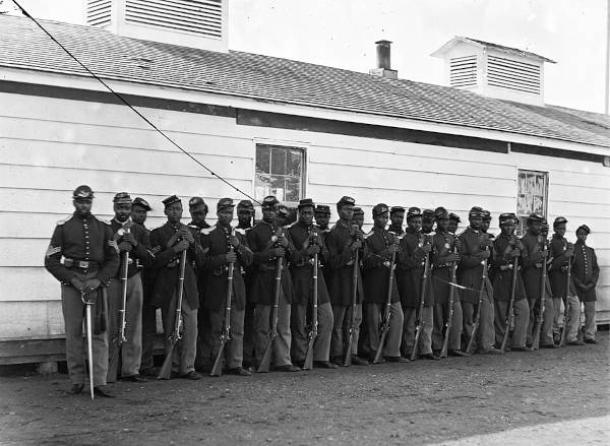
Company I of the 36th Colored Regiment, US Colored Troops, (USCT) Infantry. (Public Domain).
While the massacre left a deep scar, contemporary coverage was minimal, as might have been expected in a state where sympathy for the Confederacy ran high. Local newspapers only briefly mentioned that residents buried the soldiers in a trench, and no formal burial record was kept. Even more tellingly, the Union burial commission made no effort to recover or document the location of the graves after the war ended, revealing a great indifference for the suffering of African Americans who had contributed to the Union war effort.
The End of a Long and Exhaustive Search
Over 150 years later, a relentless effort to expose this buried history and recover the bodies of the victims was launched by Jerry Miller, a local historian and former Kentucky State Representative. He dug through oral accounts and historic archives and studied maps from the period in hopes of pinpointing the elusive burial site connected to what has become known as the Simpsonville massacre.
Miller first teamed up with Mink and his archaeological team back in 2008. The researchers intially focused on a historically African American cemetery in the area, but this did not produce any results. A turning point came in the fall of 2023, when Miller found a 1936 map that distinctly marked a Civil War burial mound, now located on land owned by a soybean farmer. When contacted, the landowner confirmed family stories that had been handed down through generations, reporting that Civil War soldiers were buried somewhere on the property.
Encouraged by this lead, Mink and his team initiated a geophysical survey of the site in December 2023. They deployed a drone-mounted magnetometer to detect buried metallic objects, such as bullets or belt buckles, and used terrestrial ground-penetrating radar to identify subsurface disturbances suggestive of graves.
Analysis of the data revealed a significant anomaly beneath the surface: a cavern or excavation of some sort that measured approximately five feet (1.5 meters) deep, 13 feet (four meters) wide, and 65.6 feet (20 meters) long, which was consistent with a mass grave.
But this wasn’t their only eye-opening discovery. A second anomaly of similar dimensions was also identified, leading to the possibility that there were multiple burial sites, reflecting the high death toll of the Simpsonville massacre.
“This is not what I expected,” Mink admitted. “There’s a possibility that there may be two mass graves because, out of the 22 men who were killed, 14 were instantly killed and were buried immediately.”
He suggested the remaining soldiers, who later died from injuries, may have been interred in a separate location.
Since the land is currently under cultivation with soybeans, excavation of the sites will have to wait until the fall of 2025. The archaeological team will be consulting with local African American communities and the descendants of the massacred soldiers, military officials, and historic preservationists, to develop a plan of action for the sites if bodies are ultimately found.
- Women’s Changing Roles Before and During the American Civil War
- The Tragedies that Befell the Five Civilized Tribes that were Forced to Trek the Trail of Tears
This investigation into a dark chapter of America’s past has already drawn attention and praise from other professionals.
“I’m so impressed with the use of modern technology to give dignity to these long-ignored and forgotten African American soldiers,” Holly K. Norton, Colorado’s state archaeologist, who is not involved in the project, told Live Science.
To honor the fallen, Kentucky’s Shelby County Historical Society has prepared headstones inscribed with the names of the USCC soldiers believed to have been killed during the Simpsonville ambush. Additionally, the Commonwealth of Kentucky has erected a historical marker at the massacre site.
“In an ideal world, these men will be removed and reburied with full military honors at the Camp Nelson National Cemetery, where many of their other comrades are buried,” Mink said.
Black Union Soldiers: Paying the Ultimate Price in a Quest for Freedom
The likely discovery of these graves has brought renewed attention to the broader, often underappreciated contributions of Black soldiers during the Civil War. Though frequently omitted from traditional narratives, nearly 200,000 African American men served in the Union Army and another 20,000 in the Union Navy. Many of these men were formerly enslaved and saw service as a path to both freedom and citizenship.
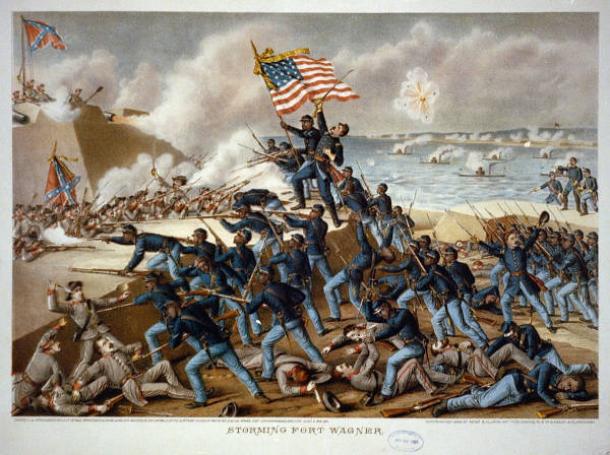
A lithograph of the storming of Fort Wagner by by the all-black 54th Massachusetts Infantry on July 18, 1863. (Library of Congress/Public Domain).
As the war progressed, more regiments of Black soldiers were formed under the banner of the United States Colored Troops (USCT). These units played a crucial role in bolstering the Union’s manpower during the final years of the conflict, and by the end of the war Black troops made up 10% of the Union Army and 16% of the Navy. African American troops participated in 40 major battles and hundreds of smaller skirmishes, with 16 men receiving the Medal of Honor for bravery.
The sacrifices made by this group of Union soldiers were immense. Approximately 20% of all African Americans enrolled in the military lost their lives during the Civil War, with a mortality rate that was significantly higher than that of white soldiers. This reflects a lack of access to good medical care and the dangerous nature of the missions to which they were assigned in the war’s later stages.
As has been revealed by the discussion of what happened in Kentucky, black soldiers were sometimes targeted for execution by militias associated with the Confederacy. This raises the disturbing possibility that many of the African Americans who lost their lives in the Civil War were not casualties of battle at all, but the victims of intentional episodes of mass murder. Tragically, there may be other mass graves connected to other massacres just waiting to be discovered.
Top image: Memorial site set up to honor the soldiers murdered at Simpsonville in 1865.
Source: Brian Mabelitini/Kentucky Office of State Archaeology.
By Nathan Falde