
A tiny silver goblet discovered decades ago in the Judean Hills might hold the oldest known depiction of cosmic creation – and the scenes etched into its surface tell a surprisingly peaceful story. For over half a century, scholars believed the 4,300-year-old vessel illustrated the violent Babylonian creation myth known as Enuma Elish, where gods battled in chaos. However, a groundbreaking new study published in the Journal of the Ancient Near Eastern Society "Ex Oriente Lux" argues the imagery depicts something far older and more universal: the orderly birth of the cosmos itself.
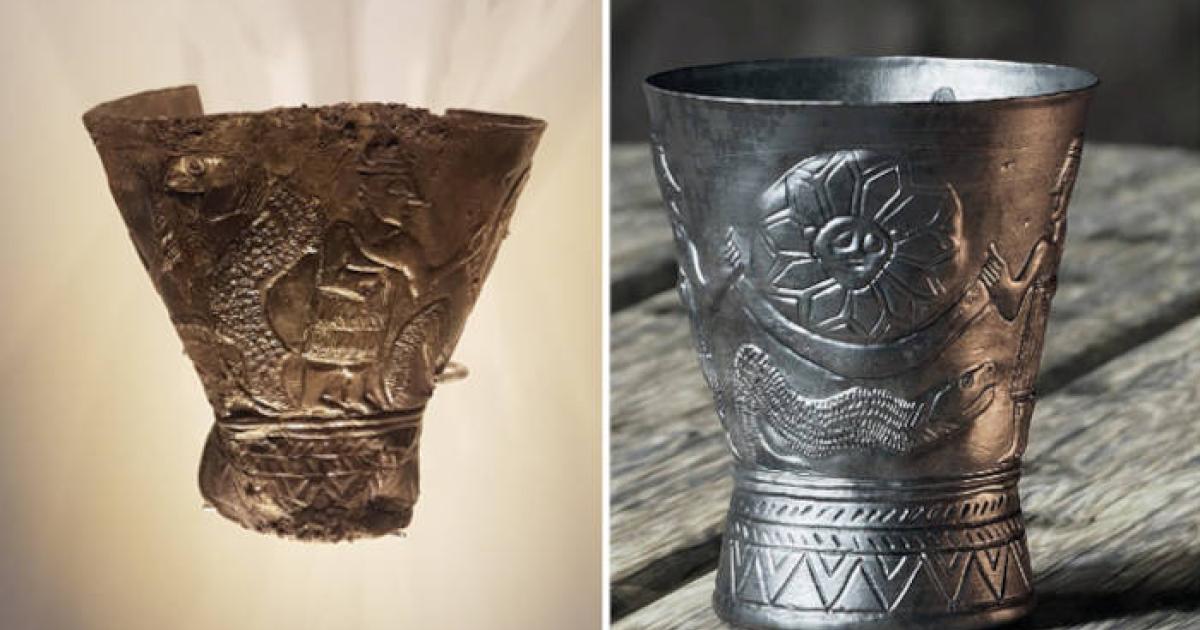
The Ain Samiya goblet, standing just three inches tall, was unearthed in 1970 from an ancient tomb in the West Bank. Its exquisite engravings show a bull-bodied chimera clutching plant fronds, a menacing serpent, celestial symbols, and mysterious figures carrying a crescent "boat of light" across the sky. According to the new research by Dr. Eberhard Zangger and colleagues at Luwian Studies, these scenes don't depict divine warfare - they show the universe transforming from primordial chaos into structured order, with the sun deity being born and rising to prominence.
- The Origins of Human Beings According to Ancient Sumerian Texts
- Tiamat, Mesopotamian Mother Goddess: From Chaos to Creation
Challenging Five Decades of Interpretation
The goblet dates to the Intermediate Bronze Age, approximately 2650-1950 BC, making it the only piece of genuine art discovered from this period in the Levant region. Early interpretations, notably by Israeli archaeologist Yigael Yadin, suggested the engravings depicted a proto-version of Enuma Elish - where the god Marduk battles the chaos goddess Tiamat and fashions the world from her corpse. But critics quickly noted glaring problems with this theory. The scenes contain no violence, no combat, no dismembered deities. More significantly, Enuma Elish wouldn't be written for another thousand years after the goblet was crafted.
"The goblet does not tell of a violent struggle between gods, but of a peaceful process of cosmic ordering," co-author Daniel Sarlo told The Telegraph. "It shows how the Sun is born, banishes chaos and renews the world."
The research team's analysis reveals that the imagery represents a universal ancient Near Eastern concept: the establishment of cosmic order through divine intervention, not through warfare.

A flat rendering of the scenes depicted on the Ain Samiya Goblet. (Nattering Nabob of Nanofabrication/CC BY-SA 4.0)
Reading the Cosmic Timeline
The goblet's decoration functions as a visual timeline, according to a report by Phys.org. The left scene shows a chaotic primordial state: a part-human, part-bull chimera figure clutches vegetation, with a tiny rosette (representing the newborn sun) positioned low between its legs. A powerful serpent stands tall and assertive, symbolizing the forces of disorder.
In the right scene, order has been established - two divine figures wearing elegant tunics and jewelry carry a crescent boat containing the Sun, now depicted with a smiling human face and radiating strength. The once-mighty serpent lies subdued beneath the crescent.
"The artist has effectively depicted the passage of time through a series of simple stylistic choices," the study authors explain. "For example, on the left, the sun appears quite small, demonstrating its recent birth, while on the right it appears to have grown and radiates strength and happiness with its en face depiction."
Even the gods show subtle aging - wrinkles on their necks suggest the passage of eons. The serpent, once proud and upright, now appears "bent over" under the weight of cosmic order.
- 3,600-year-old Silver Pieces Confirmed As First Money Used in the Levant
- Egyptian Creation Myth and the Gods of Chaos: Life From Darkness
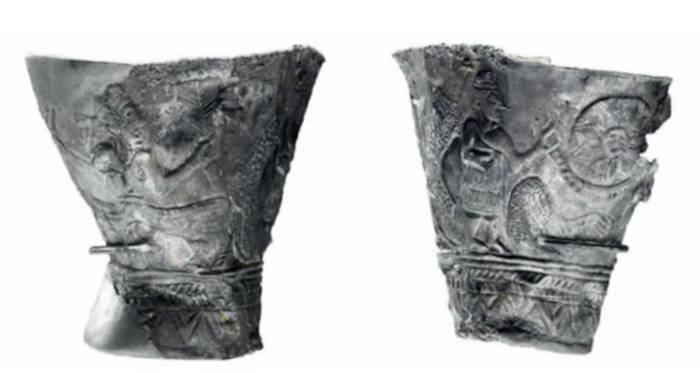
The goblet from Ain Samiya. ( Ardon Bar Hama/The Israel Museum)
Ancient Near Eastern Cosmology
The "boat of light" depicted on the goblet represents a widespread Bronze Age belief that celestial bodies were transported across the sky in vessels.
"This boat has a practical purpose: it's a vehicle that transports celestial bodies across the sky, and this was considered the explanation why the Sun and the Moon are moving," Dr. Zangger explained to the New York Post. This cosmological concept appears across Egypt, Mesopotamia, and Anatolia, suggesting shared cultural exchanges throughout the ancient Near East.
The research team identified striking parallels with other ancient artworks, particularly the closing scene on the sarcophagus of Egyptian Pharaoh Seti I (1279 BC) and bull-human hybrid reliefs from the Hittite sanctuary of Yazılıkaya in Anatolia (circa 1230 BC). These similarities led researchers to conclude the goblet was designed by someone from southern Mesopotamia but manufactured in northern Mesopotamia or Syria, where silver was readily available during the Bronze Age.
Scholarly Debate Continues
Despite the compelling new interpretation, not all experts are convinced. Mark Smith, a Biblical scholar at Princeton Theological Seminary who was not involved with the study, told Smithsonian Magazine that the imagery might represent other myths entirely, such as the Baal cycle. "I think the objection to assuming that it's a Babylonian creation story is correct, but it's not clear that this is a creation myth at all," Smith noted.
The original condition of the goblet at discovery was poorly documented, with part of the vessel damaged and a section missing. This makes definitive interpretation challenging, as the research relies on iconographic parallels rather than accompanying textual evidence. Nevertheless, the study represents a significant reinterpretation of one of the Bronze Age's most enigmatic artifacts, suggesting our ancestors conceived of cosmic creation as a gradual, peaceful process rather than a violent clash of divine forces.
The Ain Samiya goblet remains on display at the Israel Museum in Jerusalem, where visitors can contemplate humanity's oldest visual meditation on existence - a 4,300-year-old answer to the eternal question: How did the universe begin?
Top image: Left; The 4,300-year-old Ain Samiya goblet. Right; Artist's reconstruction of the Ain Samiya goblet showing mythological scenes with chimeras, serpents, and celestial symbols depicting cosmic creation. Source: Left; CC BY-SA 4.0, Right:Luwian Studies #5053/Journal of the Ancient Near Eastern Society "Ex Oriente Lux" (2025)
By Gary Manners
References
Zangger, E., Sarlo, D., and Haas Dantes, F. 2025. The Earliest Cosmological Depictions: Reconsidering the Imagery on the ˁAin Samiya Goblet. Available at: https://zenodo.org/records/17594730
Kasal Krystal, 2025. Imagery from 4,000-year-old goblet might depict a cosmic creation story, not Enuma Elish myth. 2025. Phys.org. Available at: https://phys.org/news/2025-11-imagery-year-goblet-depict-cosmic.html
Knapton, S. 2025. World's oldest depiction of Creation discovered. The Telegraph. Available at: https://www.telegraph.co.uk/news/2025/11/13/world-oldest-depiction-universe-discovered-west-bank/
Randolf, M. 2025. Scholars Thought This Ancient Silver Goblet Told One Myth for 50 Years. Is It Actually Telling Another Story? Smithsonian Magazine. Available at: https://www.smithsonianmag.com/smart-news/scholars-thought-this-ancient-silver-goblet-told-one-myth-for-50-years-is-it-actually-telling-another-story-180987675/
Young, A. 2025. Ancient goblet found in West Bank holds oldest image of the universe's birth: study. 2025. New York Post. Available at: https://nypost.com/2025/11/14/world-news/ancient-goblet-found-in-west-bank-holds-oldest-image-of-the-universes-birth-study/