
Abaris the Hyperborean is a peculiar figure in Greek tradition. He was known as a priest of Apollo who came from the Hyperboreans, a people Greek writers placed in the far north, and later writers said he crossed rivers, seas and mountains carried on an arrow. Some claimed he cured cities of plague and became a pupil of Pythagoras. But did anyone in the ancient world actually believe he was real?
The answer depends on which writer you ask, because Herodotus mentioned the tale only to set it aside, while Plato named Abaris as a source of healing charms. Much later, writers who admired Pythagoras turned him into a flying holy man. Following the story through those authors shows how a single name grew into a legend.
The Story Herodotus Refused to Tell
The earliest surviving mention comes from Herodotus, in Book 4 of his Histories. After describing the gifts that Hyperborean maidens were said to have carried to the island of Delos, the historian turns away from the subject with a brisk remark. In the translation by George Rawlinson, he writes:
"As for the tale of Abaris, who is said to have been a Hyperborean, and to have gone with his arrow all round the world without once eating, I shall pass it by in silence."
Herodotus then shows exactly how he felt about the far north, writing that "Thus much, however, is clear: if there are Hyperboreans, there must also be Hypernotians," and adding that he could not help laughing at mapmakers who drew the world without good reason. It is a remarkable dismissal, because it shows that the arrow story was already circulating among Greeks in his day.
Herodotus placed this passage among stories about the Hyperboreans, the northern people at the heart of the legend of Hyperborea, and he treated much of that northern lore with open suspicion. Herodotus himself was a writer whose reliability has long been argued over, as Ancient Origins explored in a piece asking whether he was the father of history or of lies. Here, at least, he made his doubts plain.
A Healer Named by Plato
Plato gave Abaris a very different role. In the dialogue Charmides, Socrates tells the young Charmides that he knows a cure for the headache, but that the soul must be treated as well as the head. If the youth is already temperate, Socrates says, then he has "no need of any charms, whether of Zamolxis or of Abaris the Hyperborean," according to the Benjamin Jowett translation.
The line is brief, yet it is telling, because Plato could drop the name into conversation as though his readers would know who Abaris was and what kind of healing was linked to him. However, the dialogue gives no hint of an arrow, a journey or a meeting with Pythagoras. Those details arrive only in much later sources, which add far more color than Plato ever did.
The Plague, the Oracle and the Athenians
The Greek reference work known as the Suda gathered several older traditions about him. In the Suda On Line translation by Anne Mahoney, it calls him "Scythian, son of Seuthes," and credits him with works including Purifications, a Theogony and a poem titled Arrival of Apollo among the Hyperboreans. It adds: "He came from Scythia to Greece."
The same entry says "The legendary arrow belongs to him, the one he flew on from Greece to Hyperborean Scythia. It was given to him by Apollo." It then repeats a story that a note in the translation traces to Harpokration, in which a plague swept the whole inhabited world and Apollo's oracle reportedly told the Greeks and foreigners that the Athenians should pray on behalf of everyone, and Abaris came as ambassador of the Hyperboreans.
The Suda places that visit in the third Olympiad, which the translation's notes equate to 768 to 765 BC. However, those notes also show how unstable the date was, explaining that Harpokration also listed later alternatives, namely the twenty first Olympiad (696 to 693 BC) or "the time of Croesus, king of Lydia," which the note dates to about 560 to 546 BC. That leaves a spread of more than 200 years between the earliest and latest dates offered for a single visit.
Abaris Meets Pythagoras
The most colorful version comes from two later Greek authors, Porphyry and Iamblichus, who both wrote lives of Pythagoras, a figure whose religious teachings went well beyond his famous theorem. In their telling, Abaris became a witness to Pythagoras' divinity.
In Kenneth Sylvan Guthrie's 1920 translation of Porphyry, the sage "showed his golden thigh to Abaris the Hyperborean, to confirm him in the opinion that he was the Hyperborean Apollo, whose priest Abaris was." Porphyry also gives him a nickname, writing that "Abaris was called Aethrobates, the walker in air," because he was carried through the air on an arrow of the Hyperborean Apollo over rivers, seas and inaccessible places.
Iamblichus, in Thomas Taylor's 1818 translation, tells the meeting at greater length and calls Abaris a priest of the Apollo worshipped among the Hyperboreans. In his account, Abaris was returning north with gold he had collected for Apollo's temple when he passed through Italy, saw Pythagoras and concluded that he was the god himself. He then handed over the arrow, which Taylor translates as a "dart":
"For he was carried by it, in passing through inaccessible places, such as rivers, lakes, marshes, mountains, and the like, and performed through it, as it is said, lustrations, and expelled pestilence and winds from the cities that requested him to liberate them from these evils."
Iamblichus says Lacedaemon was purified this way and no longer suffered from pestilence, and he adds that Pythagoras taught Abaris to foretell the future by numbers rather than by the entrails of animals. Elsewhere in the same book, Abaris "dwelt in temples, and was never seen either to eat or drink." But it didn't end there. Iamblichus even placed Abaris beside Pythagoras when the philosopher was held by Phalaris, a tyrant he calls "the most cruel of tyrants," debating the gods and divine providence.
A Shaman in Greek Dress?
Modern scholars have mostly asked a different question. Rather than whether Abaris flew, they ask what kind of figure he represented. In a 2016 survey of the debate, Jan N. Bremmer of the University of Groningen traces how earlier scholars grouped Abaris with Pythagoras, Epimenides and Empedocles, and how some of them came to compare these figures with shamans.
Bremmer reports that the German scholar Hermann Diels grouped such figures as "Wundermänner," and that Karl Meuli later promoted Aristeas and Abaris to "skythischer Wundermann." Bremmer is skeptical of that step, writing that "there is no evidence at all in our sources that they were Scythians." He also reports that Walter Burkert, following Diels, Dodds and Meuli, set Pythagoras, Aristeas and Abaris within a shamanistic framework.
For Abaris in particular, Bremmer's notes point readers to a 2015 study by Dowden and to work by Piras. As far as Ancient Origins can establish, those studies are known here only from Bremmer's notes, so their arguments are not summarized. The shaman reading remains a modern interpretation and is still debated, which is why it is labeled Disputed below.
What Can We Say About Abaris?
None of the sources cited here describes any physical trace of Abaris, and the works the Suda lists appear there only as titles, so nothing can safely be called his own writing. The oldest witness, Herodotus, already treated the arrow as a tale. Plato knew the name in connection with healing charms, and the fullest stories come from much later writers whose books set out to celebrate Pythagoras as more than a man.
That pattern suggests the legend grew in the retelling, although it does not prove that no northern priest ever visited Greece. Was there once a real traveler behind the name, perhaps an envoy who brought offerings to Apollo? The sources simply cannot say. Who Abaris was, if he was anyone at all, is a question the sources leave open, and there is still much to learn.
How we label claims
Established: that Herodotus, Plato, the Suda, Porphyry and Iamblichus wrote about Abaris as quoted above, including the ancient stories of his journey on Apollo's arrow (Herodotus, the Suda, Porphyry and Iamblichus) and of his living without food (Herodotus and Iamblichus). Unverified: that Abaris was a real person, that he wrote the works the Suda lists, any date for his visit to Greece, and his meeting with Pythagoras. Disputed: the modern reading of Abaris as a figure like a shaman, as surveyed by Bremmer. Fringe: that Abaris literally flew on an arrow or lived without food.
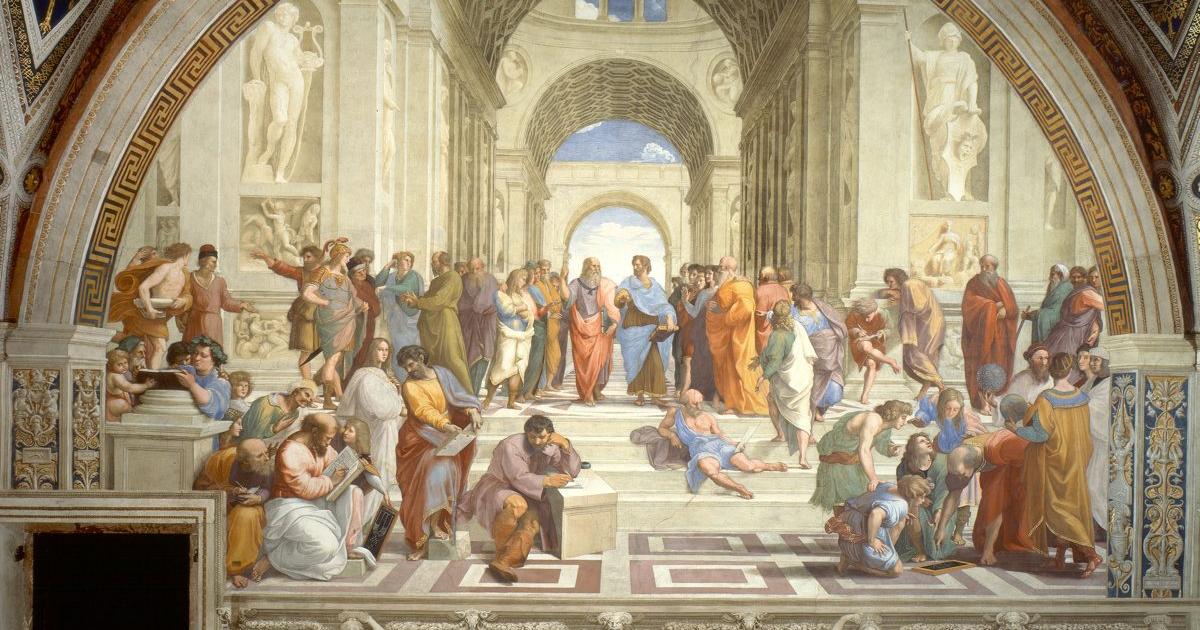
Illustration only: The School of Athens, a fresco by Raphael dated on its Wikimedia Commons file page to 1511. It shows an imagined gathering of Greek thinkers and does not depict Abaris or any scene from his story. Raphael, The School of Athens, image stitched together from vatican.va, via Wikimedia Commons, in the public domain (no copyright, per the Commons file page).
By Aris Manus
Sources
- Herodotus, The History of Herodotus, Book 4 (4.36), translated by George Rawlinson (Wikisource)/Book_4)
- Plato, Charmides, translated by Benjamin Jowett (Project Gutenberg)
- Suda, alpha 18, Abaris, translated by Anne Mahoney, Suda On Line
- Porphyry, Life of Pythagoras, translated by Kenneth Sylvan Guthrie, 1920 (tertullian.org)
- Iamblichus, Life of Pythagoras, translated by Thomas Taylor, 1818 (Project Gutenberg)
- Jan N. Bremmer, Shamanism in Classical Scholarship: Where are We Now?, in P. Jackson (ed.), Horizons of Shamanism, Stockholm University Press, 2016, CC BY 4.0