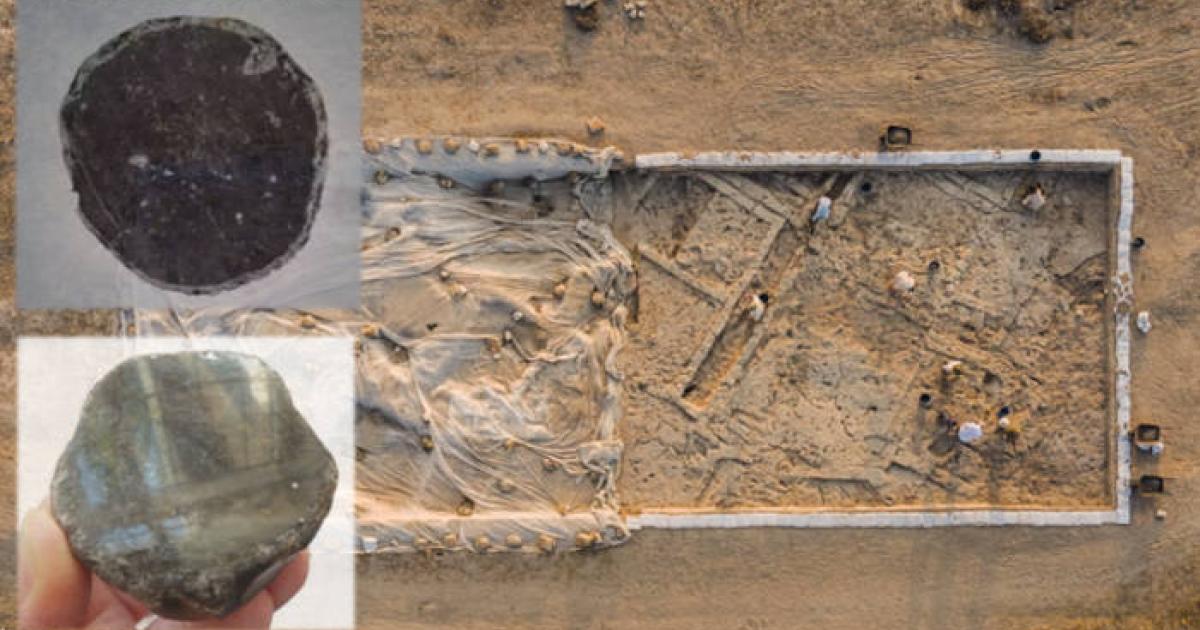

Archaeologists excavating at Canhasan in central Turkey have unearthed an extraordinarily rare 8,500-year-old obsidian mirror. The discovery represents one of only 56 such mirrors ever found across the entire Near East, making this polished volcanic glass artifact an exceptional window into ancient Anatolian culture.
The mirror, dated to approximately 6,500 BC, was discovered during the second phase of excavations at the Canhasan mounds in Karaman's Alaçatı village, conducted under the Turkish Ministry of Culture and Tourism's Heritage for the Future Project. Led by Associate Professor Adnan Baysal from Ankara University, the research has revealed not only this remarkable mirror but also a collection of finely incised obsidian arrowheads with decorative patterns unique to the region. These findings underscore Canhasan's pivotal role in the development of Central Anatolian Neolithic culture, positioning it as a crucial link between earlier settlements and the famous site of Çatalhöyük.
- World's Oldest Street Challenges Our Understanding of Neolithic Urban Planning
- The Unmatched 9500-Year-Old Honeycomb City of Çatalhöyük
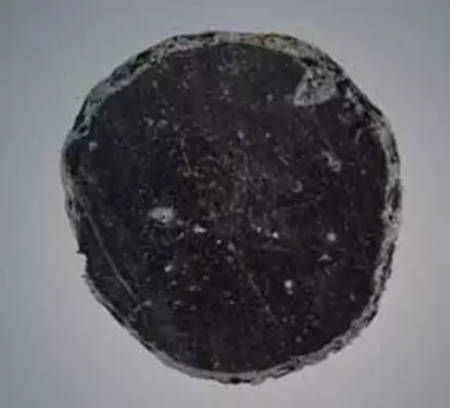
8,500-Year-Old Mirror Unearthed at Canhasan. (Canhasan Archaeological Excavation Team)
The Manufacturing Mystery: Tepecik Çiftlik's Obsidian Workshop
The rarity of obsidian mirrors in the archaeological record has long puzzled researchers, but recent discoveries have begun to illuminate their production process. Earlier this year, archaeologists identified Tepecik Çiftlik in the Cappadocia region as the primary manufacturing center for these enigmatic artifacts. Located in the Melendiz Plain with direct access to the Nenezida and Güllüdağ obsidian sources, Tepecik Çiftlik was occupied between 7000 and 6000 BC and developed a specialized industry in obsidian working.
What makes this site exceptional is the discovery of not just finished mirrors but also preforms in various stages of manufacture, allowing researchers to reconstruct the complete production sequence for the first time. According to a study published in the Journal of Archaeological Science: Reports, the manufacturing process involved at least eight distinct stages, each requiring specialized knowledge and considerable skill. Craftspeople first selected obsidian fragments with relatively flat surfaces and subcircular shapes, then systematically removed sharp edges and ridges before beginning the painstaking polishing process.
The polishing technique itself was remarkably sophisticated. Initial smoothing used coarse-grained stones, followed by progressively finer abrasives including sand or ash mixed with water, fat, and leather. The final stage may have involved rubbing with fat and soft fabrics to achieve the characteristic reflective sheen. This multi-stage process produced portable objects with surfaces capable of reflecting clear images, though their exact function remains debated.
- Early Neolithic Ceremonies in Turkey Found to Include Piercing Rituals
- Kahin Tepe Excavation Uncovers Neolithic Temple in Turkey
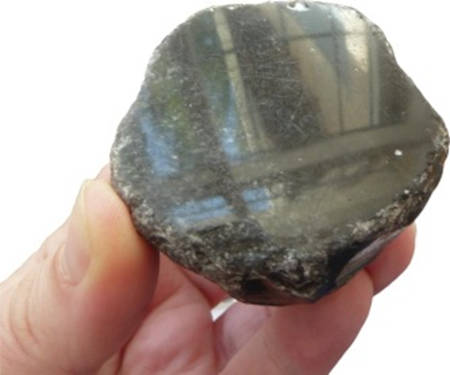
A finished mirror discovered at Tepecik Çiftlik in 2012 in a Ceramic Neolithic level with a highly reflective surface. (A. Vinet./Journal of Archaeological Science)
A Window Into Neolithic Symbolic Culture
The Canhasan mirror's discovery adds to our understanding of how these objects were used and valued in Neolithic Anatolia. Associate Professor Baysal emphasized that the specimen is contemporary with mirrors found at Çatalhöyük, and all known examples originate within modern Turkey's borders, suggesting obsidian mirror-making was a distinctly Anatolian innovation. The technical expertise required to create these artifacts indicates they were not casual crafts but products of specialized knowledge passed down through generations.
"These mirrors require an exceptional level of skill," Baysal explained.
"The production process is incredibly challenging - obsidian must be carefully shaped and polished using abrasive materials. This was not a casual craft; it was a specialized technology."
The scarcity of these objects throughout the archaeological record reinforces their special status. With only six sites in Anatolia yielding mirrors - Tepecik Çiftlik, Çatalhöyük-East, Sırçalıtepe, Güvercinkayası, Domuztepe, and Akarçay Tepe - and one additional specimen found as far away as Tel Kabri in the Levant, these artifacts clearly held significant cultural importance.
Symbolic Significance and Social Status
The context in which obsidian mirrors have been found provides intriguing clues about their function. At Çatalhöyük, mirrors discovered in tombs were accompanied by pigments in red, yellow, blue, and green, leading archaeologists to speculate they may have been used in rituals related to beautification of the deceased. Other theories suggest these reflective objects served as status symbols, signaling instruments, or even tools for redirecting light in architectural spaces.
The most widely accepted interpretation positions mirrors as prestige goods restricted to high-ranking individuals within their communities. The complexity of their manufacture, combined with their limited distribution, strongly suggests they were reserved for special contexts rather than everyday use. The Canhasan mirror's discovery in a settlement that also yielded evidence of advanced urban planning - including a possible 10,000-year-old street system - reinforces the connection between technological sophistication and social complexity in early Neolithic communities.
Local Traditions and Engraved Symbolism
Alongside the mirror, excavators at Canhasan discovered several obsidian arrowheads decorated with fine linear incisions. These engraved patterns appear to be exclusive to the Canhasan region, representing a distinctive local symbolic tradition. "These engraved pieces indicate a long-standing local tradition," Baysal noted. "While obsidian is found in many Neolithic sites, this specific incised style seems so far to be exclusive to Canhasan."
The motifs carved into these arrowheads may have held symbolic meaning related to social identity, ownership, or ritual practices. Such symbolic expression characterizes Neolithic communities transitioning from nomadic lifestyles to permanent agricultural settlements. The combination of sophisticated mirror production and distinctive decorative traditions at Canhasan suggests a community with strong cultural identity and advanced technological capabilities that extended well beyond basic subsistence needs.
Rewriting Neolithic History
The discoveries at Canhasan are fundamentally changing how archaeologists understand the development of Neolithic culture in Central Anatolia. For decades, Çatalhöyük dominated scholarly attention as the apparent center of this cultural flowering, but Baysal emphasizes this narrative is incomplete.
"Up until now, we have learned only the Çatalhöyük chapter of this cultural evolution," he stated. "Canhasan helps us uncover the earlier chapters - ones that began in sites like Aşıklı Höyük and Boncuklu Höyük, evolved through Canhasan, and eventually culminated in Çatalhöyük."
As excavations continue at Canhasan, each new discovery adds depth to our understanding of how the world's first settled societies organized themselves, shaped their material culture, and expressed their identities through objects of beauty and symbolic power. The 8,500-year-old obsidian mirror stands as a brilliant testament—both literally and metaphorically—to the ingenuity and creativity of Neolithic peoples who once inhabited the high plains of Central Anatolia.
Top image: 8,500-year-old obsidian mirror and artifacts unearthed at Canhasan excavation. Source: The Canhasan Archaeological Excavation Team
By Gary Manners
References
Baysal, A. 2025. 8,500-Year-Old Mirror Unearthed at Canhasan in Central Türkiye. Available at: https://arkeonews.net/8500-year-old-mirror-unearthed-at-canhasan-in-central-turkiye/
La Brújula Verde. 2025. The Place Where the Rare Obsidian Mirrors of the Neolithic in Anatolia and the Near East Were Manufactured Has Been Found. Available at: https://www.labrujulaverde.com/en/2025/02/the-place-where-the-rare-obsidian-mirrors-of-the-neolithic-in-anatolia-and-the-near-east-were-manufactured-has-been-found/
Vinet, A. 2025. Neolithic obsidian mirrors from Southwest Asia: A reflection on their diffusion and manufacture. Journal of Archaeological Science: Reports, Volume 62, Article 105047. Available at: https://www.sciencedirect.com/science/article/pii/S2352409X25000793