
Hundreds of tiny skeletons buried beneath an ancient sanctuary in Crete may reveal a fascinating aspect of early religious rituals, inspiring curiosity about lost practices. Archaeologists who recently excavated the sanctuary of Apollo located at Gortyn, Crete, have discovered a votive deposit containing the remains of hundreds of mice. The discovery points to a local cult, Apollo Smintheus, at the 7th-century BC site. The rodents appear to have been deliberately collected and buried, raising questions about Apollo’s more obscure connections with mice, disease, healing, and divine protection.
450 Mice Unearthed in Apollo’s Sanctuary at Gortyn
A summer excavation season at Gortyn, one of Crete's largest and longest-inhabited archaeological sites, has produced an unusual clue about the religious life of the early Cretan city-state: the remains of more than 450 mice, buried as part of a votive deposit within the Sanctuary of Apollo. Fieldwork carried out from July 19th up until August 14th, 2026, has been a collaboration between the Italian Archaeological School at Athens and the Department of Cultural Heritage at the University of Padua, continuing a long-running Italian research program at this site.
Inside One of Crete’s Oldest Sacred Enclosures
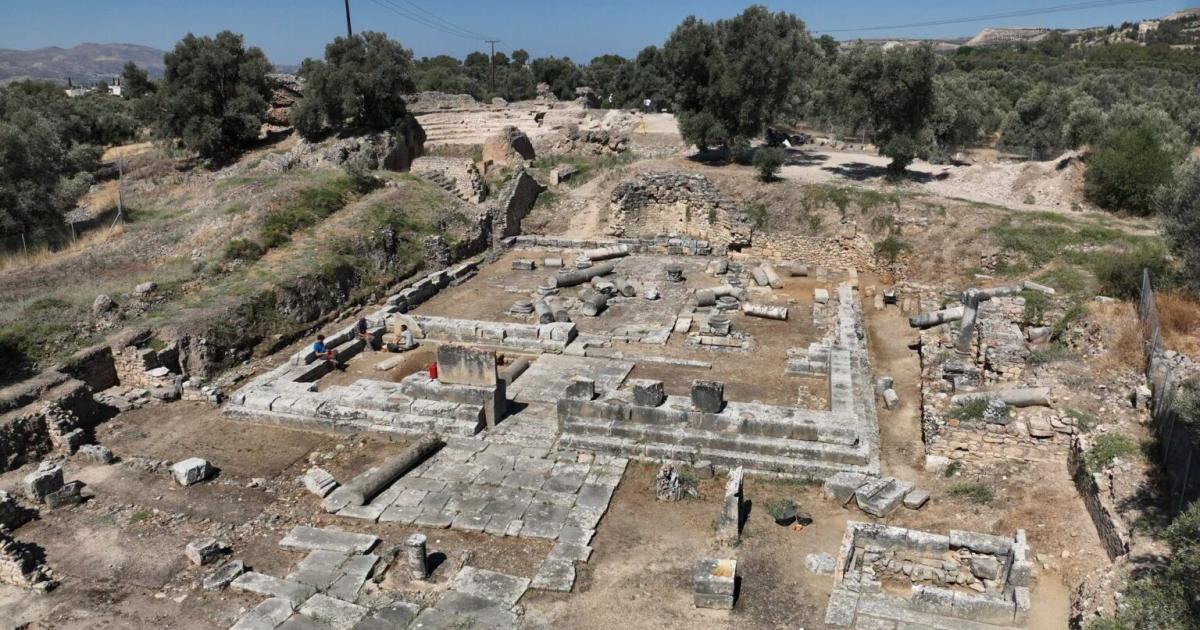
The current excavations are investigating the sacred enclosure of Apollo, a walled precinct built around the middle of the 7th century BC. According to the research team, it is one of the oldest and most architecturally complex cult buildings associated with the Cretan polis. These city-states were taking shape during this period. Three new stratigraphic trenches were opened during the excavation to confirm the enclosure's dating and to produce new evidence on construction techniques, adding details to a phase of Cretan history that lacks written sources. By the beginning of the Hellenistic period, the sanctuary associated with the cult of Apollo had become one of the city’s principal religious complexes. At the center of this year’s research was the votive deposit of mice along with a range of other offerings.
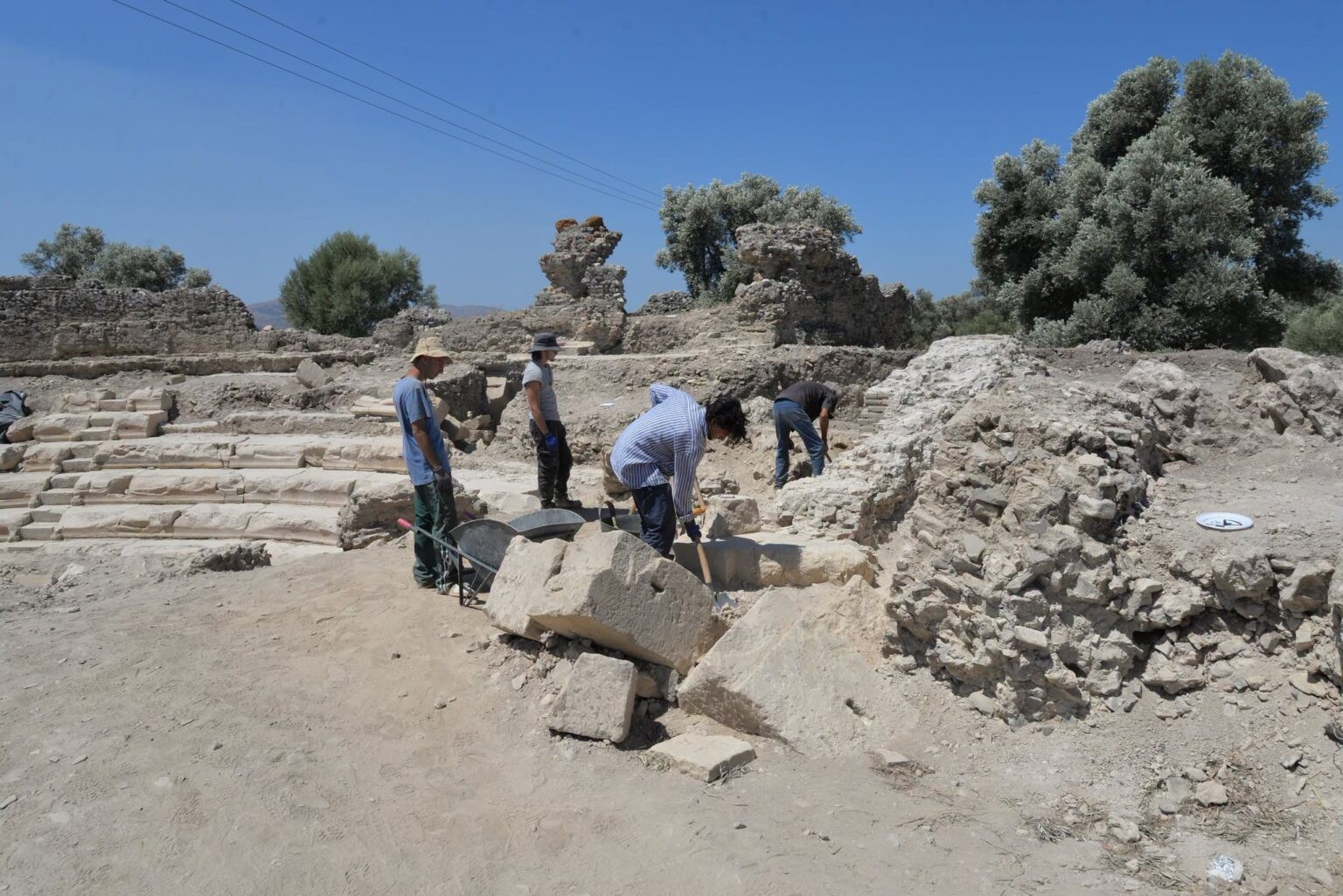
Archaeologists conducting excavations at ancient Gortyn on Crete have found evidence of unusual ritual activity involving hundreds of mice in the sanctuary of Apollo. (Scuola Archeologica Italiana di Atene/Facebook)
Could the Mice Reveal a Cult of Apollo Smintheus?
Researchers now believe that the find may actually point to a cult of Apollo Smintheus, or “mouse Apollo,” Highlighting the rich diversity of ancient Greek religious practices. The cult revered Apollo as both a bringer and a queller of plague. The best-documented sanctuary of this particular cult was located at Chryse in the Troad region of northwestern Anatolia, near Gulpinar in Turkey. The sanctuary is mentioned in the opening book of Homer’s Iliad, where the priest Chryses prays to Apollo Smintheus, asking that he bring a plague upon the Greek army besieging the city of Troy.
When Sacred Mice Lived Beneath Apollo’s Altar
According to ancient tradition, the Troad sanctuary kept live mice under its altar and even fed them at public expense. This tradition can be seen in the 4th-century BC cult statue by the sculptor Skopas, which reportedly depicted Apollo himself with his foot resting on a tiny mouse. Apollo, the protector, could clear a field of destructive mice with his arrows or command the mice to unleash a plague on the enemies of his followers. The geographer Strabo also noted that several places throughout Asia Minor bore the name Sminthe and held festivals in the god’s honor, suggesting the cult was never confined to a single sanctuary. The Gortyn discovery allows researchers to present evidence of a previously undocumented branch of this cult in existence on Crete. Its followers may have worshipped alongside non-cult worshippers in the same sanctuary.
Excavations Reveal More of Gortyn’s Roman Theater
Excavations also continued at the theater, which stands immediately beside the sanctuary. It is known to archaeologists as the Theater of the Pythion. The theater was constructed during the 2nd century AD when the Roman Empire controlled the island. It’s considered one of the best-preserved Roman-era theaters in Crete. Its semicircular cavea, divided by a central walkway, could seat almost 2,000 spectators, and the theater complex was fronted by a large colonnaded portico measuring 76 by 36 meters, with staircases along its outer sides giving access to the seating area. Researchers uncovered substantial new sections of the building’s scaenae frons, the elaborately decorated stage front that once closed off the back of the performance space. Ancient descriptions list this facade as 50 meters long, and built with rectangular platforms flanking a central doorway and fronted by black-and-white Doric columns, with marble inlay decorating parts of the stage walls.
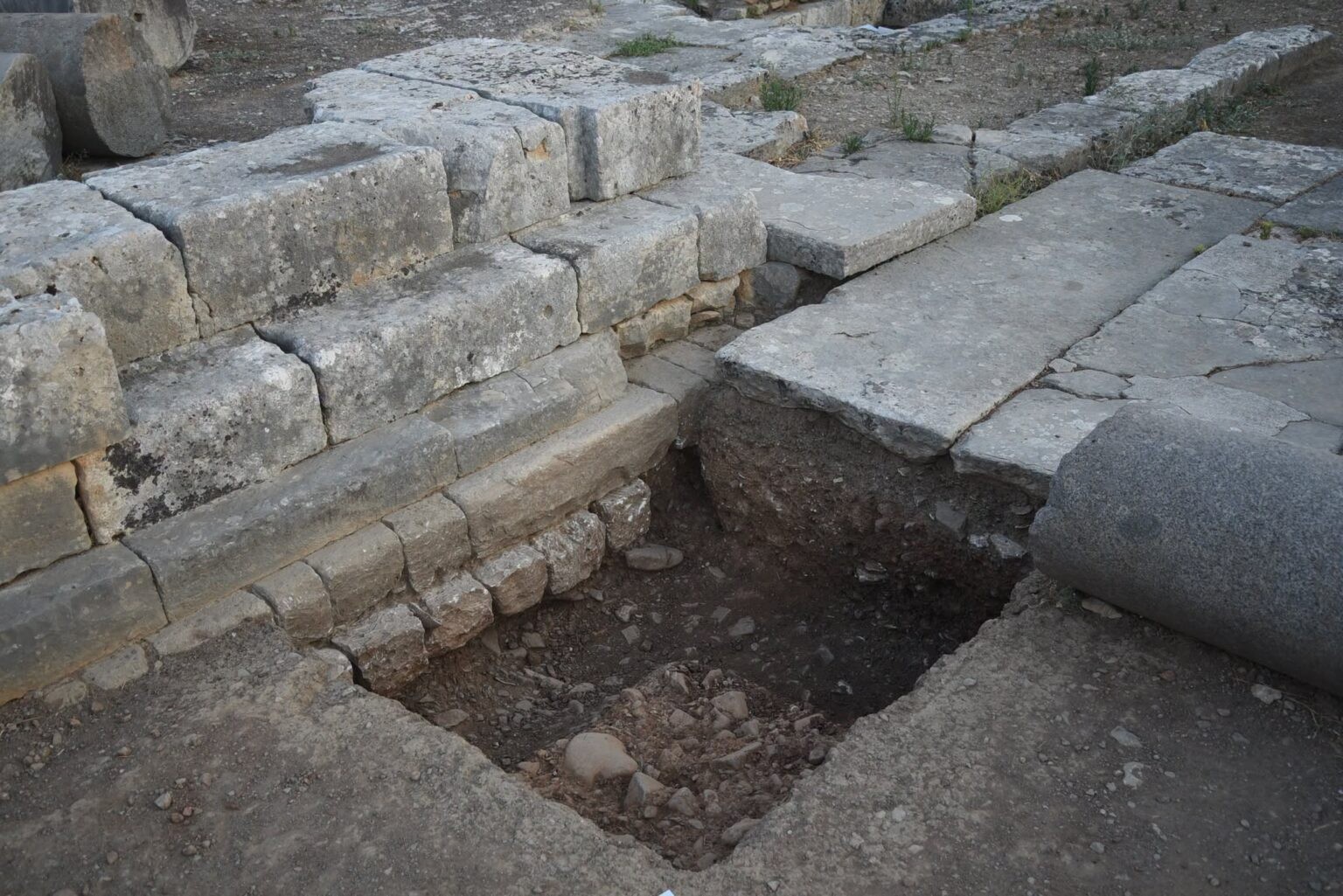
Excavated archaeological deposits beside the ancient stone architecture at Gortyn, Crete. Recent investigations of the sanctuary of Apollo have uncovered an extraordinary concentration of mouse remains that researchers are examining for evidence of ritual activity. (Scuola Archeologica Italiana di Atene/Facebook)
Collapsed Architecture Offers Clues to the Theater’s Original Splendor
Alongside these structural remains, archaeologists have recovered material from the building’s collapse, including carved decorative fragments that specialists will later use to reconstruct the original facade. The theater itself has been the subject of systematic investigation by the Italian Archaeological School and the University of Padua since the early 2000s to maintain the physical and architectural relationship between the stage building and the sanctuary of Apollo.
A Tiny Discovery Could Transform a Major Cretan Sanctuary
This archaeological project has brought together students and researchers from the University of Padua, Rome, Sapienza and Pisa in Italy, along with Germany’s Ruhr-Universität Bochum, in an exciting effort to uncover new insights about religious practices at Gortyn. The results of their work are still emerging. The unexpected presence of hundreds of small rodent bones may challenge previous ideas about this major Cretan sanctuary. This new evidence adds depth to the story of the sanctuary and the intriguing theater built beside it, sparking curiosity about what future discoveries might reveal.
Gortyn Rose from Ancient Settlement to Cretan Powerhouse
Gortyn lies on the fertile Mesara plain in southern Crete, just south of modern Heraklion. Archaeological evidence shows that this area was already settled during the Neolithic period. By the Late Bronze Age, a fortified settlement stood on the city’s acropolis, initially overshadowed by the majestic Minoan palace at Phaistos. Over the following centuries, Gortyn grew into one of the most powerful city-states on Crete. Over time, the city-state allied with and rivaled powerful Knossos for dominance of the whole island. Its most famous archaic document is the Gortyn Law Code, which was inscribed around the 5th century BC and is regarded as the oldest substantially complete law code still surviving from the Greek world. The code covers important issues such as property rights, inheritance, and marriage.
Conclusion
The city’s fortunes rose to their highest point after 67 BC, when Rome conquered the island of Crete. After a few decades of Roman rule, Gortyn became the capital of the joint province of Crete and Cyrenaica. The city of Gortyn flowered under the Roman Empire. It expanded well past its earlier core, gaining a praetorium, baths, and odeon. There were also temples to Egyptian gods and goddesses such as Isis and Serapis, as well as the sanctuary and theater of Apollo. Gortyn remained an important administrative and religious center well into the Byzantine period, when it became the seat of Crete’s first bishop. A major earthquake in the 9th century AD, accompanied by an Arab invasion, brought the long history of the city and its status as a major urban center to an end.
Top Image: Aerial view of the sacred enclosure of Apollo at Gortyn, Crete, where archaeologists discovered an unusual votive deposit containing the remains of more than 450 mice. Source:(Scuola Archeologica Italiana di Atene/Facebook)
By Ramsey Hardin
References
Buyukyildirim, O.August 9, 2026. “450 Mice Found in a 2,700-Year-Old Sanctuary in Crete Point to an Unknown Cult.” Arkeonews. Available at:
https://arkeonews.net/450-mice-found-in-a-2700-year-old-sanctuary-in-crete-point-to-an-unknown-cult/
Garcia, A. August 10, 2026. “The Discovery of the Remains of 450 Mice Deposited as an Offering in the Sanctuary of Apollo in Gortyna Indicates an Ancient Change of Dedication”. La Brújula Verde. Available at:
Halbherr, F. 1889. “The Queen of Inscriptions: The Laws of Gortyn.” Rome: Tipografia della Reale Accademia dei Lincei. Available at: Accademia Nazionale dei Lincei – Gortyn archaeological bibliography
Lippolis, E., Giatti, C., and Interdonato, E. 2010. “Gortyn, Praetorium. Defining contexts and chronology. Fine pottery: problems and approaches.” LANX. Rivista della Scuola di Specializzazione in Beni Archeologici. Università degli Studi di Milano. Available at: https://doi.org/10.13130/2035-4797/500