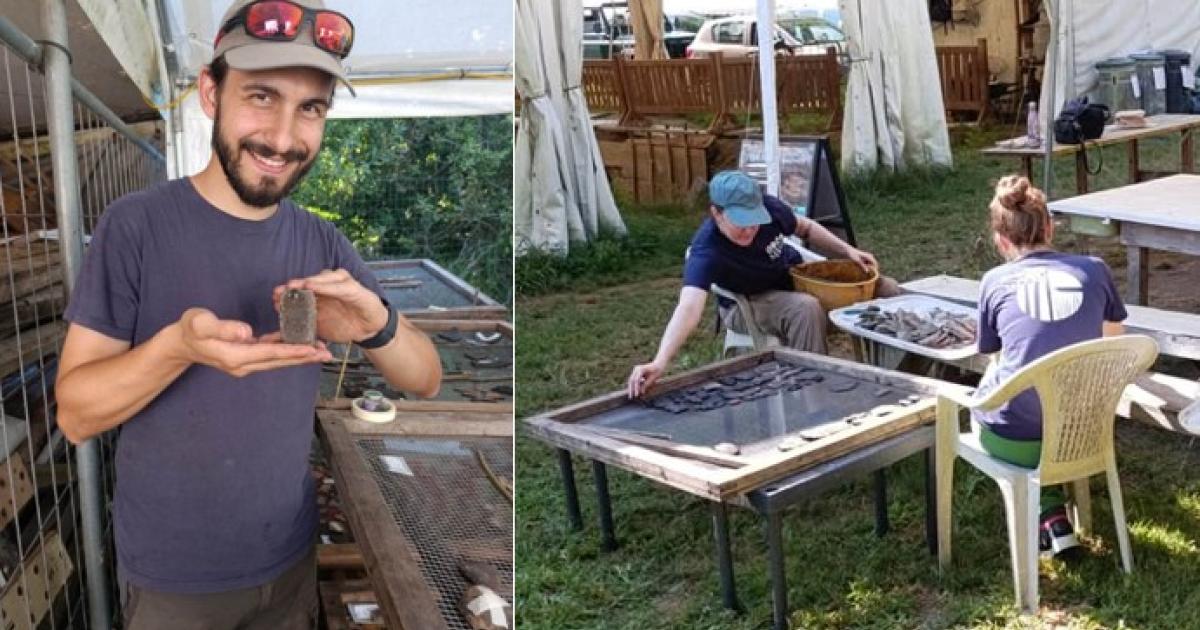

Archaeologists working on the prehistoric settlement of Lucone di Polpenazze, near Lake Garda in northern Italy, have discovered a roughly 4,000-year-old intact clay tablet bearing mysterious incised and impressed geometric markings. This enigmatic Bronze Age tablet is the first such artifact found at Lucone since 2019. It brings the total known artifacts from the Lucone plain to 21–more than any other archaeological site, according to the excavation team. The discovery raises questions about how its prehistoric inhabitants communicated, recorded information—or even expressed beliefs within a prehistoric society that left no known conventional writing system.
Remarkably Complete Tablet Deepens the Lucone Mystery
This rare tablet emerged during the third week of the 2026 excavation campaign from a charcoal-rich layer designated US 1015. This find is only the third enigmatic tablet recovered from Lucone’s Site D, the area currently under excavation. Its intact survival is quite rare, since many known examples survive only partially or in fragmentary condition.
- The Bronze Age - A Spark That Changed the World
- Tabula Cortonensis: A 2,200-year-old Tablet with a Bronze Key to Understanding the Etruscan World
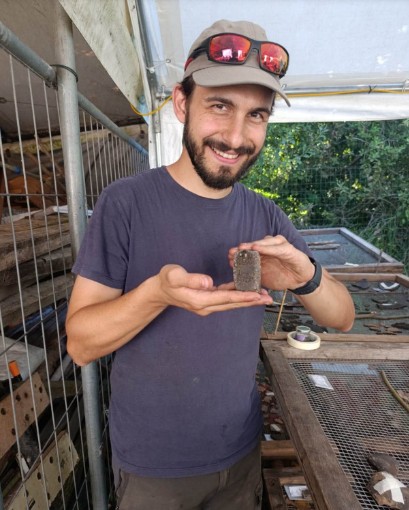
A member of the Lucone excavation team holds the newly discovered Bronze Age enigmatic tablet. The small artifact belongs to a mysterious class of objects decorated with recurring geometric symbols whose meaning remains unknown. (Scavi al Lucone/Museo Archeologico della Valle Sabbia)
Ancient Symbols Without a Known Writing System
The newly discovered artifact belongs to a distinctive group known in Italian archaeology as tavolette enigmatiche, or “enigmatic tablets.” German-language scholarship often calls them Brotlaibidole, literally “bread-loaf shaped idols,” after the rounded or loaf-like appearance of many examples. Despite the name “tablet,” they shouldn’t be conflated with the written clay tablets of Mesopotamia. No accepted writing system has been identified. Their surfaces carry combinations of incised lines and impressed geometric signs, including circles, dots, triangles, squares and rectangular motifs. The tablets were created from clay, or more rarely, stone. The Archaeological Museum of Valle Sabia notes that Lucone specimens display considerable variation in shape and decoration.
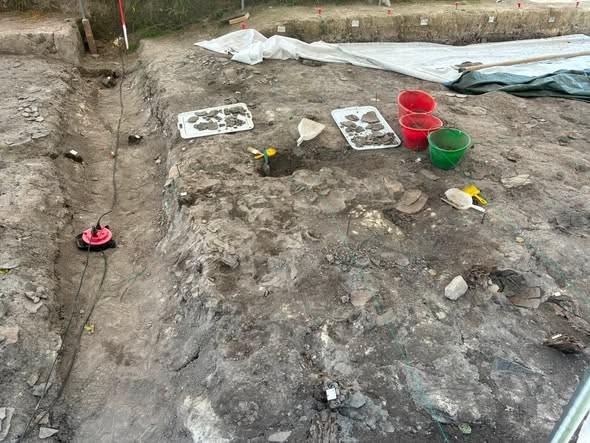
Excavation underway at Lucone di Polpenazze near Lake Garda in northern Italy. (Scavi al Lucone/Museo Archeologico della Valle Sabbia)
A Shared Symbolic Language Across Bronze Age Europe?
Comparable objects occur across northern Italy and large parts of Central and southeastern Europe, principally dating from the Early to Middle Bronze Age, roughly 2100–1400 BC. A Bronze Age example from nearby Polada is estimated, based on the data gathered, to date to approximately 2200-1700 BC. Similar combinations of lines and impressions occur hundreds of kilometers apart, raising the possibility that the markings belonged to a shared system of signs or conventions circulating through long-distance networks.
- Dried Lakebed Site Reveals Game Changing Bronze Age Jewelry of Chełmno Culture
- Fascinating Sardinian Bronze Figurines Tell Tale of Vast European Trade
Calendars, Tokens, or Trade Records? The Mystery Continues
The tablets’function remains unsolved. Researchers have proposed interpretations ranging from calendars and ritual objects to counting devices, identification tokens, and even exchange records. One persistent hypothesis links them to Bronze Age trade, possibly as tokens used in the circulation of metals. This interpretation remains a distinct hypothesis rather than a decipherment. There is still no agreed-upon method to decipher the symbols, nor any evidence that they represent language in the conventional sense. Their significance may lie in recurring combinations of standardized signs.
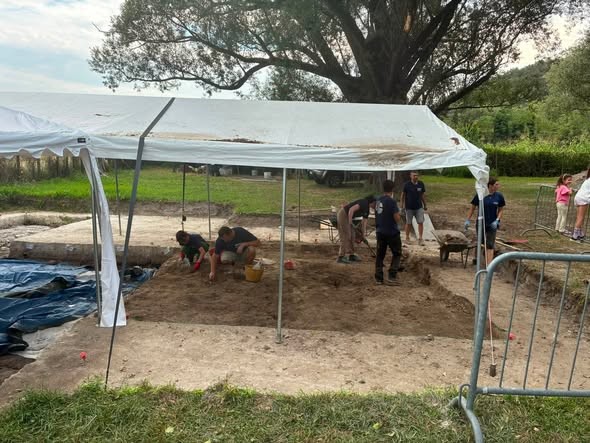
Archaeologists excavating the Bronze Age settlement at Lucone di Polpenazze, west of Lake Garda. The unusually well-preserved site provides a detailed archaeological record of a community that lived here around 4,000 years ago. (Scavi al Lucone/Museo Archeologico della Valle Sabbia)
From Lake Garda to the Carpathians: Tracing Ancient Connections
The broad distribution of enigmatic tablets has long encouraged researchers to investigate connections between northern Italy, Central Europe and the Danubian-Carpathian region during the Bronze Age. Research at Lucone has already provided evidence for connections beyond the Lake Garda region. Researchers have used 3D scanning and digital comparison to identify similarities between signs and investigate whether geographically separated tablets followed common conventions.
- Roman 'Machine Gun' Scars Found on Pompeii's Ancient Walls
- High-Tech Scans Prove Austria’s Venus of Willendorf Originated in Italy
Tree Rings Date Lucone’s Bronze Age Village to 2034 BC
The discovery is more significant because of its archaeological location. Lucone di Polpenazze once occupied a small wetland basin in the hills west of Lake Garda. Several prehistoric settlement areas have been identified there, while excavation of this site, known as Lucone D, has been undertaken since 2007. A dendrochronological study of Lucone D posts placed activity at approximately 2034–1967 ±10 calibrated BC, while building and repair activity continued well into the late 20th century BC. The settlement provides an unusually precise chronological window into life around 4,000 years ago.
Fire and Water Preserved a 4,000-Year-Old Village
At one stage, a major fire devastated part of the village. Wooden architectural elements collapsed into the wet environment. Waterlogging and charring helped preserve materials that would normally disappear, including wooden tools, plant remains, textiles, cereals, and elements of houses. Together, these factors have allowed archaeologists to reconstruct an in-depth view of food production, construction, and everyday life. Lucone is one of the Italian components of UNESCO’s Prehistoric Pile Dwellings around the Alps, a World Heritage property making up 111 prehistoric settlements in six European countries.
- What Archaeology Tells US About Pre-Roman Cultures
- Etruscans Transported Bees by Boat to Reach the Best Flowers!
Twenty-One Tablets Could Hold the Key to the Bronze Age Mystery
The new tablet adds one more unusual artifact to the Lucone collection. With 21 enigmatic tablets now recovered from the plain, the site offers archaeologists an unusually large dataset for comparing signs, manufacturing techniques, and archaeological contexts. Whether the objects recorded trade, measured time, identified individuals, or served another purpose remains unknown, but Lucone may eventually help archaeologists solve one of the Bronze Age's enduring archaeological mysteries.
Top Image: Members of the archaeological team process finds during excavations at the Bronze Age settlement of Lucone di Polpenazze near Lake Garda in northern Italy. The waterlogged Bronze Age settlement has yielded an exceptional collection of artifacts, including the site's enigmatic tablets. Source: Scavi al Lucone/Museo Archeologico della Valle Sabbia.
By Ramsey Hardin
References
Baioni, M., Mangani, C., Bona, F., Gulino, F., and Longhi, C. 2018. Il sito D del Lucone di Polpenazze del Garda (BS): un breve quadro di sintesi. Available at:
https://unipv.unifind.cineca.it/resource/item/554778?language=en-US
Baioni, M., Mangani, C., Maltese, G., Martinelli, N., Nicosia, C., Quirino, T., and Saletta, E. 2023. Ricostruire le strutture di tipo palafitticolo dell’antica età del Bronzo: il caso del sito D del Lucone di Polpenazze del Garda (BS). Available at:
University of Verona research repository
Capano, M., Martinelli, N., Baioni, M., Tuna, T., Bernabei, M., and Bard, E. 2020. Is the dating of short tree-ring series still a challenge? New evidence from the pile dwelling of Lucone di Polpenazze (northern Italy). Journal of Archaeological Science 121, article 105190. Available at:https://doi.org/10.1016/j.jas.2020.105190.
International Coordination Group UNESCO Palafittes. n.d. Polpenazze del Garda (BS) – Lucone, IT-LM-05. Available at:
https://www.intern.palafittes.org/fundstelle-en.html?sid=138
Manuela, C. et al. 2020. Is the Dating of Short Tree-Ring Series Still a Challenge? New Evidence from the Pile Dwelling of Lucone di Polpenazze (Northern Italy). Journal of Archaeological Science. Elsevier. Available at:
https://www.intern.palafittes.org/fundstelle-en.html?sid=138
Ministero della Cultura. 2026. Civico Museo Archeologico della Valle Sabbia. Available at:
Italian Ministry of Culture Museum page
Museo Archeologico della Valle Sabbia. n.d. Lucone di Polpenazze – primi scavi (1965–1986). Available at:
https://museoarcheologicogavardo.it/node/292
Museo Archeologico dell’Alto Mantovano. 2010. Enigma. Le tavolette enigmatiche, un antico processo di interazione in Europa. Available at: