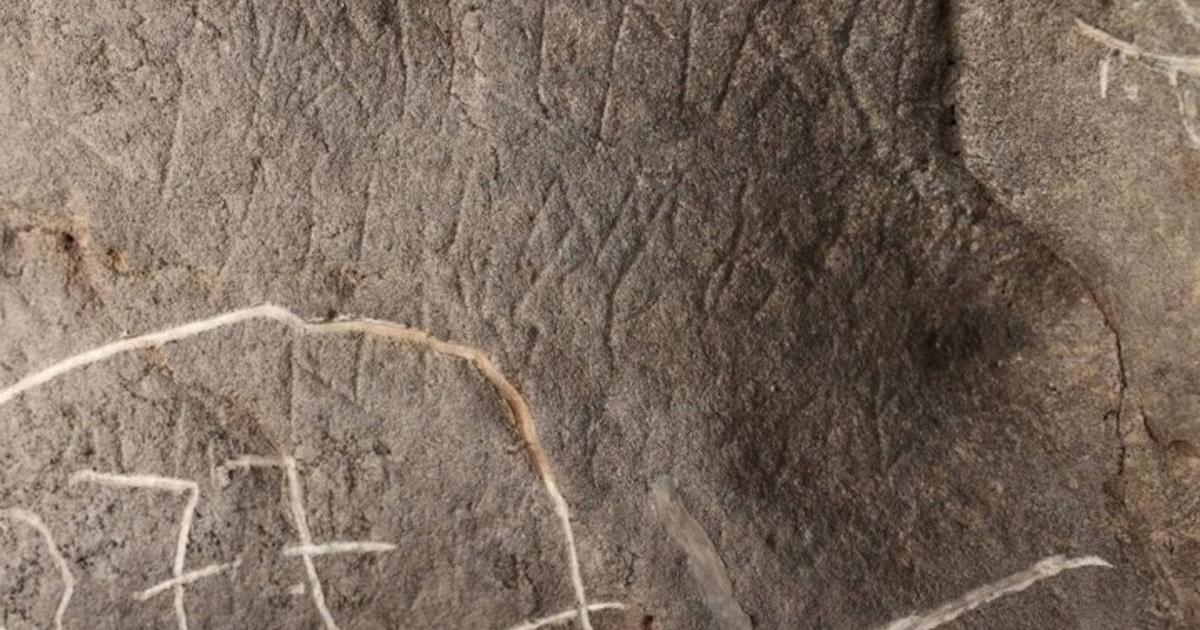
Researchers from the Universities of Alicante (UA) and Zaragoza (Unizar) have uncovered a Roman sanctuary in Cova de les Dones, located in the municipality of Millares, Valencia on the eastern coast of Spain. The sanctuary lies in a chamber located more than 650 feet (200 meters) from the cave entrance, where at least fifteen Roman inscriptions that are still being interpreted have been reported.
In addition to the inscriptions, a coin from the reign of Emperor Claudius—placed as an offering between a fissure and a stalactite in the ceiling—has also been found. Claudius served as emperor from 41 to 54 AD, and a preliminary analysis has confirmed that the Roman sanctuary dates to the mid-to-late first century AD, when the Roman Empire was in full bloom.
A Truly Extraordinary Site, In Use for Thousands of Years
The new findings further highlight the exceptional nature of Cova de les Dones, which has been drawing professional archaeologists and amateur treasure hunters in equal number since the 18th century. Initially the most important Paleolithic cave complex in eastern Iberia, it later became a place of worship for the Iberians, and now, evidence confirms its use by the Romans for similar spiritual purposes.
- Largest Collection of Cave Art Found in Eastern Spain Dated to 22,000 BC
- Entering an Unknown Pagan Sanctuary: New Discoveries Made at a Roman Site in Israel
Cova de les Dones was classified as an Iberian cave sanctuary in the 1960s, based on the discovery of Iron Age ceramics. This latest find strengthens the theory that the sanctuary remained in use for many centuries, and was likely repurposed by the Romans once they realized how long the cave had been regarded as a sacred location.
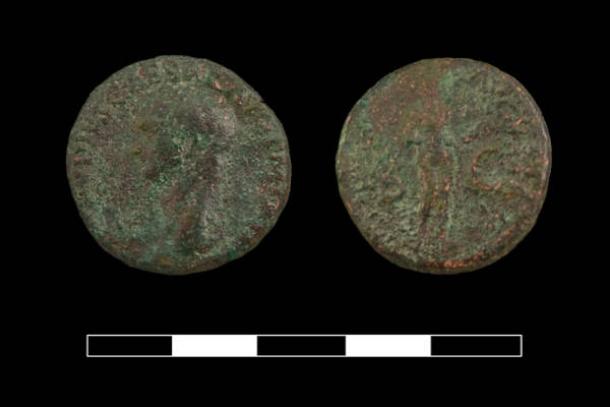
Front and back sides of Roman coin dating to time of Roman Emperor Claudius, found in Cova de les Dones. (Universidad de Alicante).
This latest discovery is particularly significant, both for its novelty and its unique characteristics, as it represents a major find located at an exceptional depth within the cave. Roman inscriptions have seldom been found so deep inside of a cave, on the Iberian Peninsula or anywhere else—although such inscriptions have been discovered in the depths of Cueva del Puente and Cueva de Román de Clunia, both of which are in the province of Burgos.
The Iberian Peninsula’s Mecca for Paleolithic Rock Art Hunters
This discovery builds on research published in the British journal Antiquity in 2023, when scholars identified an astonishing collection of rock motifs in the cave. With the sheer number of motifs and the variety of techniques used, Cova de les Dones is considered the most significant Palaeolithic cave art site on the eastern Mediterranean coast of the Iberian Peninsula.
The Dones Cave is a well-known site in the area, highly visited by speleologists and hikers with records of explorations going back to the 18th century. However, the existence of Paleolithic paintings in the cave was unknown until their discovery in 2021 by doctors Aitor Ruiz-Redondo (Unizar), Virginia Barciela González (UA) and Ximo Martorell Briz (UA), archaeologists and specialists in Prehistoric Art. Between the three of them, they have discovered more than thirty new rock art sites in the last two decades in different European regions (it was in the context of this work that they discovered the rare Roman era sanctuary).
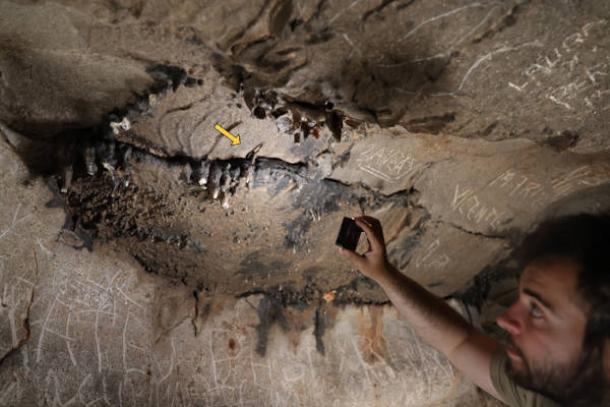
Researcher Xabier Garín Artázcoz points out the exact location of the cavity where the Roman coin from the time of the Emperor Claudius was found. (Universidad de Alicante).
In Cueva Dones, more than a hundred graphic units (cave paintings) have been documented to date, made by painting, simple engraving and scraping. In fact, it is probably the cave with the largest number of Paleolithic rock art samples discovered in Europe since 2015, when archaeologists found a similar collection at Atxurra Cave in Northern Spain.
Unlike the latter cavern, which is located in the Cantabrian region (one of the places with the highest density of Paleolithic sites in the world), Dones Cave is in an area where this type of site is not frequently found. In almost 150 years since the initial discovery of European Paleolithic cave art (at Altamira in 1879), no site of this importance had been discovered in the territories of Catalonia, Valencia or Murcia. The scarcity of these large sites has been considered paradoxical, since the world's largest collection of Paleolithic rock art can be found inside Valencia’s Cueva del Parpalló.
- Roman Temples and Sacred Stones Unearthed in the Netherlands
- New Stone Age Rock Art Discovered at Romanelli Cave
The study of the rock art is still ongoing, and consists of a preliminary analysis of the characteristics and relevance of the site in the context of European Paleolithic Art. The site includes at least 19 verified animal representations (hinds, horses, aurochs and a stag) and stands out, in addition to its number of paintings and geographical location, for a peculiar technical feature: most of the paintings were made with clay. Although this technique is known in Palaeolithic art, there are few examples of its use in the overall count, whereas in Dones Cave it is the most common technique.
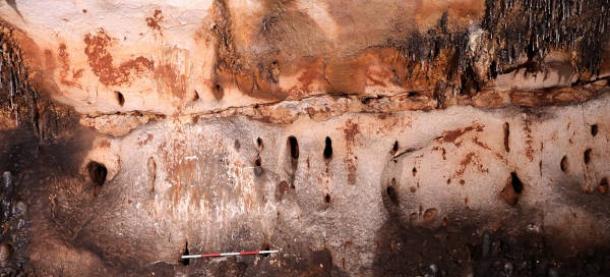
Several rock art items painted with clay in a frieze in Cova de les Dones. (Universidad de Alicante).
Despite their simplicity, the antiquity of these 'clay paintings' is supported by their artistic style (which includes clear Paleolithic conventions) and by the presence of thick stalagmite crusts that cover several of them. Based on all the accumulated evidence, the Spanish researchers estimate that these rock paintings are at least 24,000 years old.
Presumably, the presence of this ancient art helped convince the Romans that spiritual energies were strong inside the walls of Cova de les Dones
A Deep Cave Going Back Deep into Time
Cova de les Dones is an extraordinarily deep cave, extending approximately 1,640 feet (500 meters) into the earth. The study of it remains at an early stage, with only 20% of the Paleolithic decorated area examined in detail. The Roman inscriptions are now undergoing systematic analysis, and given the scale of the site further fascinating discoveries are anticipated in the coming years.
The archaeological work at the cave forms part of the DONARQ research project, which investigates the cave sanctuary and its broader archaeological context.
This article includes information from two press releases published by the University of Alicante in 2023 and 2025, respectively, entitled ‘The Largest Palaeolithic Art Site On the Eastern Mediterranean Coast of the Iberian Peninsula is Discovered in the Dones Cave’ and ‘Roman Sanctuary Unearthed in Cova de les Dones—One of Iberia’s Largest Cave Art Sites’.
Top image: Roman inscriptions found at a depth of more than 200 meters in Cova de les Dones, Spain.
Source: Universidad de Alicante.