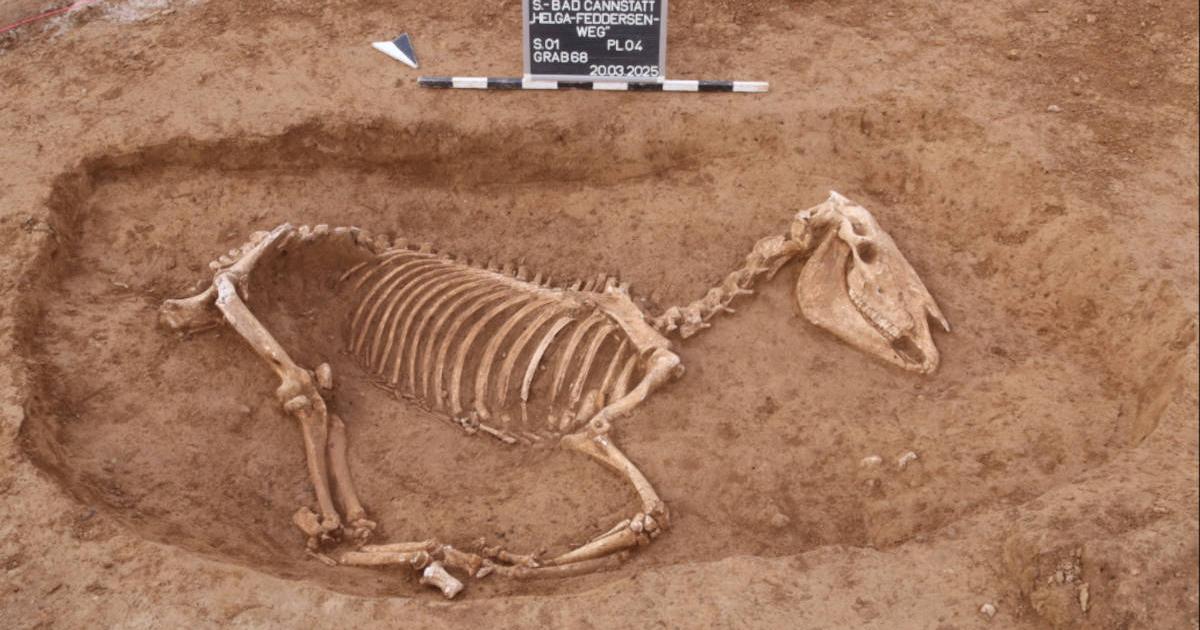
A remarkable archaeological discovery has revealed more about the Roman military presence in what is now southwestern Germany in the early part of the first millennium. In Stuttgart’s Bad Cannstatt district, more than 100 horse skeletons dating to the second century AD have been uncovered during a routine excavation. Experts believe the animals once belonged to a Roman cavalry unit stationed nearby, offering rare insights into how the Roman army managed and utilized its equine forces.
The horses are thought to have been part of an Ala, a Roman cavalry unit composed of approximately 500 riders. These troops, stationed at Hallschlag in the province of Germania Superior during the early second century AD, would have required a horse population of at least 700 animals to remain operational. When a horse died—whether from age, illness, injury, or other causes—it was removed from the settlement and buried in a designated area some distance from both the fort and the nearby civilian population. With so many horses this was a routine affair, necessitating the creation of a large horse cemetery such as the one that has just been unearthed.
This latest discovery was made in conjunction with exploratory digs undertaken in anticipation of a new residential development project that will soon be launched in Stuttgart. Beginning in July 2024, archaeological investigations became necessary to assess the site before construction could proceed. The fieldwork, conducted by ArchaeoBW and overseen by the State Office for the Preservation of Monuments (LAD), has now concluded, and the horse burials were by far the most significant discovery.
- Roman Cavalry, the Backbone of Rome’s Great Expansion
- Rare Iron Roman Cavalry Face Mask Discovered At Hadrianopolis, Turkey
Honorable Burials for Cherished Companions
This isn’t the first time horse skeletons have been found in the area. In the 1920s, similar finds were made during the construction of apartment blocks near Nastplatz. Even then, the area was suspected to have functioned as a Roman “Schindanger,” or horse cemetery. Now, with the latest excavation and the application of modern archaeological methods, that interpretation has been definitively confirmed.
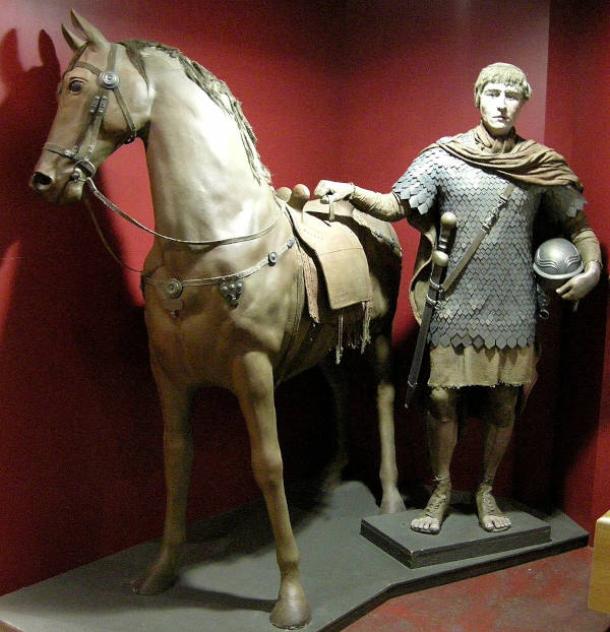
Display of Roman cavalryman and his horse, found at the Roman Museum in Canterbury, Kent, England. (Linda Spashett/CC BY-SA 3.0).
"The first horse bones uncovered during this project were radiocarbon dated to the second century AD," explained Sarah Roth, the lead archaeologist from the LAD. “Based on our knowledge of Roman activity in Bad Cannstatt, it’s clear these horses belonged to the cavalry unit that operated from Hallschlag between 100 and 150 AD. Given the size of the troop, regular losses would have been inevitable—and replacements constantly needed.”
The horses were typically buried in shallow individual pits roughly 400 meters from the cavalry fort and 200 meters away from the civilian settlement. Most were laid on their sides, with limbs either stretched out or bent, suggesting deliberate placement. According to Roth, the area was likely marked above ground in some way, since few burial pits overlap, even in the more densely packed sections.
Interestingly, the horses do not appear to have died en mass, as would be expected in the case of a battle or epidemic. Rather, they seem to have been buried gradually over time.
“These weren’t victims of one catastrophic event,” Roth noted. “These animals either died naturally or were put down because they could no longer perform their military duties. If a horse could still walk, it was likely led to the cemetery and euthanized there to avoid having to transport the heavy carcass.”
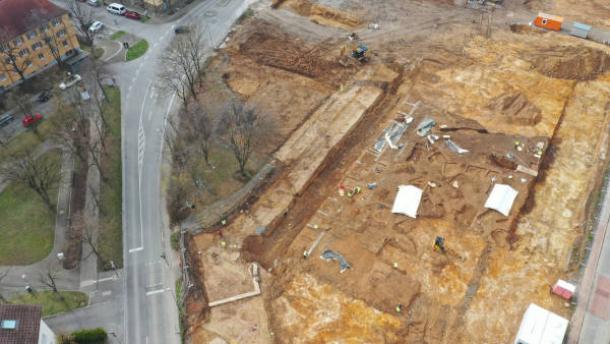
Aerial view of the excavation site on the grounds of the housing project in Stuttgart. (State Office for the Preservation of Monuments Stuttgart/ArchaeoBW).
The total size of the cemetery remains uncertain, but the recent excavations have revealed a densely used area measuring about 230 by 260 feet (70 by 80 meters). Roth believes the original horse burial ground was likely much larger. "What we've uncovered is just a portion of a more extensive necropolis for military horses," she said.
Among the discoveries, one horse grave stood out for its unusual inclusion of grave goods, two ceramic jugs and a small oil lamp. Such items are typically reserved for human burials, suggesting a deeply personal farewell.
- Roman Centurions: Elite Forces of the Roman Empire’s Military
- Ancient Horse Burials of the Bronze Age: Folklore and Superstition
"It’s clear the owner had a special bond with this horse," Roth said. "Even after nearly 1,800 years, the sorrow behind that gesture is still palpable."
In sharp contrast, a human skeleton—an adult male—was found nearby, lying face-down and without any accompanying grave goods. His remains were located far from the regular Roman burial grounds, tucked between the horse graves. Archaeologists believe this man may have been an outcast, someone excluded from formal Roman funerary rites. His burial in the margins of society, both physically and symbolically, offers a rare glimpse into how social hierarchies were reinforced in Roman society, even in death.
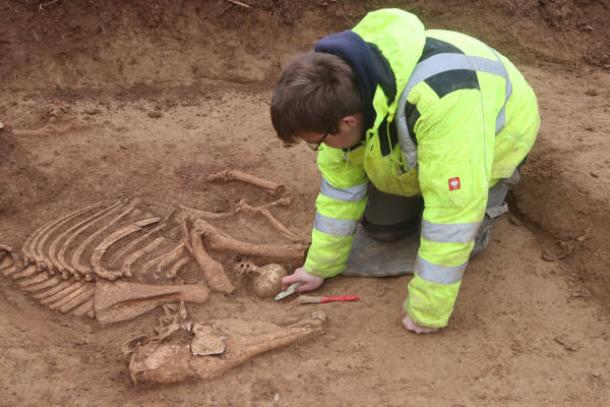
Excavation of the horse burial that included grave goods, two ceramic jugs and an oil lamp. (State Office for the Preservation of Monuments Stuttgart/ArchaeoBW).
Unlocking New Knowledge about Roman Cavalry Practices
Now that the excavation is complete, scientists have an exceptional opportunity to study the remains in detail. Archaeozoologists will examine the horses to determine their age at death, sex, physical build, and possible causes of death. These findings could reveal valuable information about the practices of the Roman cavalry, showing how its horses were raised, trained, and maintained.
Further scientific analysis could also reveal more about the horses’ origins. Were they bred locally in the fertile lands around Bad Cannstatt, or were they brought in from other parts of the Roman Empire? It’s a compelling question in a city whose name—Stuttgart—derives from “Stutengarten,” or “Mare’s Garden,” a nod to its long association with horse breeding.
Top image: A perfectly intact horse skeleton unearthed at the Roman horse cemetery in Stuttgart.
Source: State Office for the Preservation of Monuments Stuttgart/ArchaeoBW.
This article is an edited version of a translated version of a press release from the Stuttgart Baden-Württemberg Regional Council, entitled ‘Final Resting Place for Rome's Mounts – Largest Roman Horse Cemetery in Southern Germany Discovered in Stuttgart-Bad Cannstatt.’